
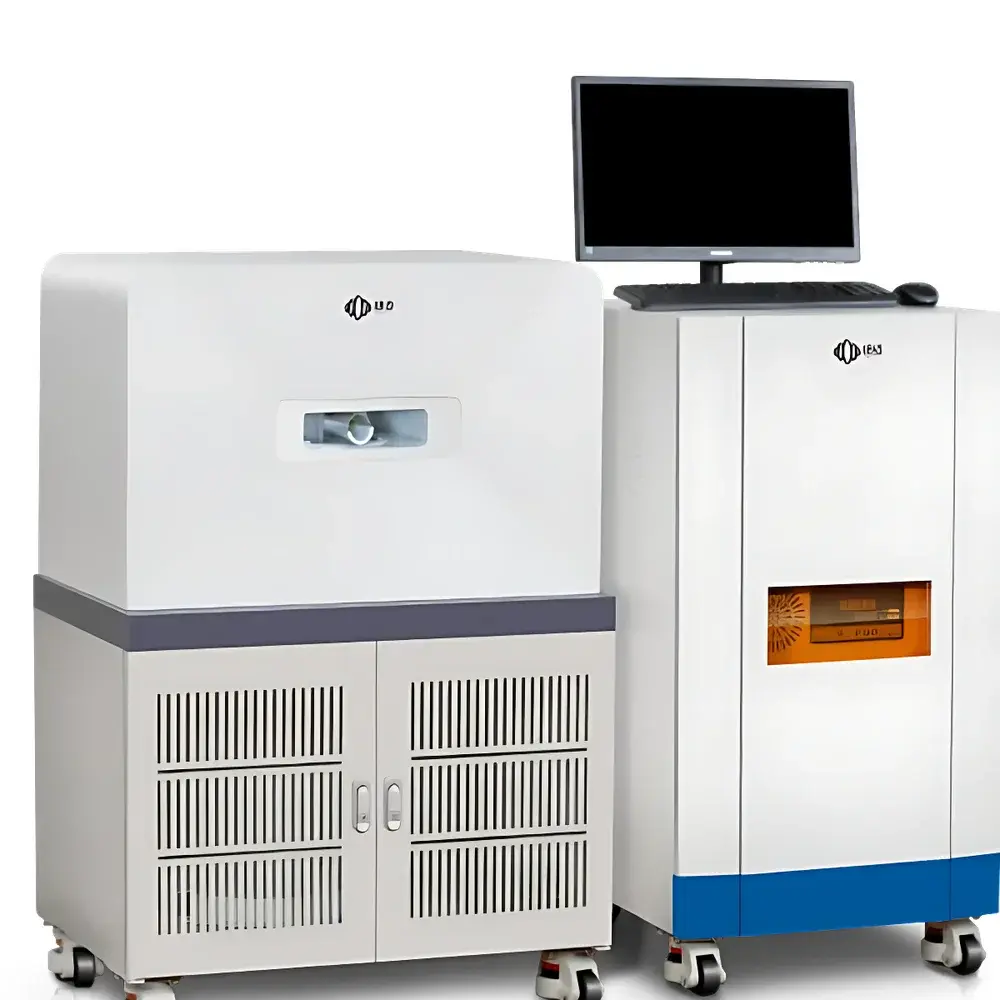
NIUMAG MesoMR Series Triaxial NMR Imaging Analyzer for Geomaterials
| Brand | NIUMAG |
|---|---|
| Origin | Jiangsu, China |
| Manufacturer Type | Authorized Distributor |
| Product Origin | Domestic (China) |
| Model | MesoMR Series |
| Pricing | Available Upon Request |
| Instrument Type | Low-Field Nuclear Magnetic Resonance (LF-NMR) Analyzer |
| Sample Compatibility | Solid-Liquid Coupled Systems |
| Operating Frequency | 21.3 MHz |
| Data Acquisition Method | Fourier Transform |
Overview
The NIUMAG MesoMR Series Triaxial NMR Imaging Analyzer is a purpose-built low-field nuclear magnetic resonance (LF-NMR) platform engineered for quantitative, non-invasive characterization of geomaterials under controlled mechanical and environmental stress conditions. Unlike conventional benchtop NMR analyzers, the MesoMR integrates a triaxial mechanical loading system—capable of applying independent axial and confining pressures—with a permanent-magnet-based 0.5 ± 0.08 T static field (21.3 MHz 1H Larmor frequency). This architecture enables simultaneous acquisition of NMR relaxation spectra (T2, T1-T2 correlation), diffusion-weighted signals, and spatially resolved MRI data while subjecting soil, rock, or frozen ground specimens to realistic geomechanical boundary conditions. The system operates on the principle of pulsed Fourier-transform NMR, where spin-echo sequences (e.g., CPMG) probe hydrogen-bearing fluid phases—including pore water, unfrozen water in permafrost, and hydrocarbon-saturated pores—without sample destruction or chemical labeling. Its design targets fundamental research and applied testing in geotechnical engineering, permafrost science, reservoir rock physics, and unsaturated soil mechanics.
Key Features
- Integrated triaxial pressure cell with independent axial and lateral load control (up to 20 MPa confining pressure, 30 MPa axial load—configurable via optional high-pressure modules)
- Permanent magnet system delivering stable 0.5 ± 0.08 T field homogeneity (< 10 ppm over 60 mm DSV), optimized for robust operation in laboratory and field-deployable environments
- 60 mm diameter RF probe coil, compatible with standard cylindrical soil/rock cores (Ø38–60 mm × H ≤ 100 mm) and custom triaxial cells with NMR-transparent end caps
- Modular environmental control interface supporting third-party and NIUMAG-developed hardware: cryogenic modules (–40 °C to +100 °C), high-pressure gas/liquid saturation systems, and thermal gradient stages
- Dual-mode acquisition capability: rapid single-point T2 distribution mapping (≤ 2 min per scan) and high-resolution 2D/3D MRI (spatial resolution down to 100 µm isotropic, depending on signal-to-noise and scan time)
- Fully programmable pulse sequence library compliant with standard NMR methodologies (CPMG, IR, STIR, PGSE) and customizable via Python-based API
Sample Compatibility & Compliance
The MesoMR accommodates heterogeneous, multiphase geomaterials including saturated/unsaturated soils, consolidated sediments, artificial and natural rock analogs, and frozen ground specimens (e.g., silty clay, loess, sandstone, and permafrost cores). Its solid–liquid coupled analysis capability permits concurrent quantification of bound vs. mobile water fractions, capillary water dynamics during consolidation, and ice–water phase transitions under stress. From a regulatory standpoint, raw NMR data output conforms to ASTM D7928 (Standard Test Method for Particle-Size Distribution of Soils Using Laser Diffraction)–aligned reporting conventions for moisture distribution profiling. While LF-NMR itself is not subject to FDA or ISO 17025 accreditation as a standalone technique, the instrument’s audit-trail-enabled software supports GLP-compliant workflows—including user access logs, parameter versioning, and electronic signature capture—as required for academic reproducibility and industrial R&D documentation.
Software & Data Management
Control and analysis are executed through NIUMAG’s proprietary MesoMR Studio software suite, built on a modular Qt/C++ framework with MATLAB-compatible scripting extensions. Core functions include real-time echo train visualization, automated T2 inversion using non-negative least squares (NNLS) with regularization, multi-exponential decay fitting, and voxel-wise parametric MRI reconstruction (e.g., T2-weighted, diffusion-weighted, and apparent diffusion coefficient maps). All processed datasets export to HDF5 and CSV formats, ensuring interoperability with industry-standard platforms such as MATLAB, Python (NumPy/Pandas), and commercial geomechanical simulation tools (e.g., FLAC, TOUGH2). Data provenance is preserved via embedded metadata tags covering pulse sequence parameters, mechanical loading history, temperature setpoints, and calibration timestamps—critical for longitudinal studies and cross-laboratory validation.
Applications
- Soil Mechanics: Quantification of water redistribution during triaxial shear; determination of effective stress–pore pressure coupling; measurement of compressibility and consolidation coefficients via time-resolved T2 shifts
- Permafrost Research: In situ monitoring of unfrozen water content evolution during freeze–thaw cycling under confining stress; identification of ice lens formation thresholds and microstructural anisotropy
- Reservoir Characterization: Pore-scale fluid saturation mapping in core plugs under reservoir-relevant pressure–temperature conditions; differentiation of movable vs. irreducible hydrocarbons using T1/T2 contrast
- Geotechnical Stability Modeling: Input parameter generation for constitutive models (e.g., elastoplasticity, critical state theory) via NMR-derived porosity, permeability proxies (e.g., T2 cutoff), and saturation-dependent stiffness metrics
- Environmental Geoscience: Solute transport tracking via paramagnetic ion-doped tracer studies; clay–water interaction analysis using surface relaxivity modeling
FAQ
What distinguishes the MesoMR from standard LF-NMR analyzers?
It uniquely combines NMR detection with full triaxial mechanical actuation, enabling direct correlation between stress–strain behavior and pore-fluid dynamics—unachievable with static-sample NMR systems.
Can the system perform T1–T2 correlation measurements under load?
Yes—its flexible pulse sequence engine supports 2D NMR experiments during active mechanical loading, provided motion artifacts are mitigated via synchronized triggering and vibration damping.
Is the 60 mm probe compatible with ASTM D2166-compliant soil specimens?
Yes—the standard triaxial cell geometry aligns with ASTM D2166 dimensions (Ø39.1 mm × 80 mm), and custom adapters ensure seamless integration without compromising field homogeneity.
Does the software support automated batch processing for long-term creep or consolidation experiments?
Yes—scheduled acquisition protocols allow unattended sequential scanning over days or weeks, with auto-save, failure recovery, and metadata-anchored time-series alignment.
Are calibration standards and traceable reference materials provided?
NIUMAG supplies NIST-traceable aqueous MnCl2 relaxation standards and certified glass bead phantoms for T2 and spatial resolution validation, documented per ISO/IEC 17025–aligned procedures.
Related Products



