
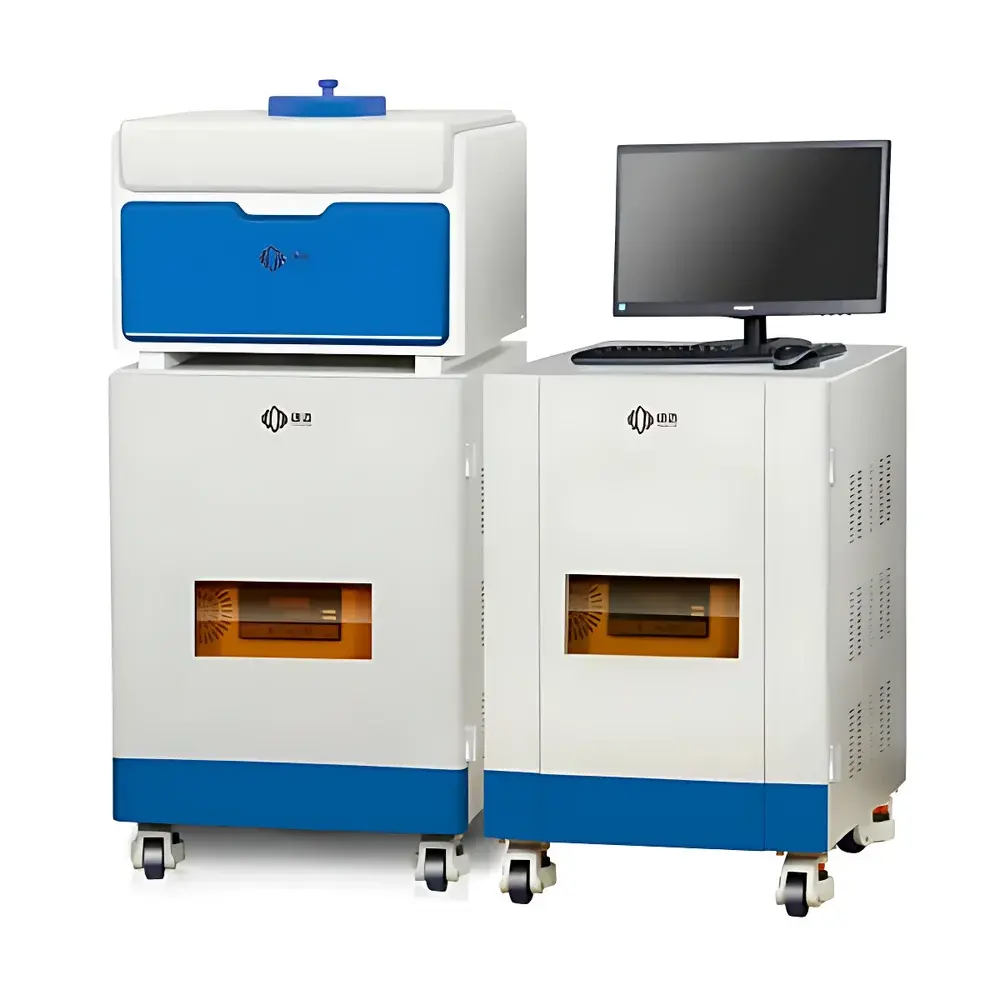
NIUMAG VTMR Carbon Fiber Composite Resin Content Analyzer
| Brand | NIUMAG |
|---|---|
| Origin | Jiangsu, China |
| Manufacturer Type | Authorized Distributor |
| Origin Category | Domestic |
| Model | VTMR |
| Pricing | Available Upon Request |
| Magnet Type | Permanent Magnet |
| Magnetic Field Strength | 0.5 ± 0.05 T |
| Standard Temperature Range | Ambient to 130 °C |
| Optional Cryo/High-Temp Module | −100 °C to 200 °C |
| Measurement Time | ≤2 min per sample |
| Core Technology | Low-Field NMR (T₁/T₂ Relaxometry + MRI) |
| Key Capabilities | Non-destructive resin quantification, crosslink density mapping, phase distribution imaging, in-situ curing kinetics monitoring |
| Sample States Supported | Solid composites, gels, powders, films, pre-pregs |
| Compliance Framework | Designed for GLP-compliant workflows |
Overview
The NIUMAG VTMR Carbon Fiber Composite Resin Content Analyzer is a purpose-built low-field nuclear magnetic resonance (NMR) instrument engineered for quantitative, non-invasive characterization of resin matrix distribution and content in carbon fiber-reinforced polymer (CFRP) composites. Unlike destructive gravimetric or solvent-extraction methods, the VTMR leverages proton spin relaxation dynamics—specifically transverse (T₂) and longitudinal (T₁) relaxation time distributions—to differentiate mobile resin protons from rigid carbon fiber lattice signals. This physical contrast enables direct, calibration-free quantification of uncured, partially cured, and fully cured resin fractions across heterogeneous laminates, prepregs, and molded components. The system operates at a stable 0.5 T permanent magnetic field, optimized for high signal-to-noise ratio in short-T₂ systems typical of highly crosslinked epoxy, vinyl ester, and thermoplastic matrices. Its integrated real-time temperature control—standard from ambient to 130 °C and expandable to −100 °C–200 °C—allows kinetic profiling of resin vitrification, gelation, and network formation during thermal curing cycles without sample removal.
Key Features
- Non-destructive, contactless resin content measurement with ≤2-minute acquisition time per sample—enabling high-throughput batch screening and in-line process validation.
- FLAT (Fast Low-Amplitude Transient) pulse sequence technology specifically optimized for weak, fast-decaying NMR signals from restricted polymer chain mobility in CFRPs.
- Dual-mode operation: quantitative T₁/T₂ relaxometry for resin fraction and crosslink density calculation, plus 2D/3D NMR imaging (MRI) for spatial mapping of resin-rich zones, voids, and interfacial delamination.
- Modular thermal environment: standard convection-heated probe (ambient–130 °C) with optional cryogenic and extended-range modules for sub-zero debulking studies or high-temperature post-cure analysis.
- Robust mechanical design with vibration-damped magnet housing and active field homogeneity compensation—ensuring reproducibility across multi-shift production environments.
- Open architecture software interface supporting custom pulse sequence import, batch processing scripts, and raw FID/data export in HDF5 and NMR-ML compliant formats.
Sample Compatibility & Compliance
The VTMR accommodates standard CFRP geometries including flat laminates (up to 60 mm × 60 mm × 15 mm), cylindrical rods, and curved airframe skins via adjustable sample holders. It accepts both dry and solvent-saturated specimens without pretreatment, eliminating risks associated with chemical digestion or thermal degradation. Method development aligns with ASTM D7904 (Standard Practice for Quantitative Analysis of Polymers by Low-Field NMR) and ISO 17285 (Plastics — Determination of Crosslink Density by NMR). Data integrity meets GLP and GMP documentation standards: all acquisitions include timestamped metadata (temperature, field stability, RF power, receiver gain), automatic checksum validation, and optional electronic signature workflows compliant with FDA 21 CFR Part 11 for regulated aerospace and medical device manufacturing.
Software & Data Management
NIUMAG’s MestReNova-integrated VTMR Control Suite provides a validated platform for spectral processing, inverse Laplace transformation (ILT) of T₂ decay curves, multi-exponential fitting, and voxel-wise MRI reconstruction. Built-in reference libraries support rapid identification of common resin systems (e.g., RTM6, CYCOM 5250-4, HexPly M21). All processed results—including resin weight %, T₂ mean values, heterogeneity indices, and diffusion-weighted images—are stored in structured SQLite databases with full version history. Audit trails log user actions, parameter changes, and calibration events. Export modules generate PDF reports conforming to ISO/IEC 17025 technical record requirements and support direct integration with LIMS platforms via RESTful API.
Applications
- Curing Kinetics Monitoring: Real-time tracking of resin conversion and network development during autoclave cycles, oven cures, or out-of-autoclave (OOA) processes.
- Process Window Validation: Correlating resin content uniformity with layup pressure, vacuum level, and bleed-out duration in prepreg consolidation.
- Aging & Degradation Assessment: Detecting microcrack initiation, moisture ingress, and hydrolytic scission via changes in T₂ distribution breadth and mobile phase amplitude.
- Quality Assurance: Batch-to-batch verification of resin/fiber ratio in certified aerospace structures per Boeing BAC 5312 or Airbus AITM 1-0002.
- Material Development: Screening novel toughening agents, nanofillers, or bio-based resins by quantifying dispersion homogeneity and interfacial adhesion strength proxies.
FAQ
Can the VTMR distinguish between different resin chemistries (e.g., epoxy vs. phenolic) in a hybrid laminate?
Yes—when combined with principal component analysis (PCA) of multi-temperature T₁–T₂ correlation maps, the system resolves characteristic relaxation fingerprints unique to each resin class.
Is operator training required to interpret T₂ spectra for resin content?
No—the embedded calibration-free algorithm automatically computes resin mass fraction using a physics-based two-component model; advanced users may access raw decay data for custom modeling.
Does the instrument require liquid helium or external cooling utilities?
No—its permanent magnet design eliminates cryogen dependency and ensures zero operational downtime due to quench events or refill scheduling.
How is measurement repeatability ensured across multiple laboratories?
Each unit undergoes factory certification using NIST-traceable polymer reference standards (SRM 2891, SRM 2892); inter-lab reproducibility studies demonstrate <±0.8% RSD for resin content across five independent sites.
Can the VTMR be integrated into an automated production line?
Yes—Ethernet/IP and Modbus TCP protocols enable PLC-level synchronization with robotic sample handlers and MES systems for closed-loop process control.






