
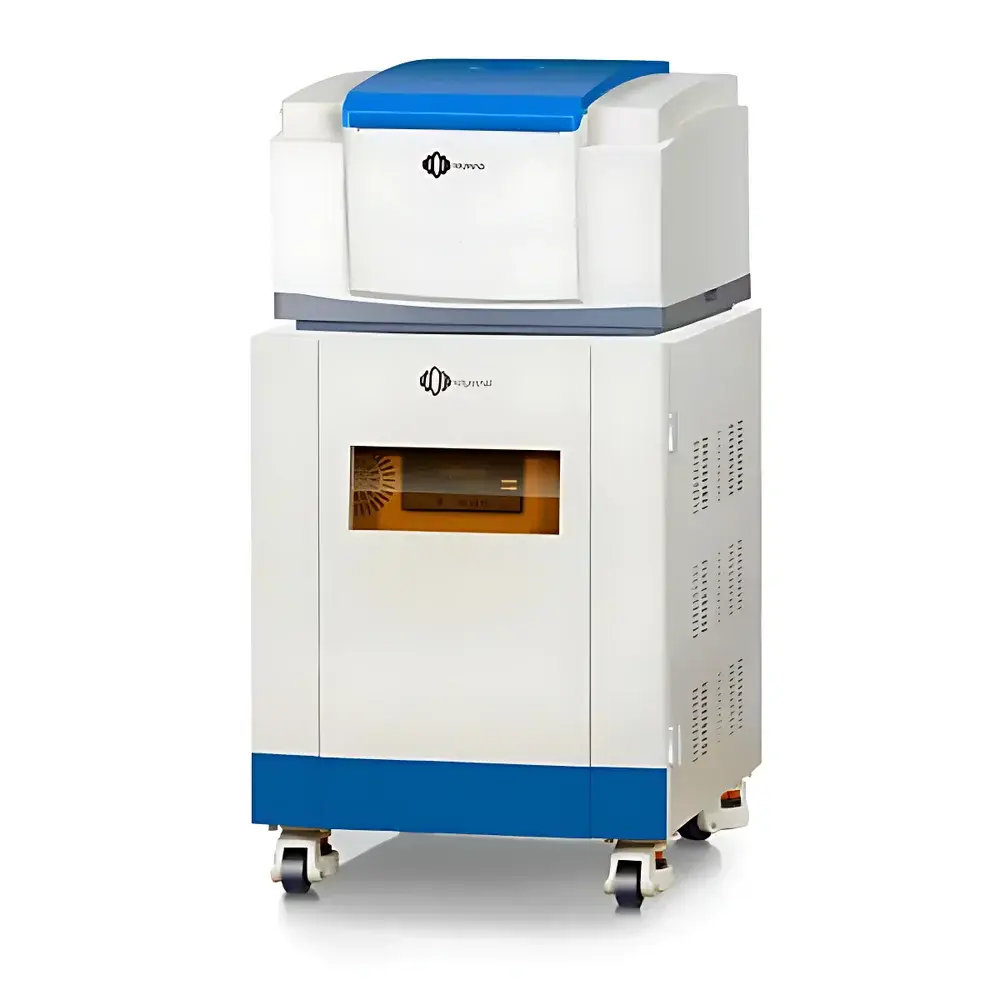
NIUMAG PQ001 Low-Field Nuclear Magnetic Resonance Coating Content Analyzer
| Brand | NIUMAG |
|---|---|
| Origin | Jiangsu, China |
| Manufacturer Type | Authorized Distributor |
| Product Origin | Domestic (China) |
| Model | PQ001 |
| Instrument Type | Low-Field NMR Analyzer |
| Sample Type | Solid–Liquid Compatible |
| Operating Mode | Pulsed Fourier Transform |
| Magnet Type | Permanent Magnet |
| Magnetic Field Strength | 0.5 ± 0.08 T |
| Probe Coil Diameter | 25 mm |
| Sample Capacity | Cylindrical samples ≤25 mm in diameter and ≤25 mm in height |
Overview
The NIUMAG PQ001 Low-Field Nuclear Magnetic Resonance Coating Content Analyzer is an engineered solution for non-destructive, rapid quantification of organic polymer coating content on inorganic or ceramic substrates. It operates on the fundamental principle of pulsed Fourier-transform nuclear magnetic resonance (FT-NMR), specifically exploiting the differential transverse relaxation times (T₂) of hydrogen nuclei (¹H) between substrate and coating phases. Inorganic non-metallic materials—such as glass, alumina, silica, or calcium carbonate—exhibit negligible or extremely short T₂ signals due to rigid lattice structures and low mobile proton density. In contrast, flexible polymeric coatings (e.g., acrylics, epoxies, polyurethanes, or silicone-based resins) contain abundant mobile protons with significantly longer T₂ values. By optimizing pulse sequence parameters—including echo time (TE), repetition time (TR), and number of scans—the PQ001 selectively detects and integrates the long-T₂ component of the FID (free induction decay), effectively suppressing substrate background. This enables direct correlation between integrated NMR signal amplitude and mass fraction of coating, calibrated via reference standards traceable to gravimetric or solvent-extraction methods.
Key Features
- Permanent magnet system delivering stable, homogeneous 0.5 ± 0.08 T field—no cryogens, no power consumption for magnet operation
- 25 mm diameter radiofrequency probe optimized for high sensitivity in small-volume solid–liquid heterogeneous samples
- Full pulsed FT-NMR architecture supporting standard sequences: CPMG (Carr–Purcell–Meiboom–Gill) for robust T₂ distribution analysis and single-pulse acquisition for rapid content screening
- Automated calibration workflow with built-in reference curve management; users define and store multiple calibration models per material class
- Onboard real-time signal processing: exponential fitting, baseline correction, and amplitude integration executed within the instrument firmware
- Reproducibility validated at ≤1.2% RSD (n = 10) for repeated measurements on identical coated substrates under ambient lab conditions (20–25 °C, non-vibrating bench)
Sample Compatibility & Compliance
The PQ001 accommodates cylindrical solid samples up to 25 mm in diameter and 25 mm in height—compatible with standard 25 mm OD NMR tubes. It supports both free-standing coated films and coated particulates (e.g., pigment-coated TiO₂, silica-coated mica). No sample digestion, solvent extraction, or vacuum drying is required. The method complies with core principles outlined in ASTM D7904 (Standard Practice for Quantitative Analysis of Polymer Coatings by Low-Field NMR) and aligns with ISO 17855 (Plastics — Determination of coating content on mineral fillers using NMR). While not a regulated GMP instrument per se, its audit-ready data structure—including timestamped raw FIDs, parameter logs, and calibration history—supports GLP-compliant documentation workflows. All spectral data are stored in vendor-neutral binary format (IEEE 754 float32), enabling third-party reprocessing.
Software & Data Management
The PQ001 is controlled via NIUMAG’s proprietary NMI-Studio software (Windows 10/11 compatible), featuring a validated, role-based user interface with configurable access levels. Software functions include: sequence parameter scripting, multi-point calibration curve generation (linear, quadratic, or spline-fitted), batch report export (PDF/CSV), and metadata embedding (operator ID, sample ID, date/time, instrument serial number). Audit trail functionality records all parameter changes, calibration updates, and measurement executions in encrypted SQLite database format—fully compliant with FDA 21 CFR Part 11 requirements when deployed with Windows domain authentication and electronic signature modules. Raw data files include embedded MD5 checksums to ensure integrity verification.
Applications
- Quantitative resin content verification in functionalized mineral fillers for paints, plastics, and adhesives
- In-line QC of anti-corrosion coatings on metal oxide substrates during pilot-scale coating process development
- Stability assessment of stimuli-responsive hydrogel coatings on medical device surfaces (e.g., pH- or temperature-triggered release layers)
- Batch-to-batch consistency monitoring of antimicrobial polymer coatings on ceramic filters or filtration membranes
- Research-grade characterization of gradient coating architectures via depth-resolved T₂ mapping (with optional surface coil upgrade)
FAQ
What sample preparation is required prior to measurement?
No chemical treatment or drying is needed. Samples must be geometrically stable within the 25 mm probe and free of macroscopic air gaps or delamination.
Can the PQ001 distinguish between different polymer types in a mixed coating?
Not inherently—quantification assumes a single dominant polymer phase. Multi-component analysis requires prior knowledge of individual T₂ signatures and multivariate calibration (e.g., PCA-LDA), supported via optional advanced software module.
Is temperature control available during acquisition?
The base system operates at ambient temperature. An accessory Peltier-controlled sample holder (−10 °C to +60 °C) is available for temperature-dependent T₂ studies.
How is instrument performance verified over time?
NIUMAG provides annual validation kits containing certified reference standards (e.g., doped polystyrene pellets with known H-content), enabling users to verify signal-to-noise ratio, linearity, and repeatability per ISO/IEC 17025 guidelines.
Does the system support remote operation or integration into LIMS?
Yes—NMI-Studio includes RESTful API endpoints and OPC UA server capability for bidirectional communication with laboratory information management systems (LIMS) and MES platforms.




