
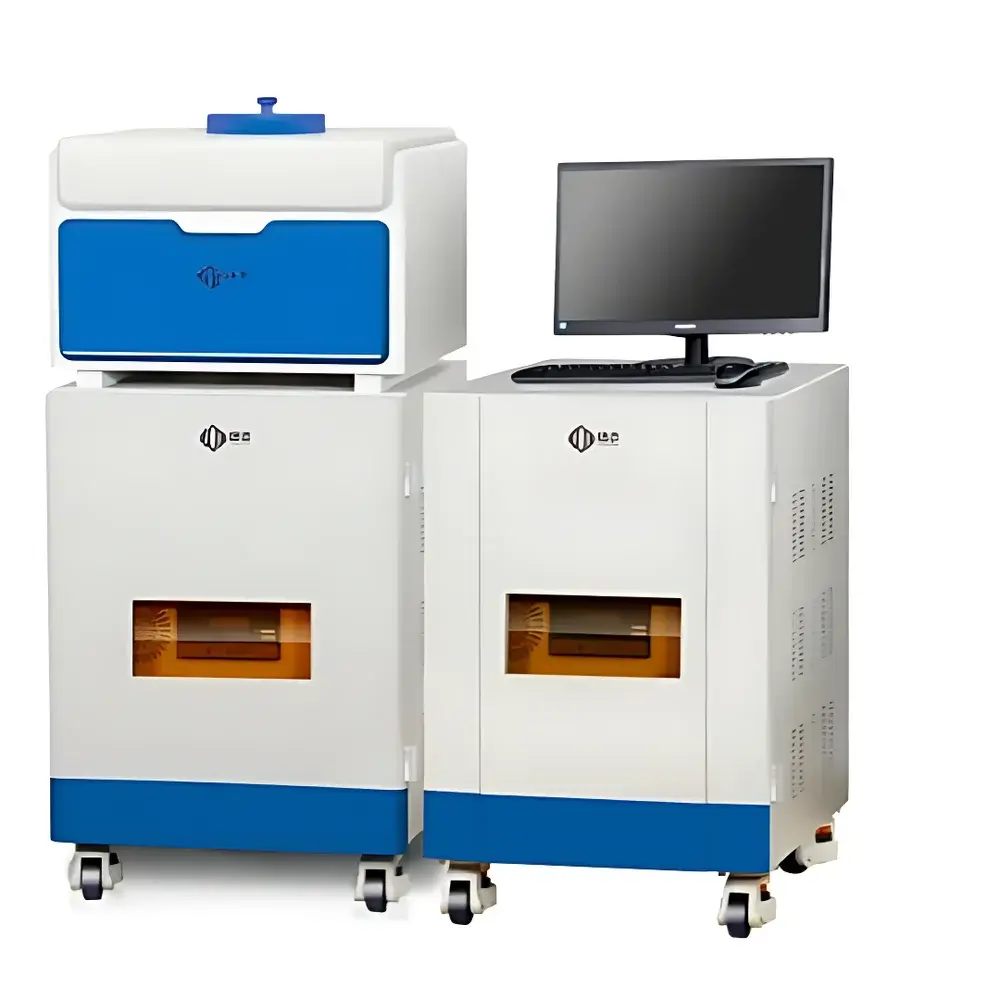
NIUMAG MesoMR Series Low-Field Nuclear Magnetic Resonance Analyzer (1D & 2D NMR)
| Brand | NIUMAG |
|---|---|
| Origin | Jiangsu, China |
| Instrument Type | Low-Field NMR Analyzer |
| Sample Compatibility | Solid-Liquid Dual-Phase Samples |
| Magnet Field Strength | 0.50 ± 0.03 T |
| Sample Orientation | Vertical Insertion |
| Optional Probe Coils | 25 mm (1″), 38 mm (1.5″), and ≤10 mm diameter configurations |
| Primary NMR Modes | 1D Spin-Echo (CPMG), 2D T₁–T₂ Correlation Spectroscopy |
Overview
The NIUMAG MesoMR Series is a benchtop low-field nuclear magnetic resonance (NMR) analyzer engineered for quantitative petrophysical characterization and molecular mobility analysis in heterogeneous porous media. Operating at a static magnetic field strength of 0.50 ± 0.03 T (corresponding to a 1H Larmor frequency of approximately 21.3 MHz), the system employs pulsed NMR techniques—including Carr–Purcell–Meiboom–Gill (CPMG) echo trains for transverse relaxation (T₂) measurement and phase-cycled inversion-recovery or saturation-recovery sequences for longitudinal relaxation (T₁) profiling. Its core capability lies in acquiring high-fidelity 2D T₁–T₂ correlation spectra, which resolve hydrogen-bearing species—such as kerogen, adsorbed hydrocarbons, mobile oil, bound water, and free water—based on distinct relaxation time signatures. Unlike high-field NMR spectrometers optimized for molecular structure elucidation, the MesoMR Series is purpose-built for industrial and geological applications where robustness, reproducibility, and non-destructive bulk sample interrogation are prioritized over spectral resolution.
Key Features
- Vertical-bore permanent magnet architecture with stable field homogeneity (<±0.05% over 25 mm DSV) and passive temperature compensation for long-term operational stability.
- Dual-mode acquisition platform supporting both 1D CPMG-based T₂ distribution analysis and 2D T₁–T₂ inverse Laplace transform (ILT) reconstruction with user-selectable encoding schemes (e.g., linear, logarithmic, or hybrid T₁/T₂ grids).
- Modular probe system accommodating standard rock core geometries: 25 mm (1″) and 38 mm (1.5″) diameter samples, plus custom-configured coils for sub-10 mm specimens—enabling consistent signal-to-noise ratio (SNR) across diverse porosity and permeability ranges.
- Optimized pulse sequence library for low-porosity, low-permeability reservoirs, including enhanced short-T₂ sensitivity via shortened inter-echo spacing (≤50 µs), increased receiver bandwidth (>500 kHz), and adaptive RF power calibration.
- Integrated thermal control option (±0.1 °C stability) for temperature-dependent relaxation studies compliant with ASTM D7171 and ISO 10427 standards for core analysis.
Sample Compatibility & Compliance
The MesoMR Series accepts intact cylindrical rock cores, powdered solids, emulsions, gels, polymers, and other hydrogen-containing materials without chemical modification or destructive preparation. Its solid–liquid dual-phase capability supports simultaneous quantification of immobile matrix-bound protons and mobile fluid-phase protons. All hardware and firmware comply with IEC 61000-6-3 (EMC emission limits) and IEC 61000-6-2 (immunity requirements). Data acquisition protocols align with industry-standard petrophysical workflows defined in API RP 40 and ISO 17025-accredited laboratory practices. The system supports audit-ready data logging per GLP/GMP guidelines, with timestamped metadata, instrument configuration snapshots, and raw FID/echo train storage.
Software & Data Management
NIUMAG’s proprietary MesoMR Studio software provides a validated environment for sequence design, real-time acquisition monitoring, batch processing, and multidimensional spectral deconvolution. It implements constrained non-negative least-squares (NNLS) algorithms for T₂ and T₁–T₂ ILT inversion, with built-in regularization parameter optimization. Export formats include ASCII, CSV, HDF5, and NIfTI for interoperability with MATLAB, Python (SciPy/NumPy), and commercial reservoir simulation platforms (e.g., CMG, PETREL). Electronic records meet FDA 21 CFR Part 11 requirements through role-based access control, digital signature integration, and immutable audit trails for all processing steps.
Applications
- Petrophysical evaluation: porosity, effective porosity, irreducible water saturation (Swi), movable fluid saturation, and pore-size distribution derived from T₂ cutoffs and T₁–T₂ cross-peaks.
- Hydrocarbon phase discrimination in shale and tight reservoirs using T₁/T₂ ratio mapping—differentiating kerogen-bound hydrogen, adsorbed oil, free oil, clay-bound water, and capillary-trapped water.
- Enhanced oil recovery (EOR) monitoring: tracking surfactant-induced wettability alteration and polymer flooding efficiency via time-lapse T₁–T₂ evolution.
- Geomechanical property estimation: correlating T₂ distributions with unconfined compressive strength (UCS) and Young’s modulus in sedimentary rocks.
- Material science applications: polymer crosslink density assessment, catalyst pore confinement effects, and food matrix water mobility profiling.
FAQ
What is the primary advantage of 2D T₁–T₂ correlation over conventional 1D T₂ analysis?
2D T₁–T₂ spectroscopy resolves overlapping relaxation components that appear as a single broad peak in 1D T₂ spectra—enabling unambiguous separation of fluids with similar T₂ but distinct T₁ values (e.g., adsorbed vs. free hydrocarbons).
Can the MesoMR Series be used for quality control in pharmaceutical excipient characterization?
Yes—its ability to quantify amorphous vs. crystalline water content, monitor hydration state transitions, and assess excipient–API interaction kinetics makes it suitable for solid-state stability studies under ICH Q5C guidelines.
Is external cryogenic cooling required for operation?
No—the permanent magnet operates at ambient temperature; optional Peltier-based probe temperature control maintains setpoints between 5 °C and 60 °C without liquid nitrogen or helium.
How does field strength impact fluid identification accuracy in shale samples?
Higher Larmor frequency (e.g., 23 MHz vs. 2.5 MHz) improves spectral dispersion and SNR for short-T₂ components, enhancing resolution of organic matter signals and reducing T₁–T₂ coupling artifacts in complex kerogen–bitumen systems.
Does the system support automated batch processing for core plug libraries?
Yes—MesoMR Studio includes scriptable workflow automation, barcode-assisted sample registration, and QC flagging based on SNR, echo decay linearity, and T₂ distribution skewness thresholds.
Related Products






