
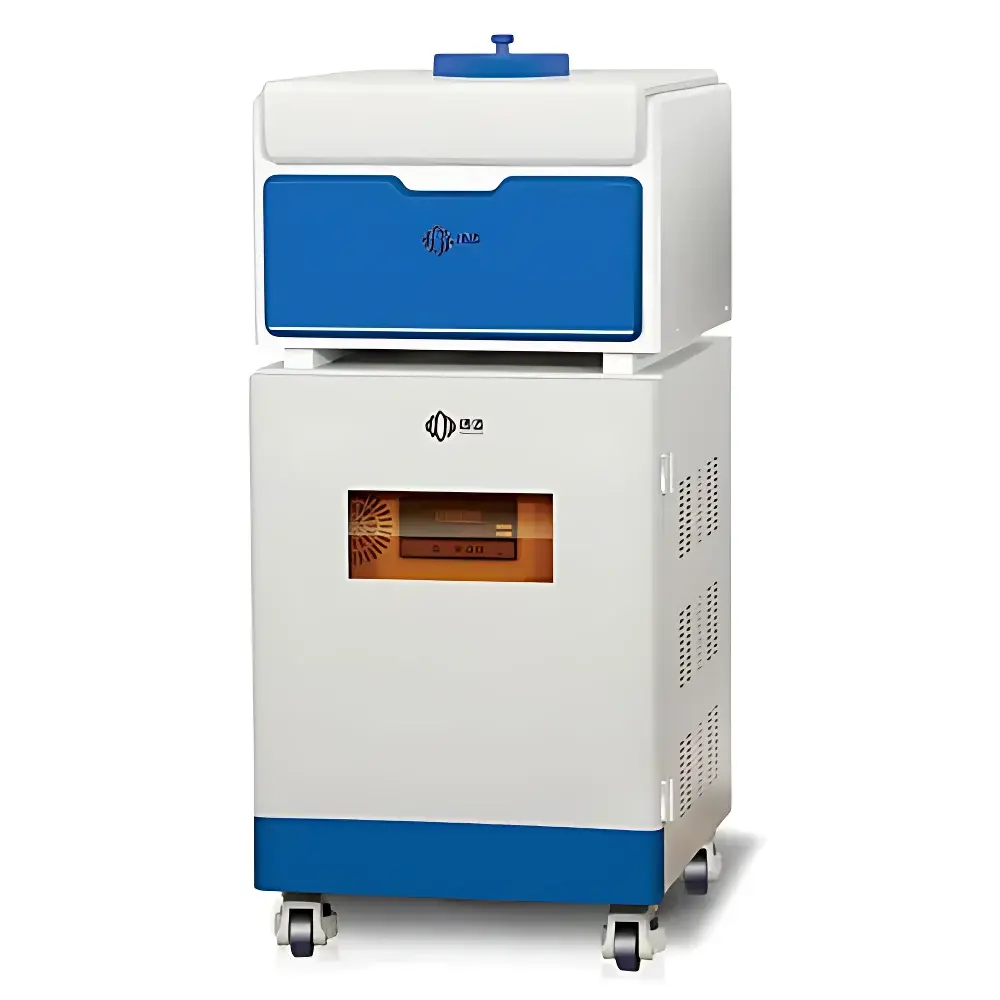
NIUMAG NMI20-040V-I Low-Field Nuclear Magnetic Resonance Imaging Analyzer
| Brand | NIUMAG |
|---|---|
| Origin | Jiangsu, China |
| Manufacturer Type | Authorized Distributor |
| Product Category | Domestic |
| Model | NMI20-040V-I |
| Instrument Type | Low-Field NMR Analyzer |
| Sample Compatibility | Solid-Liquid Dual-Phase Samples |
Overview
The NIUMAG NMI20-040V-I is a benchtop low-field nuclear magnetic resonance (LF-NMR) imaging analyzer engineered for non-invasive, quantitative characterization of food materials at the molecular mobility and spatial distribution level. Based on pulsed NMR principles—specifically spin-echo (SE), Carr–Purcell–Meiboom–Gill (CPMG), and inversion-recovery (IR) sequences—the system measures transverse (T₂) and longitudinal (T₁) relaxation times to infer water/oil content, binding states (e.g., bound, immobilized, free water), and phase segregation without chemical modification or destructive sampling. Its 0.5 T permanent magnet—constructed from rare-earth NdFeB—delivers stable, drift-free field homogeneity over time, eliminating cryogen dependency and long-term maintenance costs typical of high-field superconducting systems. The 40 mm inner diameter probe accommodates diverse sample geometries—from intact fruits and meat cuts to emulsions, powders, and gels—enabling direct correlation between NMR-derived parameters and macroscopic food quality attributes.
Key Features
- 40 mm wide-bore permanent magnet system optimized for heterogeneous food matrices, supporting both bulk relaxation analysis and spatially resolved imaging.
- Integrated dual-function architecture: simultaneous acquisition of quantitative T₁/T₂ relaxometry and 2D/3D magnetic resonance imaging (MRI) with user-defined slice orientation, thickness, and angle.
- Automated hardware calibration: real-time center-frequency search, automatic 90°/180° pulse width optimization, and gradient-based shimming—reducing operator dependency and ensuring measurement reproducibility across users and sessions.
- Zero-consumable operation: no liquid helium, no RF coils requiring replacement, no chemical reagents—aligned with green laboratory practices and ISO 14001-aligned facility management.
- Modular pulse sequence library: includes FID, SE, CPMG, SEG-CPMG, IR, MSE, and FSE sequences—fully configurable for research-grade method development in food science.
- Robust mechanical design with vibration-damping base and EMI-shielded enclosure, meeting IEC 61326-1 requirements for electromagnetic compatibility in shared lab environments.
Sample Compatibility & Compliance
The NMI20-040V-I accepts solid, semi-solid, liquid, powdered, and multiphase samples—including whole fruits, baked goods, dairy emulsions, meat products, and hydrocolloid gels—without size limitation beyond the 40 mm aperture. No dehydration, fixation, staining, or solvent extraction is required, preserving native physicochemical structure. Data output complies with ASTM E2975-22 (Standard Guide for NMR Characterization of Food Systems) and supports GLP/GMP traceability through audit-ready metadata logging (timestamp, operator ID, pulse sequence parameters, temperature). Software export formats (CSV, DICOM, NIfTI) enable integration with third-party statistical platforms (e.g., MATLAB, Python SciPy) and regulatory submission workflows compliant with FDA 21 CFR Part 11 when deployed with optional electronic signature modules.
Software & Data Management
Two dedicated software suites operate under a unified Windows-based platform: the NMR Analysis Suite and the MRI Reconstruction Suite. The former provides automated relaxation curve fitting (mono-/bi-/tri-exponential models), diffusion-weighted analysis, and moisture/oil quantification using pre-calibrated calibration curves traceable to gravimetric reference standards. The latter enables intuitive three-step imaging: (1) auto-shim + center-frequency lock, (2) slice parameter definition (orientation, thickness, FOV), and (3) sequence selection + acquisition. Both suites support batch processing, noise reduction via adaptive Wiener filtering, pseudo-color mapping, ROI-based intensity profiling, and volumetric rendering. All raw FIDs and k-space data are stored in vendor-neutral HDF5 format with embedded JSON metadata—ensuring long-term archival integrity per ISO 16363 (Trusted Digital Repository standard).
Applications
- Quantitative water/oil content and distribution mapping in processed meats, cheeses, and plant-based analogs.
- Monitoring moisture migration during drying, freezing, thawing, and shelf-life storage—correlating T₂ decay components with textural degradation.
- Non-destructive assessment of fruit ripeness, internal bruising, and freeze-thaw damage via proton density and T₂-weighted contrast.
- Characterization of myofibrillar protein hydration dynamics and structural unfolding during thermal processing.
- Optimization of formulation and process parameters in emulsion stabilization, batter rheology, and extrusion cooking.
- Validation of packaging barrier performance by tracking water vapor ingress kinetics in multilayer films.
FAQ
What sample preparation is required prior to measurement?
None. Samples are placed directly into the 40 mm tube—no cutting, drying, centrifugation, or chemical treatment is necessary.
Can the system distinguish between free water and bound water in starch gels?
Yes. Multi-exponential T₂ relaxation analysis resolves ≥3 distinct water populations based on molecular mobility—validated against DSC and sorption isotherm data.
Is the instrument suitable for routine QC in a production environment?
Yes. With <2-minute acquisition time per sample and automated calibration, it meets ASTM E2975-22 repeatability criteria (RSD < 2.5% for moisture in cereal matrices).
Does the software support compliance with 21 CFR Part 11?
Full electronic signature, audit trail, and role-based access control are available via optional GxP module—validated per IQ/OQ protocols.
What is the magnetic field stability specification over 12 months?
Drift ≤ ±0.02 ppm/hour, verified annually using built-in reference phantoms; no active shim correction required during daily operation.




