
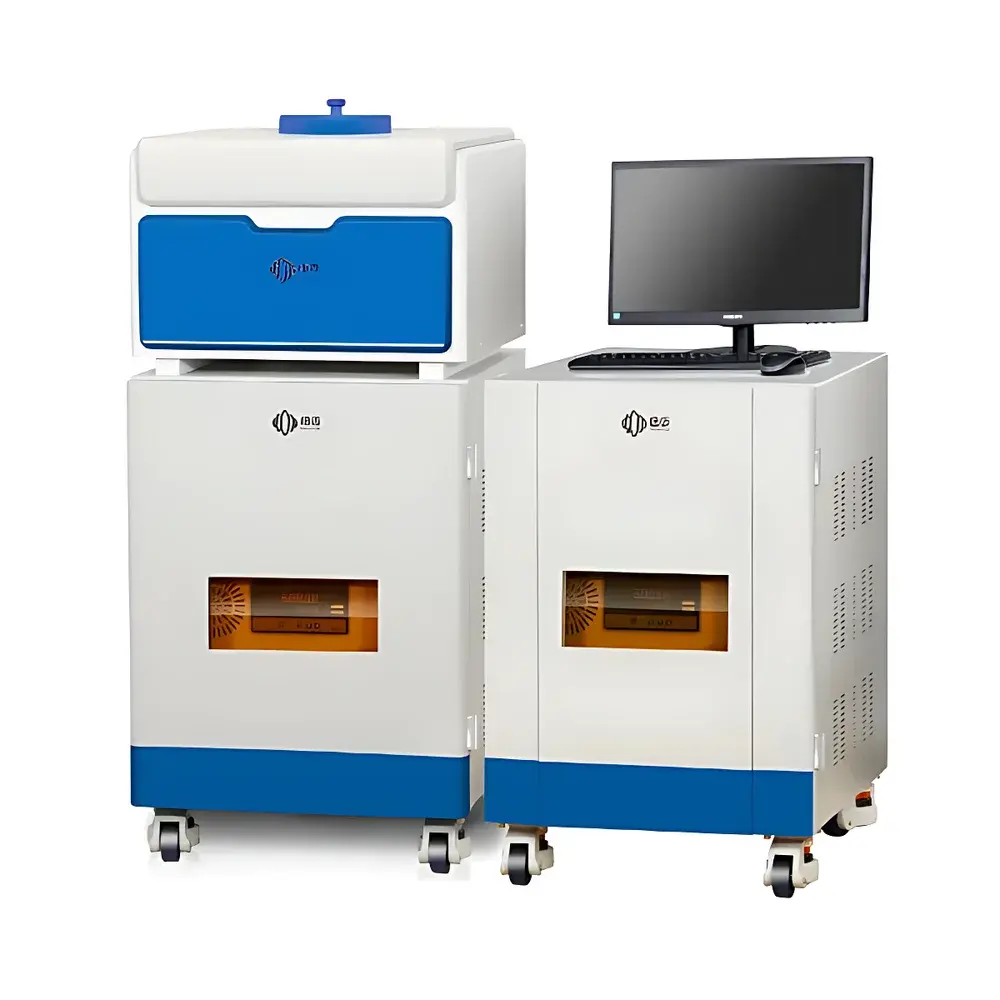
NIUMAG MesoMR12-060H-I High-Temperature Cement Hydration Analyzer
| Brand | NIUMAG |
|---|---|
| Origin | Jiangsu, China |
| Model | MesoMR12-060H-I |
| Instrument Type | Low-Field Nuclear Magnetic Resonance (LF-NMR) Analyzer |
| Sample Compatibility | Solid-Liquid Hybrid Samples |
| Standard Temperature Range | Room Temperature to 130 °C |
| Optional Variable-Temperature Module | −100 °C to 200 °C |
| Magnet Type | Permanent Magnet |
| Nominal Field Strength | 0.5 ± 0.05 T |
| Optional Imaging Capability | Yes |
Overview
The NIUMAG MesoMR12-060H-I High-Temperature Cement Hydration Analyzer is a purpose-built low-field nuclear magnetic resonance (LF-NMR) system engineered for in situ, non-destructive characterization of cement hydration kinetics and microstructural evolution under thermally extreme conditions. Unlike conventional analytical techniques—such as X-ray diffraction (XRD), scanning electron microscopy (SEM), or thermogravimetric analysis (TGA)—which require destructive sampling and yield only static, endpoint data, this instrument leverages the intrinsic sensitivity of hydrogen nuclei (1H) to local molecular mobility and pore confinement. By measuring spin-lattice (T1) and spin-spin (T2) relaxation times, the system quantifies dynamic water speciation (free vs. chemically bound water), maps pore-size distributions (1 nm–100 µm), and detects early-stage microcracking or dehydration-induced structural degradation—all without altering sample integrity. Its integrated high-temperature probe enables continuous monitoring across a controlled thermal profile (up to 130 °C standard; extendable to 200 °C with optional module), making it uniquely suited for studying calcium sulfoaluminate (ettringite), C-S-H gel formation, and decalcification pathways under geothermal, deep-well, or refractory application conditions.
Key Features
- Permanent magnet platform delivering stable, drift-free 0.5 T field (±0.05 T) with minimal power consumption and zero cryogen dependency
- Thermally regulated sample chamber supporting real-time acquisition from room temperature up to 130 °C (standard); optional extended-range module covers −100 °C to 200 °C with ±0.1 °C thermal stability
- Multi-echo CPMG and inversion-recovery pulse sequences optimized for cementitious systems, enabling robust T2 distribution deconvolution and quantitative bound-water fraction calculation
- Modular hardware architecture permitting seamless integration of optional MRI capability for 2D/3D spatial mapping of water redistribution and crack propagation
- Ruggedized RF coil design accommodating irregularly shaped cement pastes, mortars, and core samples (max Ø 60 mm × H 120 mm)
- Fully programmable acquisition protocols compliant with ASTM C1701 (infiltration rate), ISO 15659 (pore structure), and internal QC workflows for GLP/GMP environments
Sample Compatibility & Compliance
The MesoMR12-060H-I accepts heterogeneous, multi-phase cement-based materials—including Portland cements, blended systems (e.g., slag, fly ash, silica fume), fiber-reinforced composites, and oilwell cement slurries—without pre-drying, grinding, or vacuum saturation. Its solid-liquid hybrid detection capability allows simultaneous resolution of capillary water, interlayer water in C-S-H, and sulfate-bound water in ettringite. All firmware and data acquisition modules adhere to FDA 21 CFR Part 11 requirements for electronic records and signatures when configured with audit-trail logging. System validation documentation supports IQ/OQ/PQ protocols aligned with ISO/IEC 17025 and ASTM E2917 standards for analytical instrument qualification.
Software & Data Management
Control and analysis are performed via NIUMAG’s proprietary MesoMR Studio software, a Windows-based platform featuring automated calibration routines, batch processing pipelines, and customizable reporting templates. Raw FID data are stored in vendor-neutral HDF5 format; T2 spectra and derived parameters (e.g., total porosity, median pore radius, bound water ratio) export directly to CSV or Excel. The software includes built-in models for converting T2 cutoffs to pore size using the Coates equation and Bruker’s SDR correlation, with user-defined calibration against mercury intrusion porosimetry (MIP) or nitrogen adsorption (BET). Audit trails record operator ID, timestamp, parameter changes, and raw data checksums—enabling full traceability for regulatory submissions or inter-laboratory round-robin studies.
Applications
- Real-time tracking of hydration onset, induction period, and acceleration phase in high-temperature cement systems (e.g., Class G/H oilwell cements at 120 °C)
- Quantifying thermal dehydration thresholds and rehydration reversibility in calcium aluminate cements exposed to cyclic heating/cooling
- Evaluating efficacy of nanosilica or polymeric admixtures on C-S-H densification and pore refinement under simulated geothermal conditions
- Correlating T2 shortening rates with compressive strength development (per ASTM C109) and chloride diffusion coefficients (per NT BUILD 492)
- Monitoring microcrack nucleation and coalescence during thermal shock testing (e.g., rapid quenching from 150 °C to ambient)
- Supporting formulation optimization for refractory castables used in kiln linings, blast furnaces, and waste incinerators
FAQ
Can the instrument operate continuously at 200 °C?
Yes—when equipped with the optional high-temperature module, the system maintains thermal equilibrium and RF performance stability across the full −100 °C to 200 °C range, validated per IEC 61000-4-2 thermal stress testing.
Is sample preparation required prior to NMR measurement?
No. Cement pastes, mortars, or cured cores may be loaded directly into the RF coil; no drying, grinding, or vacuum saturation is needed.
How does LF-NMR compare to XRD for detecting ettringite formation?
XRD identifies crystalline phases but lacks sensitivity to amorphous C-S-H or sub-5 nm ettringite domains; LF-NMR detects all 1H-bearing species regardless of crystallinity, resolving kinetic formation pathways via T2 evolution.
Does the system support compliance with pharmaceutical or food-grade material testing standards?
While primarily designed for construction materials, its 21 CFR Part 11–compliant software architecture and audit-trail functionality enable adaptation to USP , , and ISO 22000 validation frameworks upon protocol customization.
What is the minimum detectable pore size resolution?
Based on T2 relaxation physics and signal-to-noise optimization, the system resolves effective pore diameters down to ~1 nm in hydrated cement matrices, consistent with literature-reported limits for 0.5 T LF-NMR systems.
Related Products




