
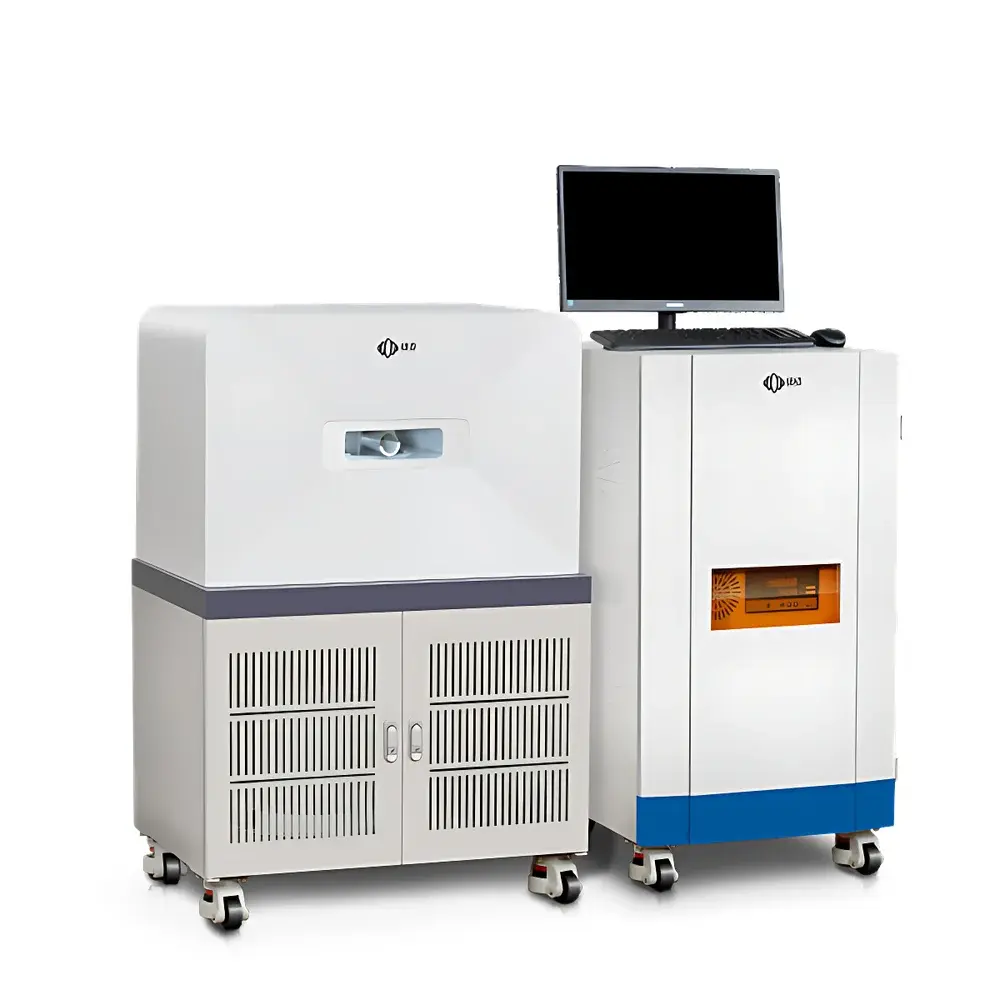
NIUMAG MesoMR12-060H-I Pseudo-Triaxial NMR Imaging Analyzer
| Brand | NIUMAG |
|---|---|
| Origin | Jiangsu, China |
| Manufacturer Type | Authorized Distributor |
| Origin Category | Domestic |
| Model | MesoMR12-060H-I Medium-Size Pseudo-Triaxial NMR Imaging Analyzer |
| Instrument Type | Low-Field NMR Analyzer |
| Sample Type | Solid-Liquid Dual-Phase Samples |
| Magnet Type | Permanent Magnet |
| Magnetic Field Strength | 0.5 ± 0.08 T (Larmor Frequency: 21.3 MHz) |
| Probe Coil Diameter | 60 mm |
Overview
The NIUMAG MesoMR12-060H-I Pseudo-Triaxial NMR Imaging Analyzer is a purpose-built low-field nuclear magnetic resonance (NMR) platform engineered for in situ, non-invasive characterization of rock mechanical behavior under controlled multi-physical loading conditions. Unlike conventional static NMR analyzers, this system integrates a pseudo-triaxial mechanical loading frame with a high-stability permanent-magnet NMR sensor—enabling real-time acquisition of transverse relaxation time (T2) spectra and spatially resolved NMR images during progressive stress application. The instrument operates at a Larmor frequency of 21.3 MHz (corresponding to a central field of 0.5 ± 0.08 T), optimized for robust signal-to-noise performance in heterogeneous porous media while maintaining thermal and mechanical stability across extended experimental durations. Its design supports simultaneous coupling of axial compression, confining pressure, and temperature control—facilitating quantitative analysis of pore structure evolution, fluid saturation dynamics, microcrack nucleation, and damage propagation in reservoir rocks under geomechanically relevant boundary conditions.
Key Features
- Integrated pseudo-triaxial mechanical loading module with independent axial and lateral pressure control (up to 60 MPa axial, 40 MPa confining), enabling simulation of deep-reservoir stress states.
- High-homogeneity permanent magnet system (0.5 ± 0.08 T) with active temperature stabilization (±0.05 °C), ensuring long-term field stability essential for quantitative T2 mapping.
- 60 mm inner-diameter RF probe optimized for core samples (25–50 mm diameter, up to 100 mm length), supporting both CPMG and IR-CPMG pulse sequences.
- Real-time NMR data acquisition synchronized with mechanical loading steps, delivering time-resolved T2 distributions and 2D/3D NMR images at sub-minute temporal resolution.
- Ruggedized sample chamber with integrated fluid ports, thermocouple feedthroughs, and optical access—compatible with brine, oil, CO2, and supercritical fluid saturation experiments.
- Modular hardware architecture compliant with industrial I/O standards (EtherCAT, Modbus TCP), facilitating integration into automated laboratory workflows.
Sample Compatibility & Compliance
The MesoMR12-060H-I accommodates cylindrical rock cores (25–50 mm Ø × ≤100 mm L), unconsolidated sediments, cementitious materials, and engineered geomaterials. It supports solid–liquid biphasic systems—including water-saturated, oil-brine partially saturated, and gas-saturated configurations—without requiring sample drying or vacuum impregnation. All mechanical and NMR subsystems adhere to ISO 9001-certified manufacturing protocols. Data acquisition firmware complies with GLP principles: audit trails record operator ID, timestamp, sequence parameters, and environmental metadata for every scan. While not FDA 21 CFR Part 11–certified out-of-the-box, the system supports export of raw FID data (IEEE 754 binary format) and processed T2 spectra in ASTM E2917-compliant ASCII structures for third-party validation and regulatory submission.
Software & Data Management
Control and analysis are performed via NIUMAG’s proprietary NMIStudio v4.x software suite, built on Qt/C++ with Python 3.9 API extension support. The interface provides synchronized visualization of mechanical load curves, real-time T2 distribution heatmaps, and slice-wise NMR image stacks. Batch processing modules enable automated T2 cutoff determination (using SDR, TIM, or Capillary Bundle models), porosity partitioning (bound vs. movable fluid), and pore-size distribution inversion via NNLS regularization. All datasets are stored in HDF5 containers with embedded metadata (MIAME-compliant schema), supporting traceable versioning and DICOM-SR export for cross-platform interoperability. Raw data archives are compatible with open-source NMR analysis tools including NMRLab, MRILab, and TOPIC.
Applications
- Quantification of stress-dependent pore collapse, crack initiation thresholds, and damage zone geometry in sandstone, shale, and carbonate reservoir analogs.
- In situ monitoring of water-oil displacement efficiency under varying capillary numbers and wettability conditions.
- Characterization of freeze-thaw, acid leaching, and salt crystallization damage mechanisms through time-lapsed T2 shift analysis.
- Calibration of digital rock physics (DRP) models using experimentally derived pore-network topology and fluid occupancy maps.
- Multi-field coupling studies integrating thermal gradients (–20 to +80 °C), pore pressure cycling, and chemical injection protocols.
- Validation of constitutive models for coupled poroelasticity and chemo-mechanical degradation in CCS and geothermal applications.
FAQ
What sample dimensions are supported?
Standard configuration accepts cylindrical cores 25–50 mm in diameter and up to 100 mm in length. Custom probe inserts accommodate irregular geometries upon request.
Can the system perform true triaxial loading?
It implements pseudo-triaxial loading: axial stress is applied uniaxially while confining pressure is hydrostatically balanced. True triaxial (σ₁ ≠ σ₂ ≠ σ₃) requires external mechanical add-ons.
Is the NMR signal affected by mechanical vibration during loading?
Yes—vibration-induced line broadening is mitigated via passive damping mounts, real-time field-frequency lock, and post-processing motion-correction algorithms embedded in NMIStudio.
How is temperature controlled during NMR acquisition?
A PID-regulated Peltier stage maintains sample temperature within ±0.2 °C; thermal drift compensation is applied to both RF frequency and gradient timing.
Does the system support diffusion-weighted imaging (DWI)?
Not natively—gradient strength is limited to 0.15 T/m. However, surface relaxation-dominated T2 analysis remains highly effective for pore-scale characterization in low-permeability rocks.




