
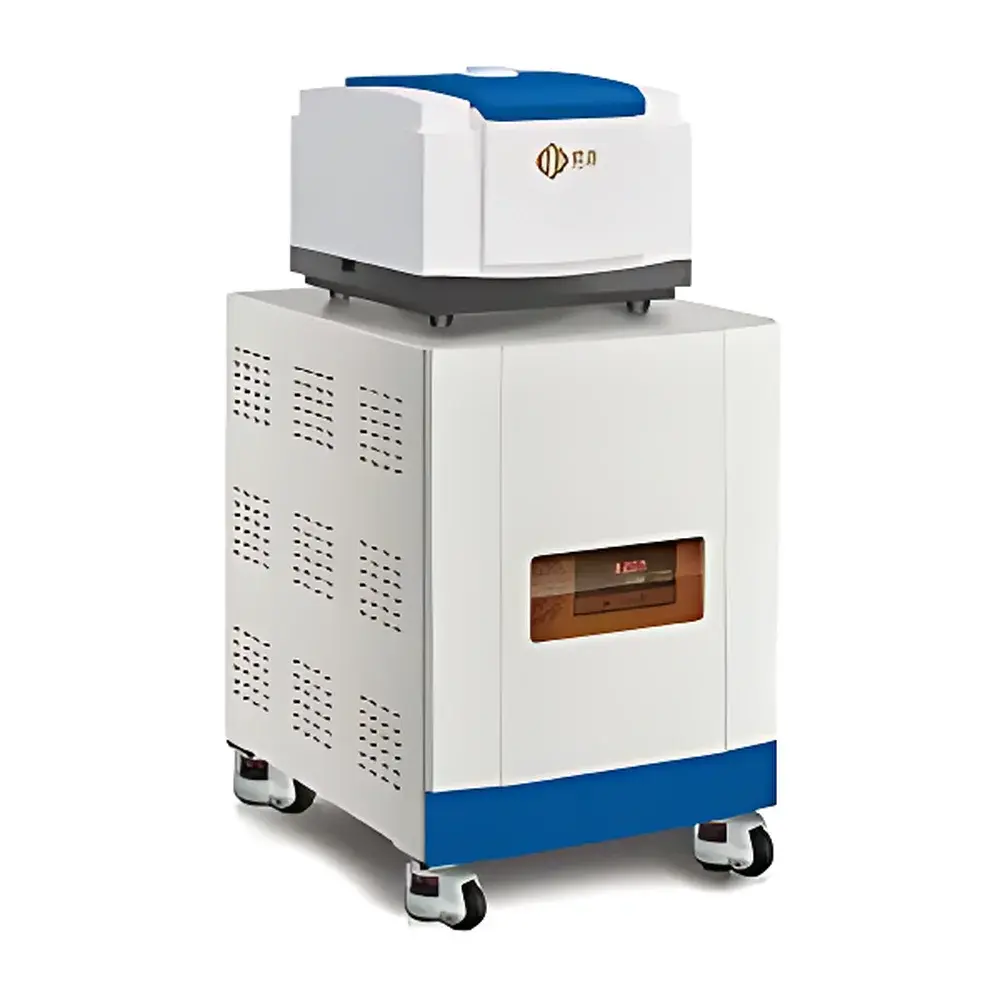
NIUMAG PQ001 Low-Field Pulsed Nuclear Magnetic Resonance (LF-NMR) Analyzer
| Brand | NIUMAG |
|---|---|
| Origin | Jiangsu, China |
| Manufacturer Type | Authorized Distributor |
| Product Origin | Domestic (China) |
| Model | PQ001 |
| Instrument Type | Low-Field NMR Analyzer |
| Sample Compatibility | Solid-Liquid Dual-Phase Samples |
| Operating Mode | Pulsed Fourier Transform (PFT-NMR) |
| Magnet Type | Permanent Magnet |
| Detectable Nucleus | ¹H |
| Resonance Frequency Range | 1–30 MHz |
| Power Supply | 220 V AC, 50 Hz |
| Typical Measurement Time | 1–3 min per sample |
| Software Interface | Integrated GUI with Dedicated Relaxometry Modules |
Overview
The NIUMAG PQ001 is a benchtop low-field pulsed nuclear magnetic resonance (LF-NMR) analyzer engineered for quantitative relaxometry-based characterization of molecular mobility, phase distribution, and physical state in heterogeneous materials. Unlike high-field NMR spectrometers optimized for chemical shift resolution, the PQ001 operates on the principle of time-domain NMR (TD-NMR), where transverse (T₂) and longitudinal (T₁) relaxation decay curves are acquired via Carr–Purcell–Meiboom–Gill (CPMG) and inversion-recovery pulse sequences, respectively. Its permanent magnet architecture delivers a stable, homogeneous static field (B₀) within the 0.02–0.7 T range—corresponding to ¹H Larmor frequencies from 1 to 30 MHz—enabling robust, non-destructive, and solvent-free analysis without sample preparation or labeling. Designed for routine industrial and academic laboratories, the PQ001 provides rapid, reproducible quantification of bound/free water ratios, oil content, polymer crosslink density, pore-size distribution in porous media, and solid fat content—making it a core tool for QC/QA, formulation development, and process optimization.
Key Features
- Compact permanent magnet system with passive temperature stabilization, eliminating cryogen dependency and reducing operational overhead.
- Dedicated ¹H resonant probe optimized for broad-line NMR detection across solid, semi-solid, and liquid phases—supporting direct measurement of heterogeneous samples without centrifugation or filtration.
- Integrated pulse programmer supporting standard TD-NMR sequences: CPMG (for T₂), Inversion Recovery (for T₁), and saturation recovery—calibrated for high signal-to-noise ratio (SNR) at low field.
- Benchtop footprint (< 60 cm × 50 cm × 45 cm) and 220 V / 50 Hz single-phase power requirement ensure deployment flexibility in regulated environments including cleanrooms and production labs.
- Real-time acquisition engine capable of completing full T₂ decay acquisition—including echo train generation, digitization, and exponential fitting—in under 180 seconds per sample.
- Self-shielding design compliant with IEC 61000-6-3 (EMC emission limits) and IEC 61000-6-2 (immunity), suitable for shared laboratory infrastructure.
Sample Compatibility & Compliance
The PQ001 accepts cylindrical samples up to Ø25 mm × H50 mm in standard 15 mm or 25 mm OD glass or plastic tubes. It supports direct analysis of emulsions, gels, pastes, powders, seeds, food matrices (e.g., meat, cheese, baked goods), pharmaceutical tablets, polymer films, and geological cores. No deuterated solvents, vacuum, or cryogenic cooling are required. The instrument meets essential safety and electromagnetic compatibility requirements per CE marking directives (2014/30/EU, 2014/35/EU). While not certified to ISO/IEC 17025 as a standalone testing facility, its measurement traceability aligns with ASTM D8147–21 (Standard Test Method for Determination of Solid Fat Content by Low-Field NMR) and ISO 10565:1998 (Oilseeds — Simultaneous Determination of Oil and Water Contents — Pulsed NMR Method). Data audit trails support GLP-compliant workflows when operated with validated software configurations.
Software & Data Management
The PQ001 runs NIUMAG’s proprietary MesoMR Studio v4.x, a Windows-based application featuring intuitive tabbed navigation for sequence selection, parameter setup, real-time signal monitoring, and automated multi-exponential T₂/T₁ fitting. All raw FID and echo train data are saved in HDF5 format with embedded metadata (pulse sequence, temperature, gain, number of scans). Quantitative reports include peak area integration, component fraction tables, relaxation time distributions (via NNLS or CONTIN algorithms), and statistical summaries across sample batches. Export options include CSV, Excel, and image-ready PNG/PDF. For regulated environments, optional 21 CFR Part 11 compliance packages provide electronic signatures, role-based access control, and immutable audit logs—fully compatible with LIMS integration via OPC UA or RESTful API endpoints.
Applications
- Food Science: Solid fat content (SFC) profiling in cocoa butter and margarines; moisture migration kinetics in snacks; authenticity screening of edible oils.
- Pharmaceuticals: Excipient hydration state analysis; tablet coating uniformity assessment; lyophilized product residual moisture mapping.
- Materials Research: Crosslink density estimation in rubber and elastomers; pore structure analysis in catalysts and MOFs; polymer blend phase separation dynamics.
- Agriculture & Seeds: Oil/water content in oilseeds (soybean, rapeseed); viability assessment of stored grains via membrane integrity indicators.
- Cosmetics: Emulsion stability evaluation through droplet size distribution modeling; rheological aging studies in creams and lotions.
FAQ
What nuclei can the PQ001 detect?
The PQ001 is configured exclusively for proton (¹H) detection. Its hardware and software are optimized for high-sensitivity ¹H relaxometry; no hardware modifications enable detection of other nuclei.
Is calibration required before each measurement?
No routine recalibration is needed. The system includes factory-calibrated reference standards (e.g., doped water, mineral oil) for periodic performance verification per ASTM D8147 Annex A1.
Can the PQ001 be used for quantitative analysis in GMP environments?
Yes—when deployed with the 21 CFR Part 11 add-on module and documented IQ/OQ protocols, the PQ001 supports GMP-aligned release testing for excipients and intermediates.
Does the instrument require external cooling or ventilation?
No. The permanent magnet and RF electronics are air-cooled and thermally stabilized; ambient lab conditions between 15–30 °C and <70% RH are sufficient.
How is data integrity ensured during long-term operation?
All acquisitions are timestamped, digitally signed, and stored with checksum validation. Raw data files are write-protected upon saving, and software enforces version-controlled method templates to prevent unauthorized parameter changes.
Related Products






