
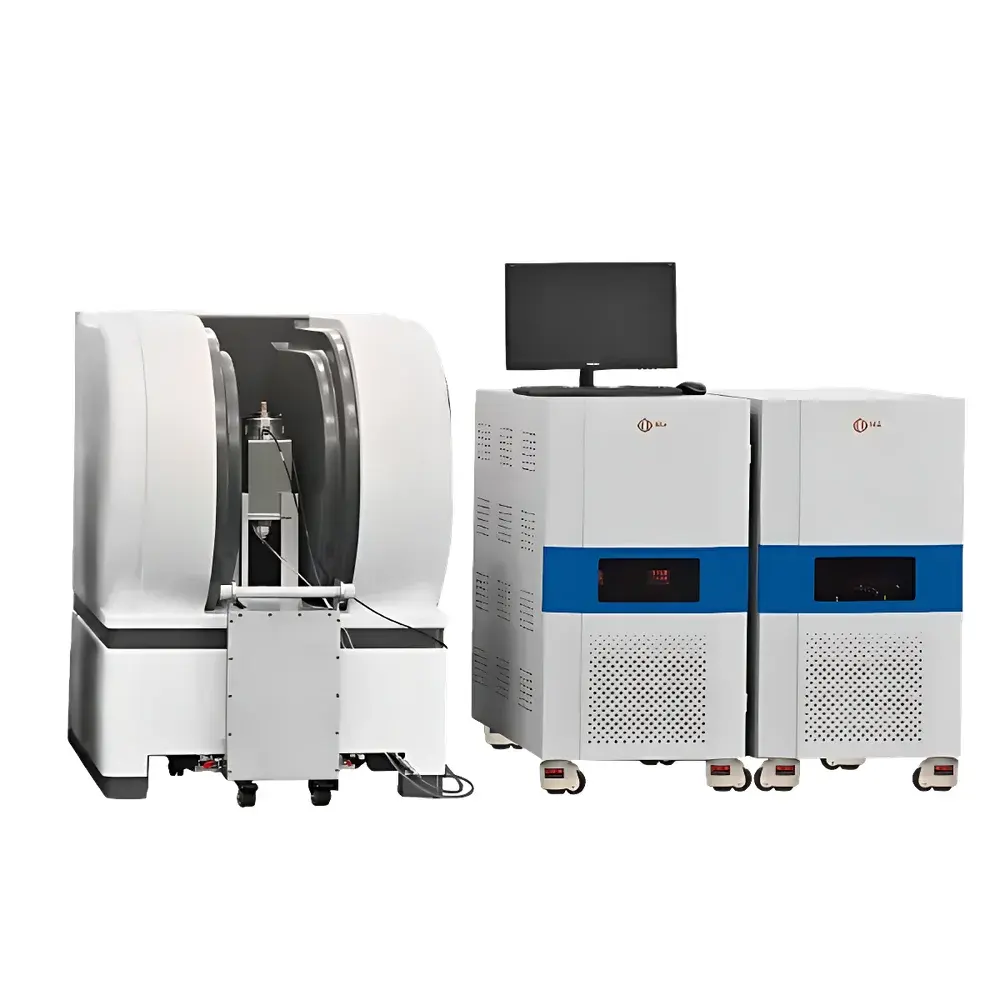
NIUMAG MacroMR12-150V-I Low-Field Nuclear Magnetic Resonance Triaxial Soil Microstructure Analyzer
| Brand | NIUMAG |
|---|---|
| Origin | Jiangsu, China |
| Instrument Type | Low-Field NMR Analyzer |
| Magnetic Field Strength | 0.30 T ± 0.03 T |
| Magnet Homogeneity | ≤50 ppm |
| Magnet Orientation | Vertical (Longitudinal Sample Insertion) |
| Sample Compatibility | Solid-Liquid Coupled Systems (Saturated Soils, Rock Cores, Geomaterials) |
| Core Diameter Range | 25–100 mm |
| Measurement Capabilities | T₁/T₂ Relaxometry, Proton Density-Weighted Imaging, Multi-Parameter Dynamic Monitoring under Mechanical Load |
| Optional Coupling | Integrated Triaxial Cell for Simultaneous Stress-Strain and NMR Signal Acquisition |
Overview
The NIUMAG MacroMR12-150V-I Low-Field Nuclear Magnetic Resonance Triaxial Soil Microstructure Analyzer is an engineered platform that unifies classical geotechnical triaxial testing with quantitative low-field NMR spectroscopy and imaging. It operates on the physical principle of nuclear magnetic resonance—specifically, the detection of hydrogen proton (¹H) spin dynamics in saturated geomaterials under a static magnetic field (0.30 T). In soils, hydrogen nuclei reside predominantly in pore water, adsorbed water layers, and organic matter; their transverse (T₂) and longitudinal (T₁) relaxation times are intrinsically linked to local molecular mobility, surface-to-volume ratio, and pore confinement. By acquiring multi-echo Carr–Purcell–Meiboom–Gill (CPMG) decay trains and inversion-recovery sequences, the system resolves relaxation time distributions (RTDs), enabling non-invasive, quantitative mapping of pore size distribution, water saturation state, bound/free water partitioning, and dynamic fluid redistribution during mechanical loading. Unlike destructive or indirect methods—including gravimetric drying, mercury intrusion porosimetry, or electron microscopy—the MacroMR12-150V-I preserves sample integrity across repeated measurements, supporting time-resolved studies of consolidation, freeze-thaw cycling, drainage, and stress-induced microstructural evolution.
Key Features
- Vertically oriented superconducting-free permanent magnet with longitudinal sample access—optimized for gravity-aligned triaxial configurations and large-diameter core samples (25–100 mm).
- High-stability RF probe with temperature-controlled tuning and matched gradient subsystem for reproducible T₁/T₂ relaxometry and proton density-weighted imaging.
- Dedicated triaxial NMR cell interface enabling synchronized acquisition of axial deviatoric stress, confining pressure, volumetric strain, and real-time NMR signal response.
- Modular environmental coupling: supports integration with temperature-controlled chambers (−20 °C to +80 °C), hydraulic/pneumatic pressure systems (up to 20 MPa), and fluid injection modules for multiphysics experimentation.
- Calibration-traceable pulse sequence library compliant with ASTM D7928 (soil particle-size analysis by NMR) and ISO/IEC 17025-accredited measurement protocols.
Sample Compatibility & Compliance
The MacroMR12-150V-I is validated for saturated cohesive soils (clays, silts), remolded and undisturbed cores, stabilized tailings, biochar-amended substrates, and frozen/frost-susceptible geomaterials. Its solid-liquid coupled measurement architecture accommodates heterogeneous, high-viscosity, and electrically conductive media without signal distortion. All hardware and firmware comply with IEC 61000-6-3 (EMC emissions) and IEC 61000-6-4 (industrial immunity). Data acquisition workflows support audit trails, electronic signatures, and metadata embedding aligned with GLP and GMP documentation requirements. Full compatibility with FDA 21 CFR Part 11-compliant software extensions is available upon configuration.
Software & Data Management
The proprietary MultiQ-NMR™ software suite provides integrated control of NMR acquisition, triaxial actuation, and environmental modules. It enables automated batch processing of T₂ spectra using inverse Laplace transform (ILT) with non-negative constrained regularization. Quantitative outputs include pore-size distribution histograms, water content depth profiles, saturation maps, and relaxation time–stress correlation matrices. All raw FIDs, processed spectra, and mechanical logs are stored in HDF5 format with embedded timestamps, instrument parameters, and user-defined annotations. Export options include CSV, MATLAB .mat, and DICOM-compatible image stacks for third-party structural analysis (e.g., Avizo, ImageJ). Audit logs record operator ID, session start/end times, parameter modifications, and calibration events—ensuring full traceability for regulatory submissions.
Applications
- Soil Hydrodynamics: Quantification of unfrozen water content during freezing, capillary rise kinetics, imbibition front propagation, and hysteresis in soil-water characteristic curves (SWCC).
- Pore Structure Evolution: In situ monitoring of pore collapse during consolidation, crack initiation in desiccating clays, and pore network reorganization under cyclic loading.
- Mechano-Hydraulic Coupling: Correlation of deviatoric strain increments with localized water redistribution in saturated clays; identification of pre-failure pore water pressure localization.
- Environmental Geotechnics: Assessment of contaminant transport pathways via diffusion-restricted water compartments; evaluation of polymer-grouted soil stabilization efficacy.
- Cryogenic Soil Mechanics: Real-time tracking of ice lens formation, phase segregation, and meltwater migration during thaw consolidation in permafrost analogs.
FAQ
What distinguishes this system from conventional benchtop low-field NMR analyzers?
It integrates mechanical load application (triaxial compression/shear) with simultaneous NMR signal acquisition—enabling direct correlation between macroscopic stress-strain behavior and microscopic water redistribution.
Can T₁ and T₂ be measured independently under load?
Yes. The system supports sequential or interleaved T₁ inversion-recovery and T₂ CPMG acquisitions during static or dynamic loading phases, with temporal resolution down to 10 seconds per spectrum.
Is the instrument suitable for regulatory-compliant reporting in environmental consulting?
When configured with Part 11-compliant software and documented calibration records, it meets data integrity standards required for ASTM D8169 (NMR-based soil moisture profiling) and EPA Method 9071B (field-moist soil water retention).
What sample preparation is required?
Minimal preparation: intact cores are sealed in NMR-compatible latex membranes and saturated under vacuum prior to insertion; no drying, coating, or vacuum impregnation is needed.
Does the system support custom pulse sequence development?
Yes. The open API allows MATLAB- or Python-based sequence design and deployment via the NMR console interface, subject to safety interlock validation.
Related Products





