
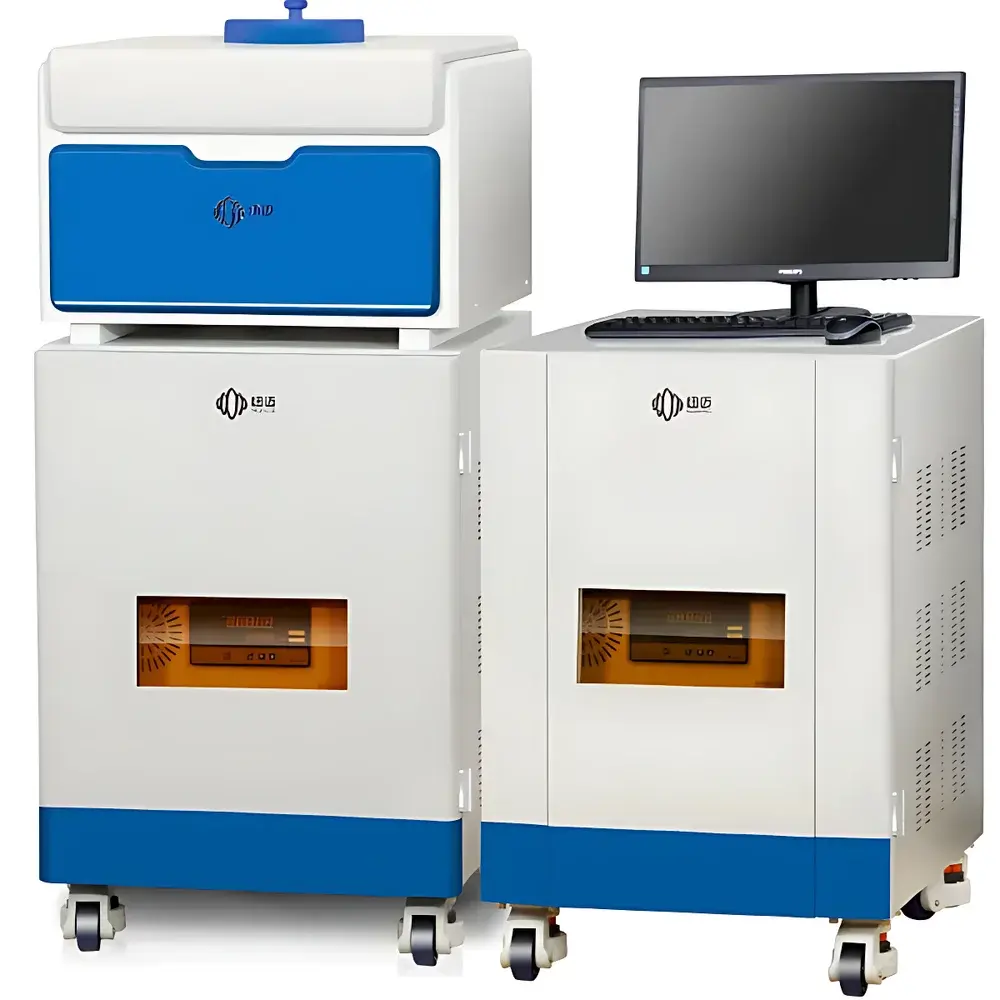
NIUMAG VTMR20-010V-01 Low-Field Nuclear Magnetic Resonance Analyzer for Crosslink Density Quantification of Solid Sodium Hyaluronate
| Brand | NIUMAG |
|---|---|
| Origin | Jiangsu, China |
| Manufacturer Type | Authorized Distributor |
| Product Category | Domestic |
| Model | VTMR20-010V-01 |
| Instrument Type | Low-Field NMR Analyzer |
| Sample Compatibility | Solid–Liquid Hybrid Samples |
| Magnet Type | Permanent Magnet |
| Static Field Strength | 0.5 ± 0.05 T |
| Temperature Control Range (Standard) | 25–130 °C |
| Optional Cryo/High-Temp Module | –100 to 200 °C |
| Measurement Time per Sample | ≤ 2 min |
| Detection Principle | Transverse Relaxation (T₂) Decay Analysis |
Overview
The NIUMAG VTMR20-010V-01 is a dedicated low-field nuclear magnetic resonance (LF-NMR) analyzer engineered for quantitative, non-invasive assessment of crosslink density in solid-phase sodium hyaluronate (hyaluronic acid, HA). Unlike conventional chemical or rheological methods requiring sample dissolution, derivatization, or destructive extraction, this instrument leverages the intrinsic magnetic relaxation behavior of hydrogen nuclei (¹H) in different molecular environments. In crosslinked HA networks, polymer chain mobility is spatially constrained: highly crosslinked regions exhibit rapid transverse relaxation (short T₂), while unbound or loosely associated segments—such as residual solvent, mobile amorphous domains, or non-crosslinked HA chains—display longer T₂ components. By acquiring and deconvoluting multi-exponential T₂ decay spectra, the VTMR20-010V-01 enables direct correlation between relaxation time distribution and local segmental mobility, thereby providing a robust, physics-based metric for crosslink density without calibration standards or reference materials.
Key Features
- Sub-2-minute measurement cycle for routine quality control and high-throughput screening
- Permanent magnet architecture ensuring field stability, minimal maintenance, and operational safety in standard laboratory environments
- Integrated temperature-controlled probe with standard range from ambient to 130 °C, supporting thermal transition analysis (e.g., glass transition, swelling behavior)
- Optional cryogenic–high-temperature module (–100 to 200 °C) for extended thermodynamic profiling and accelerated aging studies
- Non-destructive, reagent-free operation—samples remain fully recoverable post-analysis for orthogonal testing or archival
- Simultaneous detection of multiple proton populations (e.g., bound water, free water, polymer backbone CH/CH₂ groups), enabling multi-parameter characterization within a single acquisition
Sample Compatibility & Compliance
The VTMR20-010V-01 accommodates heterogeneous, solid–liquid hybrid samples—including lyophilized HA gels, injectable dermal fillers, hydrogel films, and crosslinked microspheres—without homogenization or solvent addition. Its RF coil design supports sample volumes from 0.5 to 10 mL in standard 10-mm OD NMR tubes. The system complies with IEC 61000-6-3 (EMC emission standards) and meets mechanical safety requirements per ISO 13849-1. Data acquisition and processing workflows support audit-trail generation and user-access controls aligned with GLP and GMP documentation practices. While not FDA-cleared as a medical device, the instrument’s measurement methodology is consistent with principles referenced in USP Analytical Instrument Qualification and ASTM D8143–21 Standard Guide for Low-Field NMR Characterization of Polymer Networks.
Software & Data Management
Control and analysis are executed via NIUMAG’s proprietary MesoMR software suite, featuring intuitive workflow-driven interfaces for pulse sequence selection (CPMG, IR-CPMG), automated T₂ inversion (non-negative least squares, NNLS), and spectral deconvolution. All raw FIDs and processed T₂ distributions are stored in vendor-neutral HDF5 format with embedded metadata (timestamp, operator ID, temperature setpoint, RF power, echo spacing). Software supports export to CSV, MATLAB (.mat), and ASCII for integration into LIMS or statistical process control platforms. Audit trail functionality logs all parameter modifications, data exports, and user logins—meeting traceability requirements under 21 CFR Part 11 when deployed with appropriate system validation protocols.
Applications
- Quantitative crosslink density mapping across HA batches to ensure batch-to-batch consistency in medical device manufacturing
- Differentiation of mono-phasic (fully crosslinked) versus bi-phasic (crosslinked + free HA) formulations based on T₂ component ratios
- In-process monitoring of crosslinking kinetics during carbodiimide- or BDDE-mediated reactions
- Correlation of T₂ short-component amplitude with mechanical modulus (G′) and enzymatic degradation rate (hyaluronidase assay)
- Assessment of hydration state and water compartmentalization in HA-based wound dressings and ocular implants
- Thermal stability evaluation via variable-temperature T₂ mapping across the glass transition region (Tg)
FAQ
What physical property does the VTMR20-010V-01 measure to infer crosslink density?
It measures the transverse relaxation time (T₂) distribution of ¹H nuclei, where shorter T₂ components correlate with restricted molecular motion in crosslinked network junctions.
Can the instrument distinguish between different crosslinking chemistries (e.g., BDDE vs. divinyl sulfone)?
No—it does not identify chemical structure; however, differences in network topology induced by distinct crosslinkers yield statistically resolvable shifts in T₂ distribution profiles.
Is sample preparation required beyond loading into an NMR tube?
No centrifugation, drying, or solvent exchange is needed. Samples are analyzed as-is, preserving native hydration and morphology.
Does the system support imaging capabilities?
Imaging is available as an optional add-on module (VTMR20-010V-I), enabling spatially resolved T₂ mapping for heterogeneous gel systems.
How is instrument performance verified over time?
A standardized polymeric reference material with certified T₂ dispersion characteristics is supplied for daily system suitability checks and longitudinal drift monitoring.






