
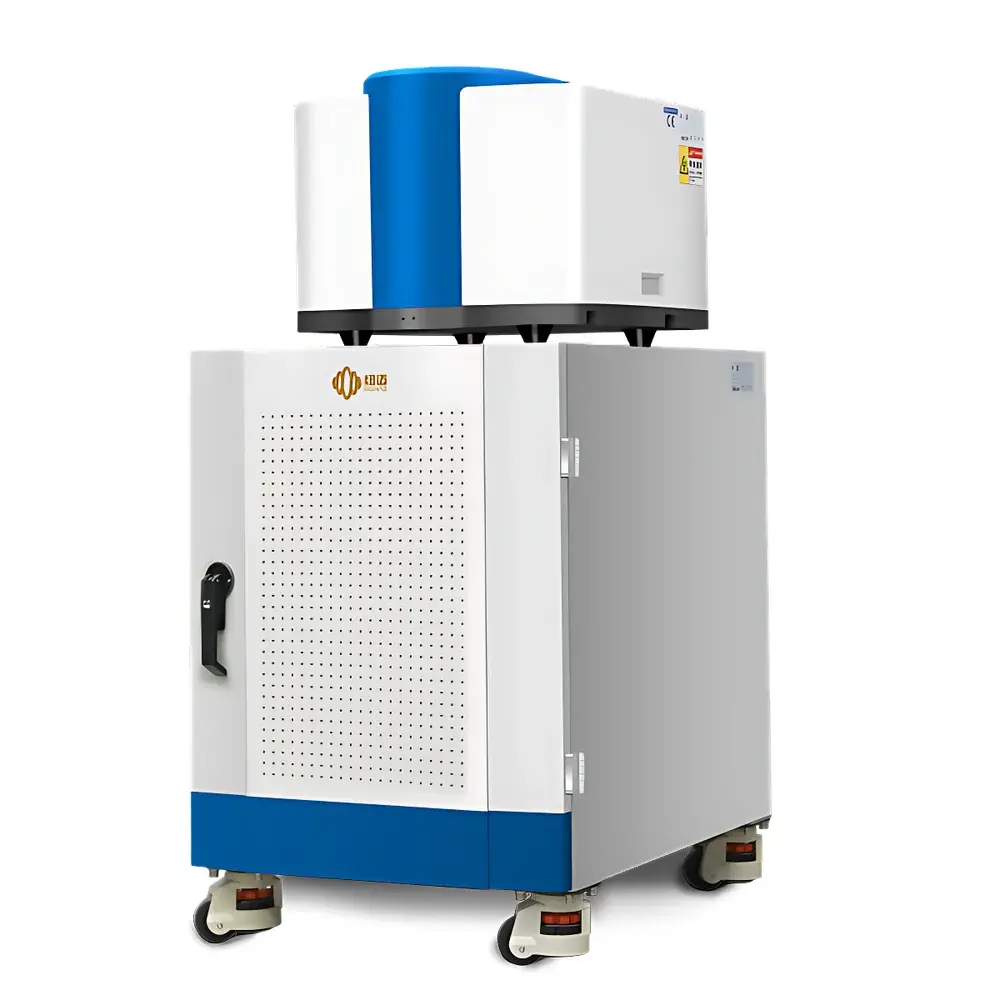
NIUMAG PQ001-Seed Protein Low-Field Nuclear Magnetic Resonance Analyzer
| Brand | NIUMAG |
|---|---|
| Origin | Jiangsu, China |
| Instrument Type | Low-Field NMR Analyzer |
| Sample Type | Solid-Liquid Combined |
| Model | PQ001-Seed Protein |
| Application Domain | Non-Destructive Seed Protein Quantification |
| Measurement Principle | Proton Transverse Relaxation (T₂) Analysis |
Overview
The NIUMAG PQ001-Seed Protein Low-Field Nuclear Magnetic Resonance Analyzer is a dedicated benchtop instrument engineered for rapid, non-destructive quantification of protein content in intact seeds. It operates on the physical principle of low-field nuclear magnetic resonance (LF-NMR), specifically measuring the transverse relaxation behavior (T₂) of hydrogen nuclei (¹H) in seed tissues. Unlike destructive wet-chemistry methods—such as Kjeldahl nitrogen determination—the PQ001 leverages intrinsic differences in molecular mobility: protons bound within protein macromolecules exhibit significantly shorter T₂ relaxation times compared to those in free water or lipid phases. By acquiring and deconvoluting multi-exponential T₂ decay curves, the system isolates the signal component attributable to protein-associated protons, enabling calibration-based estimation of total protein concentration. Designed for routine use in plant breeding programs, seed quality control laboratories, and agricultural research stations, the analyzer delivers reproducible results without grinding, solvent extraction, or chemical digestion—preserving seed viability for subsequent germination or genetic evaluation.
Key Features
- Non-destructive analysis: Seeds remain physically intact and fully viable post-measurement, supporting downstream phenotyping and seed banking.
- Ultra-rapid acquisition: Full T₂ relaxation measurement completed in ≤80 seconds per sample, enabling high-throughput screening of breeding populations.
- No sample preparation required: No drying, milling, homogenization, or reagent addition—minimizing operator variability and contamination risk.
- Environmentally compliant operation: Eliminates hazardous reagents (e.g., concentrated sulfuric acid, catalysts) associated with Kjeldahl or Dumas methods.
- Robust hardware architecture: Permanent magnet system (typically 0.3–0.5 T) with temperature-stabilized probe and integrated RF electronics optimized for heterogeneous solid samples.
- Calibration-ready platform: Supports development of crop-specific PLS or ML regression models using reference protein data from certified reference materials or orthogonal assays.
Sample Compatibility & Compliance
The PQ001 accommodates a broad range of intact, unprocessed seeds—including but not limited to wheat, rice, soybean, pea, lentil, sunflower, and rapeseed—with typical mass ranges of 1–10 g per measurement. Its solid-liquid dual-mode capability allows simultaneous assessment of both dry seed kernels and hydrated embryos, facilitating studies on hydration dynamics and protein-water interactions. The instrument complies with IEC 61000-6-3 (EMC emission standards) and meets mechanical safety requirements per ISO 13857. While LF-NMR itself is not a primary standard method, analytical procedures developed on the PQ001 may be validated per ISO/IEC 17025:2017 for testing laboratories, and data integrity supports alignment with GLP principles when implemented with appropriate audit trails and user access controls.
Software & Data Management
The embedded acquisition and analysis software provides real-time T₂ spectrum visualization, automated exponential fitting (mono-/bi-/multi-component), and customizable calibration workflows. Raw FID and processed T₂ distributions are stored in vendor-neutral formats (e.g., ASCII, CSV) for traceability. Optional software modules support FDA 21 CFR Part 11 compliance—including electronic signatures, role-based permissions, and immutable audit logs—for regulated environments. Batch reporting tools generate PDF or Excel summaries with metadata (sample ID, timestamp, operator, instrument serial number), facilitating integration into LIMS or QMS platforms used in certified seed testing facilities.
Applications
- High-throughput phenotyping in cereal and legume breeding programs for protein trait selection.
- Quality assurance of commercial seed lots prior to distribution or processing.
- Research on genotype-by-environment effects on seed protein accumulation under drought, nitrogen limitation, or elevated CO₂.
- Validation of near-infrared (NIR) calibrations using LF-NMR as an orthogonal reference technique.
- Monitoring protein stability during seed storage and aging studies.
- Educational use in food science and plant physiology laboratories for teaching NMR-based compositional analysis.
FAQ
Does the PQ001 directly measure protein mass percentage?
No—it measures proton relaxation dynamics correlated with protein-bound hydrogen; quantitative protein values require calibration against reference methods (e.g., AOAC 984.13).
Can it distinguish between different protein types (e.g., gluten vs. globulin)?
Not at the molecular subtype level; it resolves broad relaxation populations linked to macromolecular environment, not amino acid sequence.
Is temperature control available during measurement?
Yes—optional Peltier-controlled sample chamber maintains ±0.5 °C stability for temperature-sensitive relaxation studies.
What is the minimum detectable protein difference between samples?
Typically 0.3–0.5% w/w in homogeneous seed batches, dependent on calibration model robustness and sample homogeneity.
Does the system require liquid helium or cryogens?
No—low-field permanent magnet design eliminates cryogenic maintenance, reducing operational cost and infrastructure requirements.
Related Products






