
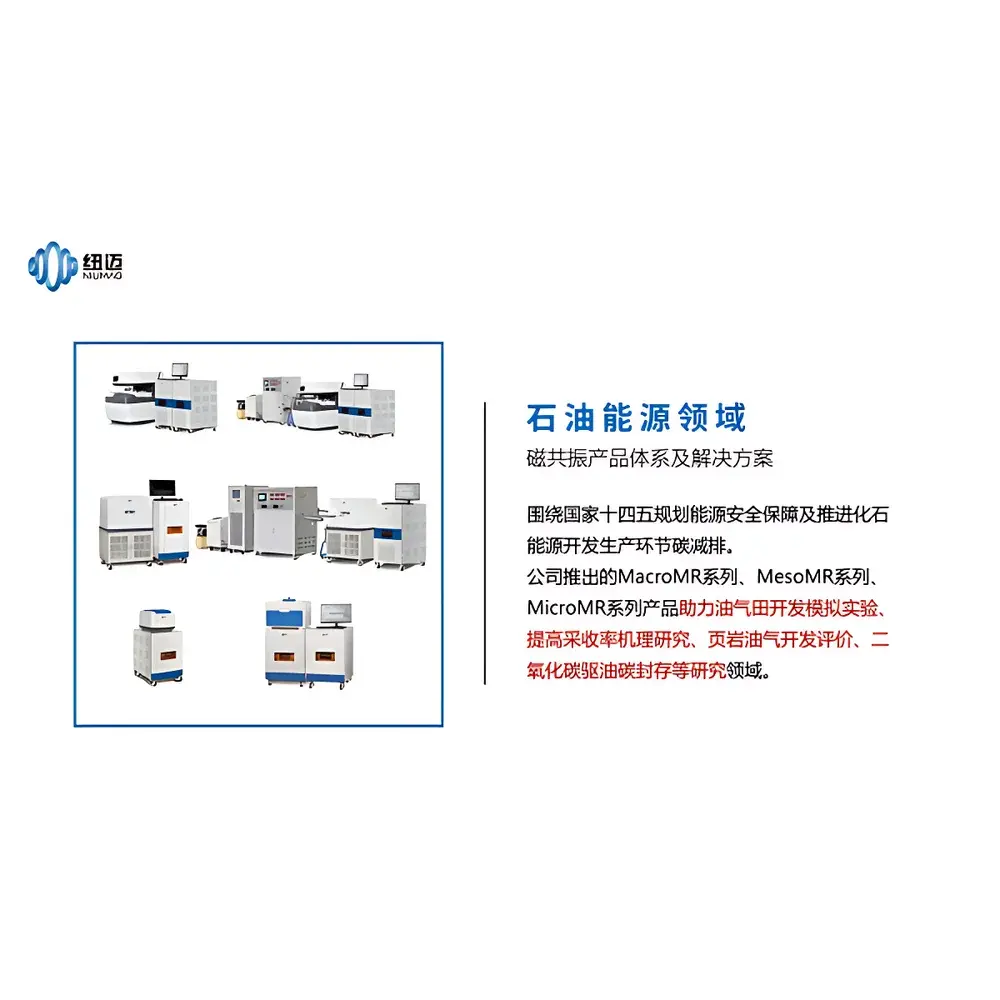
NIUMAG MacroMR Series Low-Field Nuclear Magnetic Resonance Analyzer
| Brand | NIUMAG |
|---|---|
| Origin | Jiangsu, China |
| Manufacturer Type | Authorized Distributor |
| Product Category | Domestic |
| Model | MacroMR Series |
| Instrument Type | Low-Field NMR Analyzer |
| Sample Compatibility | Solid-Liquid Dual-Mode |
| Operating Mode | Pulsed Fourier Transform |
| Magnet Type | Permanent Magnet (NdFeB) |
| Field Strength | 0.3 ± 0.05 T |
| Uniformity Zone | Designed for Multi-Configuration Probe Integration |
| Core Functionality | T₂ Relaxometry, T₁–T₂ Correlation, NMR Imaging, Porosity & Permeability Quantification, Fluid Saturation Analysis, Wettability Assessment, Microstructural Heterogeneity Mapping |
Overview
The NIUMAG MacroMR Series Low-Field Nuclear Magnetic Resonance Analyzer is an integrated benchtop NMR platform engineered for quantitative characterization of reservoir rock physical properties in petroleum geoscience and core analysis laboratories. Operating at a static magnetic field strength of 0.3 ± 0.05 T—generated by a high-stability rare-earth NdFeB permanent magnet—the system leverages pulsed Fourier transform (PFT) NMR methodology to acquire spin-echo decay signals from hydrogen nuclei (¹H) in pore-confined fluids. Unlike high-field NMR spectrometers optimized for molecular structure elucidation, the MacroMR Series is purpose-built for rapid, non-destructive, and calibration-free assessment of petrophysical parameters directly linked to hydrocarbon storage and transport behavior. Its C-shaped open-bore magnet architecture enables flexible sample handling—including whole-core plugs, cuttings, and irregular rock fragments—while maintaining field homogeneity across a wide uniformity zone compatible with multiple probe configurations. The instrument delivers intrinsic sensitivity to fluid distribution, mobility, and interfacial interactions within porous media, forming the physical basis for deriving porosity, permeability, saturation states, pore-throat geometry, and wettability without reliance on empirical correlations or destructive extraction methods.
Key Features
- C-shaped permanent magnet system using sintered NdFeB material, ensuring long-term field stability (<0.01% drift/year) and zero cryogen consumption
- Full-digital NMR spectrometer with 16-bit ADC resolution, programmable pulse sequences (CPMG, IR, STIR, T₁–T₂), and real-time signal averaging
- Push-pull sample loading mechanism supporting cylindrical samples up to Ø150 mm × H200 mm; accommodates standard core plugs (Ø25.4 mm, Ø38.1 mm), crushed rock, and sediment packs
- Integrated NMR relaxometry and imaging capability: T₂ distribution analysis, multi-dimensional T₁–T₂ correlation mapping, and gradient-echo-based spatial encoding
- Modular hardware expansion interface enabling seamless integration of optional high-pressure/low-temperature modules (up to 70 MPa, –40 °C to +150 °C)
- Pre-calibrated pulse sequence library compliant with industry-standard acquisition protocols (e.g., ASTM D7269 for core porosity, ISO 10139 for T₂ cutoff determination)
Sample Compatibility & Compliance
The MacroMR Series supports solid–liquid dual-mode analysis across a broad range of geological materials, including sandstone, carbonate, shale, tight gas sands, and unconventional reservoir analogs. It accepts both saturated and partially saturated samples, enabling direct measurement of movable vs. bound fluid saturation under controlled drainage or imbibition conditions. All core analysis workflows adhere to GLP-aligned data integrity standards: full audit trail logging, user-access control, electronic signatures, and raw FID/data file immutability—all compatible with FDA 21 CFR Part 11 requirements when deployed with validated software configuration. Hardware design conforms to IEC 61000-6-3 (EMC) and IEC 61010-1 (safety) standards. Optional high-pressure modules meet ASME B31.4 and ISO 14692 specifications for pressure boundary integrity and thermal cycling performance.
Software & Data Management
The proprietary MultiQ™ NMR Analysis Suite provides end-to-end processing—from raw echo train acquisition to petrophysical parameter reporting. Key modules include: (i) T₂ Inversion Engine using non-negative least squares (NNLS) with regularization optimization; (ii) Capillary Pressure Curve Generator via Washburn transformation; (iii) Permeability Estimator based on Timur-Coates and SDR models; (iv) Wettability Index Calculator using spontaneous imbibition T₂ shift analysis; and (v) 2D T₁–T₂ Correlation Mapper for fluid typing discrimination (oil/water/gas). All reports export to CSV, PDF, and XML formats with embedded metadata (sample ID, operator, timestamp, acquisition parameters). Data archives are structured per ISO 15489-1 for long-term traceability and support third-party LIMS integration via RESTful API.
Applications
- Quantitative porosity and effective porosity determination in conventional and low-permeability reservoirs
- Pore-size distribution profiling via T₂ cutoff calibration against mercury intrusion capillary pressure (MICP)
- Movable fluid saturation (MFS) and irreducible water saturation (Swirr) quantification under simulated reservoir conditions
- Relative permeability endpoint estimation through dynamic fluid displacement monitoring
- Natural fracture and induced microcrack visualization using diffusion-weighted NMR imaging
- Gas hydrate formation/dissociation kinetics under subzero, high-pressure environments
- Methane adsorption isotherm generation on kerogen-rich shales at elevated temperatures and pressures
- EOR screening (polymer flooding, surfactant injection) via time-resolved saturation mapping
FAQ
What is the minimum detectable porosity using the MacroMR Series?
Detection limit is sample-dependent but typically ≥0.5% for consolidated rocks with sufficient hydrogen density and signal-to-noise ratio >15:1.
Can the system distinguish between clay-bound water and capillary-bound water?
Yes—via T₂ relaxation time segmentation combined with centrifugation or controlled desaturation experiments, enabling differentiation of immobile (clay-bound) and mobile (capillary) water components.
Is the instrument suitable for routine QC testing in core labs?
Yes—its push-pull sample stage, automated sequence execution, and pre-validated analysis templates reduce operator dependency and support ASTM-compliant throughput of 8–12 samples per 8-hour shift.
Does the system require liquid helium or other cryogens?
No—permanent magnet design eliminates cryogenic infrastructure, reducing operational cost and footprint while enhancing uptime reliability.
How is data security and regulatory compliance ensured?
Multi-tiered access control, encrypted database storage, immutable raw data archiving, and full electronic record audit trails satisfy GLP, GMP, and 21 CFR Part 11 validation requirements when configured per NIUMAG’s IQ/OQ documentation package.
Related Products




