
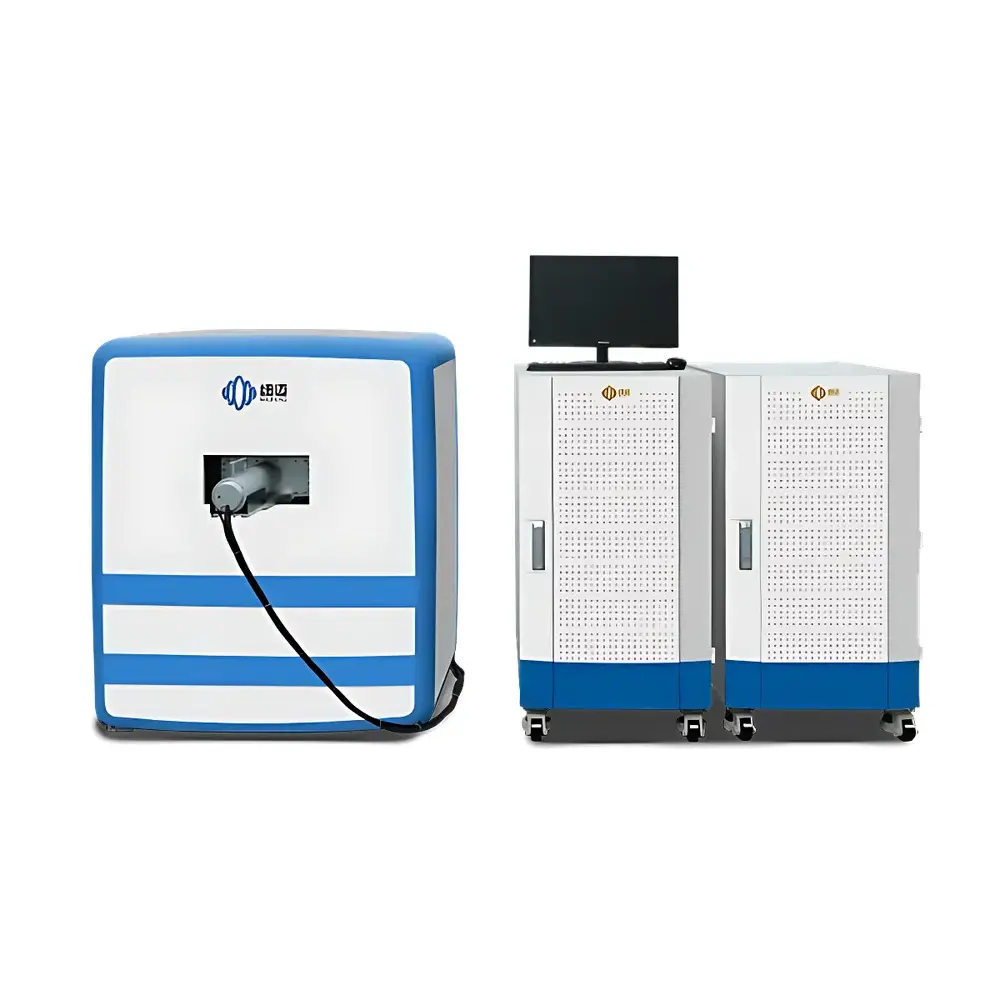
NIUMAG NM21-060H-I Low-Field Small Animal MRI Analyzer
| Brand | NIUMAG |
|---|---|
| Origin | Jiangsu, China |
| Magnet Type | Permanent Magnet |
| Field Strength | 0.5 T ± 0.03 T |
| Max Sample Dimensions | Ø68 mm × H60 mm |
| Sample Compatibility | Solid-Liquid Dual-Mode (in vivo small animals & ex vivo tissues) |
| Imaging Modes | T1-weighted, T2-weighted, Water-Fat Separation |
| Spatial Resolution | Sub-millimeter (typical in-plane resolution ≤ 0.5 mm) |
| Scan Time | ~2 minutes per standard protocol |
| Regulatory Compliance | CE-marked for research use only (RUO), compliant with ISO/IEC 17025 calibration traceability framework for NMR signal stability |
Overview
The NIUMAG NM21-060H-I is a dedicated low-field permanent-magnet small animal magnetic resonance imaging (MRI) analyzer engineered for preclinical research laboratories requiring non-invasive, longitudinal in vivo assessment without the infrastructure and operational constraints of superconducting high-field systems. Operating at a stable 0.5 T field generated by a temperature-compensated permanent magnet array, this system leverages fundamental nuclear magnetic resonance principles—specifically spin-lattice (T1) and spin-spin (T2) relaxation contrast—to generate quantitative anatomical and functional image data from live rodents. Unlike cryogen-dependent superconducting magnets, the NM21-060H-I eliminates the need for liquid helium, nitrogen, or RF-shielded rooms, enabling installation in standard biosafety level 2 (BSL-2) laboratory spaces with standard AC power and ambient temperature control. Its design prioritizes experimental reproducibility, longitudinal cohort tracking, and translational relevance—particularly in oncology, metabolic disease, neurodegeneration, and pharmacokinetic/pharmacodynamic (PK/PD) studies where repeated measurements across timepoints are essential.
Key Features
- Permanent Magnet Architecture: Zero-cryogen operation ensures continuous field stability, minimal downtime, and reduced total cost of ownership over 10+ years.
- Conscious Animal Imaging: Integrated restraint systems and acoustic noise mitigation allow imaging of awake, unrestrained, or lightly sedated mice and rats—preserving physiological homeostasis and avoiding anesthesia-induced confounding effects on cerebral perfusion, metabolism, or immune response.
- Multi-Contrast Acquisition: Supports T1-weighted, T2-weighted, and chemical shift–based water-fat separation protocols optimized for murine anatomy; enables differentiation of adipose tissue, edema, fibrosis, and tumor necrosis without exogenous contrast agents.
- Rapid Protocol Execution: Standard 2D spin-echo and gradient-echo sequences complete full-body or region-of-interest (ROI) scans in approximately two minutes, facilitating high-throughput screening of genetically modified or pharmacologically treated cohorts.
- Modular Hardware Design: Open-bore configuration (68 mm inner diameter) accommodates diverse animal positioning fixtures, physiological monitoring interfaces (respiratory gating, ECG leads), and optional RF coil upgrades (e.g., quadrature volume coils, surface coils).
Sample Compatibility & Compliance
The NM21-060H-I accepts live small mammals (mice, rats, guinea pigs) within a maximum cylindrical volume of Ø68 mm × 60 mm height. Ex vivo tissue specimens—including excised tumors, brain slices, or engineered scaffolds—are compatible under standardized sample holders. All imaging protocols adhere to internationally recognized preclinical MRI reporting standards (ARRIVE 2.0 guidelines). While classified as Research Use Only (RUO) under IVD regulatory frameworks, the system supports GLP-compliant data acquisition workflows via audit-trail-enabled software logging, electronic signatures, and exportable DICOM 3.0 datasets compatible with third-party analysis platforms (e.g., Horos, 3D Slicer, MATLAB-based toolboxes). System calibration follows ISO/IEC 17025 traceable procedures for RF pulse amplitude, gradient linearity, and field homogeneity (shimmed to ≤ 1 ppm over DSV).
Software & Data Management
NIUMAG’s proprietary MRIStudio v4.x platform provides integrated sequence programming, real-time reconstruction, and quantitative post-processing. Key modules include T1/T2 mapping (mono- and bi-exponential fitting), fat fraction quantification (IDEAL algorithm), ROI-based volumetric analysis, and dynamic contrast-enhanced (DCE) parameter extraction (Ktrans, ve). Raw k-space data is stored in vendor-neutral HDF5 format with embedded metadata (pulse sequence parameters, hardware settings, animal ID, timestamp). The software complies with FDA 21 CFR Part 11 requirements for electronic records and signatures when configured with role-based access control and encrypted database logging. Automatic backup to network-attached storage (NAS) and DICOM export ensure interoperability with institutional PACS and LIMS environments.
Applications
- Tumor xenograft growth kinetics and anti-angiogenic therapy response evaluation
- Longitudinal assessment of white matter integrity in demyelination models (e.g., EAE)
- Adipose tissue distribution mapping in diet-induced obesity and diabetes models
- In vivo validation of nanoparticle-based contrast agents (r1/r2 relaxivity profiling)
- Myocardial infarction size quantification and post-ischemic remodeling tracking
- Neuroinflammatory lesion detection in transgenic Alzheimer’s disease mouse models
FAQ
Is the NM21-060H-I suitable for regulatory submission studies?
It is designated Research Use Only (RUO) and not cleared for clinical diagnostic use. However, its data output meets FAIR (Findable, Accessible, Interoperable, Reusable) principles and has been accepted in peer-reviewed publications supporting IND-enabling toxicology packages.
What maintenance is required beyond routine cleaning?
Annual field homogeneity verification and RF coil performance calibration are recommended; no cryogen refills, vacuum pump servicing, or quench management are necessary.
Can existing high-field MRI expertise transfer to this platform?
Yes—the pulse sequence nomenclature, k-space concepts, and contrast mechanism fundamentals remain consistent; NIUMAG provides hands-on application training and protocol optimization support.
Does the system support respiratory or cardiac gating?
Yes—integrated physiological monitoring inputs enable retrospective gating and prospective triggering for motion-robust abdominal and cardiac imaging.
How is software updated and validated?
NIUMAG releases quarterly feature updates with full version-controlled release notes; each update undergoes internal IQ/OQ testing per GAMP5 guidelines and includes user-acknowledged change logs.




