
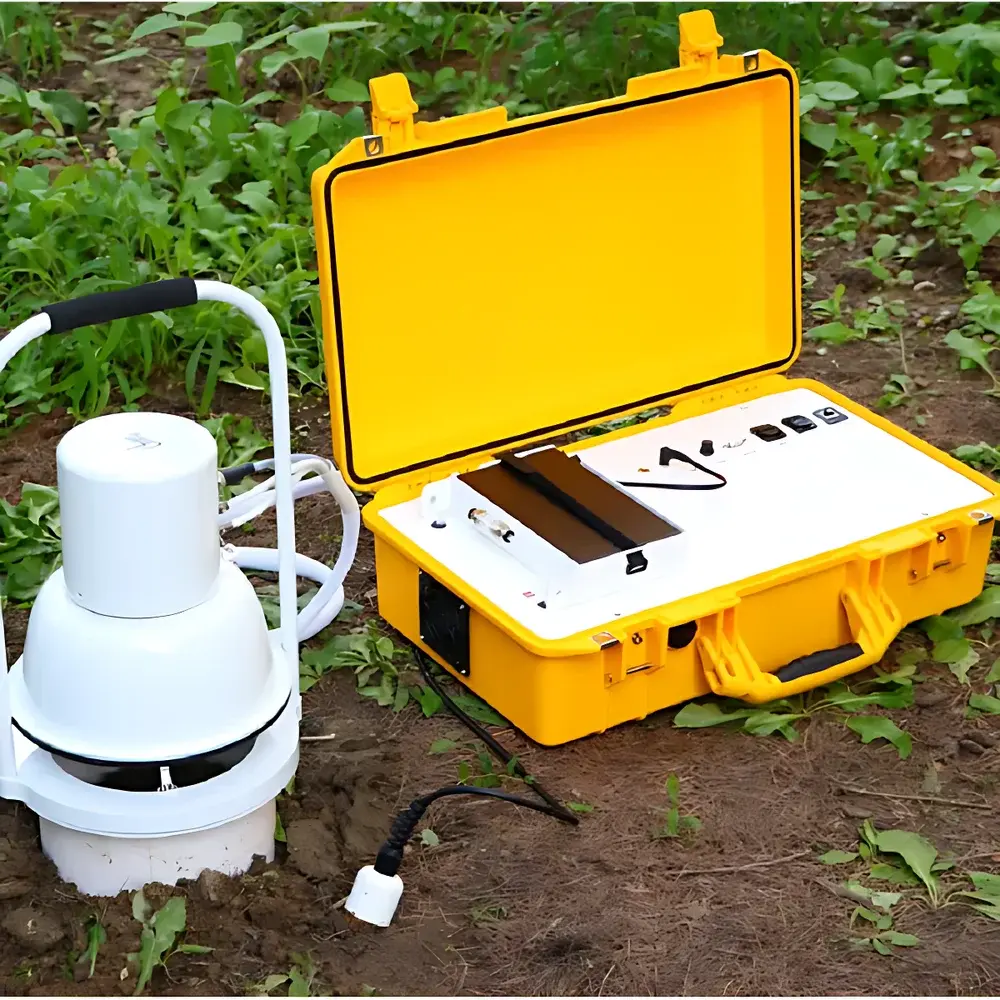
LICA PS-9600 Portable Soil Greenhouse Gas Flux Measurement System
| Brand | LICA |
|---|---|
| Model | PS-9600 |
| Measurement Principle | Cavity Ring-Down Spectroscopy (CRDS) |
| Simultaneous Target Gases | CH₄, CO₂, H₂O |
| Precision (1σ, 10 s / 100 s) | CH₄ ≤1.2 ppb / 0.6 ppb |
| Measurement Ranges | CH₄ 0–100 ppm (R² ≥ 0.9998) |
| Operating Temperature | −20 °C to +50 °C |
| Power Consumption | ≤35 W |
| Dimensions (Analyzer) | 55.38 × 35.5 × 19 cm |
| Weight (Analyzer) | 9 kg |
| SC-12 Chamber Dimensions | 27.5 × 24.5 × 44.5 cm |
| Chamber Footprint | 276.27 cm² |
| Chamber Actuation Time | ≤10 s |
| Chamber Weight | 4.05 kg |
| Data Storage | SD card |
| Communication Interfaces | RS-232, SDI-12, Wi-Fi |
| Battery | Dual rechargeable Li-ion packs included |
| Control Interface | Native Android/iOS mobile application |
Overview
The LICA PS-9600 Portable Soil Greenhouse Gas Flux Measurement System is an integrated field-deployable instrument engineered for high-precision, real-time quantification of soil-atmosphere exchange fluxes of methane (CH₄), carbon dioxide (CO₂), and water vapor (H₂O). At its core, the system employs Cavity Ring-Down Spectroscopy (CRDS)—a quantum-limited optical absorption technique offering exceptional sensitivity, stability, and specificity in trace gas detection. Unlike traditional non-dispersive infrared (NDIR) or electrochemical sensors, CRDS delivers sub-part-per-trillion (ppt) effective noise floors and eliminates cross-sensitivity through narrow-linewidth laser targeting of fundamental vibrational-rotational transitions unique to each analyte. The PS-9600 is purpose-built for eddy covariance–compatible closed-path flux measurements and chamber-based static/dynamic accumulation protocols per ISO 18587:2017 and ASTM D8177–20 guidelines. Its modular architecture couples a field-ruggedized CRDS analyzer with the SC-12 automatic soil respiration chamber, enabling autonomous, temperature-compensated, pressure-stabilized flux calculations without post-acquisition calibration or linear regression fitting.
Key Features
- Triple-gas CRDS analyzer with simultaneous, time-synchronized measurement of CH₄, CO₂, and H₂O at native temporal resolution (10 Hz data output)
- ppb-level precision: CH₄ ≤0.6 ppb (100 s average), CO₂ ≤150 ppb (100 s), H₂O ≤40 ppm (100 s) — verified against NIST-traceable standards
- Integrated embedded controller with onboard flux computation engine applying Hsieh–Wang–McMillan (HWM) and linear/nonlinear accumulation models
- Wireless operation via secure Bluetooth/Wi-Fi link to Android and iOS applications—no laptop required for setup, monitoring, or diagnostics
- Dual hot-swappable lithium-ion battery system supporting >8 hours continuous operation at 35 W nominal draw
- Ruggedized aluminum chassis rated IP54 for dust and water resistance; operating range −20 °C to +50 °C with internal thermal stabilization
- SC-12 chamber features pneumatic actuation (<10 s lid closure), integrated soil temperature (PT100) and chamber pressure (capacitive) sensors, and auto-compensation for ambient barometric drift
Sample Compatibility & Compliance
The PS-9600 is validated for use across diverse pedological matrices—including sandy loam, clay-rich vertisols, organic peatlands, and permafrost-affected tundra soils—without requiring sample pre-treatment or drying. Chamber sealing integrity is maintained across surface roughness up to 15 mm peak-to-valley via adjustable silicone gasket compression. All firmware and data logging modules comply with GLP data integrity requirements: timestamped records include audit trails for parameter changes, sensor diagnostics, and chamber cycle metadata (e.g., start/stop time, seal pressure, ambient T/P). Raw spectral data and processed flux values are stored in netCDF-4 format on removable SD cards, conforming to FAIR (Findable, Accessible, Interoperable, Reusable) principles. System design aligns with ISO/IEC 17025:2017 clause 7.7 (sampling) and supports traceability to SI units via factory calibration against CRM-certified gas standards (NIST SRM 1662a, 1663).
Software & Data Management
The LICA FieldSync mobile application provides full instrument control, live spectral visualization, real-time flux trending, and offline configuration of chamber deployment schedules (e.g., diurnal cycles, pulse-response experiments). All measurement sessions generate encrypted .nc files containing calibrated absorbance spectra, derived mixing ratios, calculated fluxes (µmol m⁻² s⁻¹), uncertainty propagation estimates (based on Allan variance analysis), and environmental metadata. Data export supports direct ingestion into R (via eddy4r and flux packages), Python (xarray, pandas), and MATLAB environments. Firmware updates and spectral library patches are delivered over-the-air (OTA) with SHA-256 signature verification. For regulated environments, optional 21 CFR Part 11-compliant user access controls, electronic signatures, and immutable audit logs are available under validated software configuration (VSC) mode.
Applications
- Long-term soil carbon balance studies in agricultural, forest, and wetland ecosystems
- Evaluation of climate-smart farming practices (e.g., cover cropping, reduced tillage, biochar amendment)
- Methane emission inventories from rice paddies, landfills, and restored peatlands
- Soil microbial respiration kinetics under controlled moisture/temperature gradients
- Validation of satellite-derived GHG flux products (e.g., OCO-3, Sentinel-5P TROPOMI)
- Field intercomparison campaigns adhering to ICOS Carbon Portal QA/QC protocols
FAQ
Does the PS-9600 require daily zero/span calibration in the field?
No. The CRDS optical cavity is inherently stable; zero reference is established via vacuum purging during factory alignment. Span validation is recommended every 90 days using certified multi-gas standards.
Can the SC-12 chamber be used with third-party analyzers?
Yes—the chamber outputs analog voltage signals (0–5 V) and digital SDI-12 commands compatible with most commercial GHG analyzers meeting IEC 61000-4-3 EMI immunity Class B.
Is GPS geotagging supported?
Yes. Internal GNSS module (GPS/GLONASS/Galileo) embeds WGS84 coordinates and UTC timestamps directly into each netCDF file header.
What is the minimum detectable flux for CH₄ under typical field conditions?
At 30-minute chamber closure with 25 °C soil temperature and 20% volumetric water content, the system achieves a 95% confidence limit of ±0.08 nmol m⁻² s⁻¹ for CH₄.
How is temperature-dependent CO₂ solubility in soil pore water accounted for?
The embedded algorithm applies Henry’s law correction using concurrent soil temperature and estimated pore-water pH (derived from soil texture and organic matter content databases).
Related Products







