
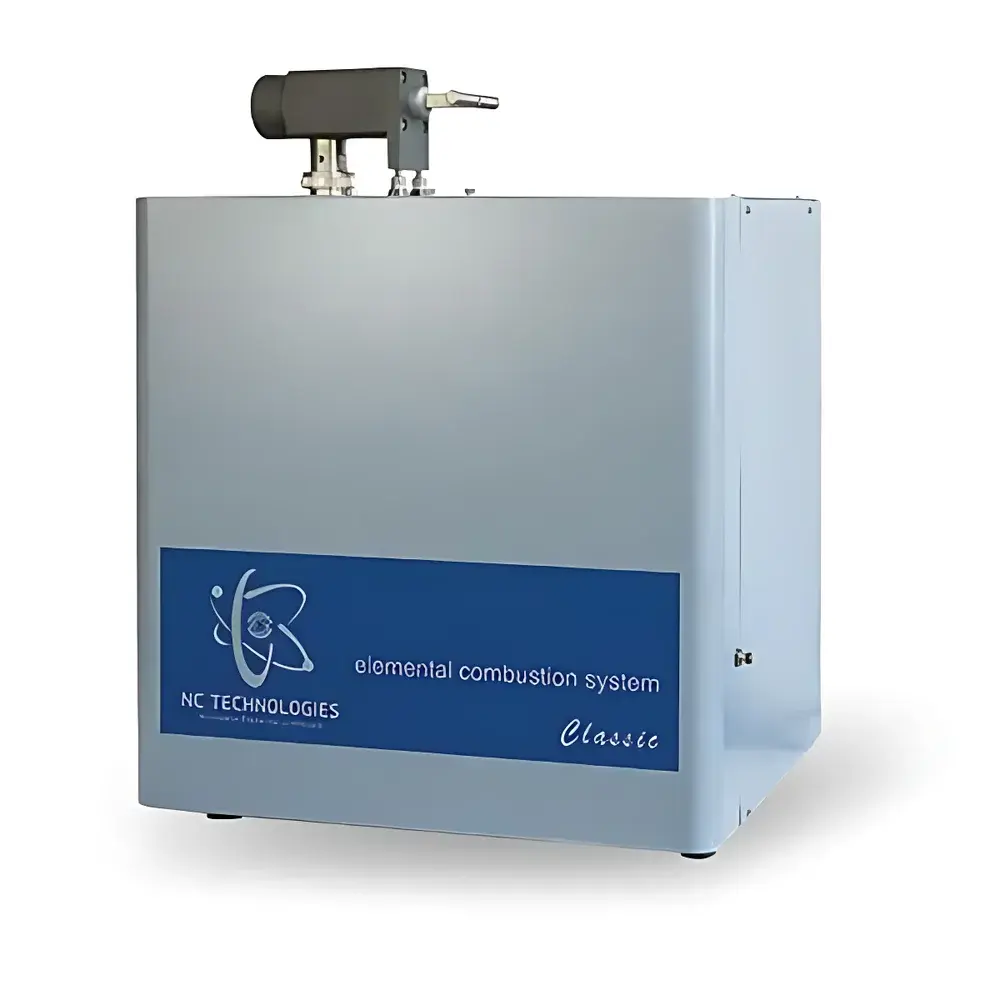
NC Technologies ECS 4010 Classic CHNS-O Elemental Analyzer
| Brand | NC Technologies |
|---|---|
| Origin | Italy |
| Model | ECS 4010 Classic CHNS-O Elemental Analyzer |
| Detection Principle | Flash Combustion coupled with Gas Chromatographic Separation |
| Elements Analyzed | C, H, N, S, O |
| Detection Range | 200 ppm – 100% |
| Sample Mass | 0.01–100 mg (matrix-dependent) |
| Accuracy | < 0.2% (vs. certified reference materials) |
| Precision | < 0.1% RSD (vs. certified reference materials) |
| Column Temperature Control | 30–110 °C (user-programmable) |
| Oxidation Reactor Temp | 800–1100 °C |
| Reduction Reactor Temp | 600–1100 °C |
| Analysis Time | ~15 min (CHNS), ~3 min (CN only, 2-m column) |
| Detector | Thermal Conductivity Detector (TCD) |
| LOQ | 1–5 µg |
| Auto-samplers | Pneumatic (up to 147 positions), Electronic (32/50/100 positions), Manual |
| Software | EAS CLARITY v.x.x (Windows OS) |
| Gas Requirements | He (99.999%, 3–5 bar), O₂ (99.999%, 3–5 bar), Oil-free Dry Compressed Air |
| Dimensions | 760 × 350 × 700 mm (L×W×H) |
| Power | 230 VAC ±10%, 1–10 A |
Overview
The NC Technologies ECS 4010 Classic CHNS-O Elemental Analyzer is a high-performance, microprocessor-controlled combustion-based instrument engineered for the quantitative determination of carbon (C), hydrogen (H), nitrogen (N), sulfur (S), and oxygen (O) in organic and selected inorganic matrices. It implements the Dumas combustion method—standardized under ASTM D5291, ISO 11843, and EN 15407—where samples are flash-combusted in a high-temperature oxygen-rich environment (800–1100 °C oxidation zone), followed by catalytic reduction (600–1100 °C) and chromatographic separation of gaseous products (CO₂, H₂O, SO₂, N₂) on a thermostatically controlled capillary or packed GC column. The system eliminates nitrogen background interference through proprietary gas management and employs a robust thermal conductivity detector (TCD) with sub-microgram detection limits (LOQ: 1–5 µg). Designed for laboratory environments requiring GLP/GMP compliance, the ECS 4010 supports audit-trail-enabled data handling and integrates seamlessly into regulated workflows governed by FDA 21 CFR Part 11.
Key Features
- Full automation with three configurable autosampler options: pneumatic carousel (stackable, up to 147 positions), electronic turntable (32/50/100 positions), or manual loading—enabling unattended overnight operation.
- Independent, user-programmable column oven temperature control (30–110 °C), ensuring optimal resolution of CO₂, H₂O, SO₂, and N₂ peaks across diverse sample types.
- No reference gas required for TCD baseline stabilization—reducing operational complexity and consumable dependency.
- Dual-stage reactor architecture: high-efficiency Pt-coated quartz oxidation tube and Ni/Cu-based reduction furnace, both thermally isolated and independently controllable.
- Modular detector interface supporting direct coupling to isotope-ratio mass spectrometers (IRMS) for δ¹³C, δ¹⁵N, δ¹⁸O, and δ³⁴S analysis without hardware modification.
- Low total cost of ownership: minimal consumables (no carrier gas switching valves, no sacrificial traps), extended catalyst lifetime (>2000 injections), and field-replaceable combustion tubes.
Sample Compatibility & Compliance
The ECS 4010 accommodates solid, liquid, and viscous samples—including powders, pellets, films, slurries, and filter-captured particulates—within a mass range of 0.01–100 mg. Its broad dynamic range (200 ppm to 100 wt%) and high reproducibility (<0.1% RSD on CRM replicates) meet stringent requirements for ISO/IEC 17025-accredited testing laboratories. Instrument validation follows IQ/OQ/PQ protocols aligned with USP , ASTM E2656, and EU Pharmacopoeia 2.2.37. All calibration curves support linear, quadratic, and cubic regression models with active recalibration capability—critical for long-term stability monitoring in QC environments subject to periodic requalification.
Software & Data Management
EAS CLARITY software provides full instrument control, real-time chromatogram visualization, peak integration, elemental quantification, and report generation compliant with 21 CFR Part 11. Audit trails log all user actions, parameter changes, and result modifications with timestamped digital signatures. Data export formats include CSV, XML, and PDF; raw chromatographic files (.raw) retain full metadata for retrospective reprocessing. The software supports multi-user role-based access control (RBAC), electronic signatures, and automated backup to network drives or cloud storage via secure SMB/FTP protocols.
Applications
The ECS 4010 serves as a core analytical platform across regulated and research-intensive domains: pharmaceutical development (API purity, excipient characterization), polymer science (backbone stoichiometry, additive quantification), agrochemical QA/QC (fertilizer N-content, pesticide C/H/N ratios), environmental monitoring (soil organic carbon, sediment TOC/TN, wastewater particulate composition), petrochemical analysis (coal rank assessment, fuel heteroatom profiling), and forensic toxicology (biological matrix screening). Its O-determination mode—based on pyrolytic decomposition in graphite-packed reactors—meets ISO 11751 for oxygen content in polymers and ASTM D7359 for halogen/oxygen co-analysis.
FAQ
What combustion principle does the ECS 4010 use?
It employs high-temperature flash combustion (Dumas method) in pure oxygen, followed by catalytic reduction and gas chromatographic separation.
Is the system compliant with FDA 21 CFR Part 11?
Yes—EAS CLARITY software includes electronic signature, audit trail, and role-based access controls required for regulated environments.
Can the ECS 4010 be interfaced with an IRMS?
Yes—its universal detector port supports direct, pressure-stabilized coupling to isotope-ratio mass spectrometers without intermediate cryo-trapping.
What gases are required for operation?
Helium (99.999%, 3–5 bar), oxygen (99.999%, 3–5 bar), and oil-free dry compressed air for pneumatic components.
How often must the combustion catalyst be replaced?
Under typical usage (≤10 samples/day), the Pt/Ni/Cu catalyst maintains performance for ≥2000 analyses before scheduled replacement.
Does the system require external cooling water or liquid nitrogen?
No—thermal management is fully air-cooled; no ancillary utilities beyond standard lab power and gas supplies are needed.





