
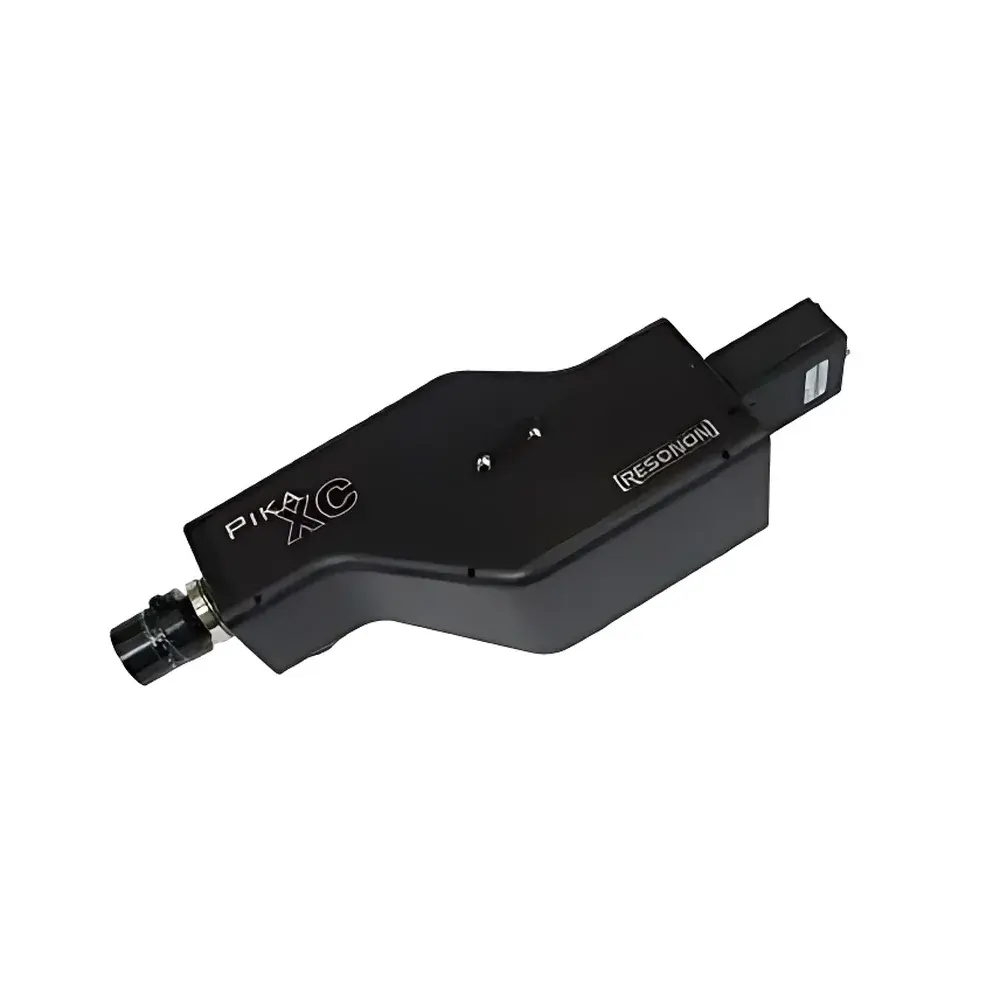
Resonon Pika XC Hyperspectral Imaging Spectrometer
| Brand | Resonon |
|---|---|
| Origin | USA |
| Model | Pika XC |
| Operating Principle | Push-broom |
| Imaging Method | Dispersive |
| Platform Compatibility | Ground-based & Airborne |
| Spectral Range | 400–1000 nm |
| Spectral Resolution | 2.4 nm |
| Spatial Pixels | 1384 |
| Frame Rate | 240 fps |
| Field of View (TFOV) | 7.2°, 10.0°, 21.5°, 29.0°, 40.0°, 57.5°, or 72.0° (selectable) |
| Instantaneous Field of View (IFOV) | 0.36, 0.5, 1.1, 1.5, 2.1, 3.1, or 4.2 mrad (selectable) |
| Bit Depth | 14-bit |
| Power Requirement | 8–30 VDC, <2.5 W |
| Weight | 1.9 kg |
| Dimensions | 12.4 × 23.9 × 21.0 cm |
| Operating Temperature | 0–45 °C |
| f-number | f/2.4 |
| RMS Spot Radius (avg.) | 6 µm |
| Smile (peak-to-peak) | 2 µm |
| Keystone (peak-to-peak) | 6 µm |
| Interface | IEEE 1394b |
Overview
The Resonon Pika XC is a high-performance, compact push-broom hyperspectral imaging spectrometer engineered for precision spectral-spatial data acquisition across visible and near-infrared (VNIR) wavelengths (400–1000 nm). Utilizing a dispersive optical architecture with a high-fidelity transmission grating and optimized relay optics, the Pika XC captures contiguous spectral bands at 2.4 nm resolution across 240 channels, while maintaining exceptional spatial fidelity—1384 spatial pixels per line—with minimal geometric distortion. Its push-broom design enables stable, line-scan-based acquisition ideal for both ground-based laboratory setups and airborne remote sensing platforms, including UAVs and manned aircraft. The system’s robust thermal stability, low power consumption (<2.5 W), and lightweight form factor (1.9 kg) make it suitable for integration into resource-constrained mobile systems without compromising radiometric integrity or spatial accuracy.
Key Features
- Optimized VNIR performance with enhanced sensitivity in the blue and near-UV regions (400–500 nm), supporting applications such as pigment identification, chlorophyll fluorescence analysis, and mineralogical mapping.
- Ultra-low optical distortion: peak-to-peak smile ≤ 2 µm and keystone ≤ 6 µm ensure high-fidelity pixel registration across all spectral bands—critical for quantitative pixel-wise spectral unmixing and classification.
- C-mount compatibility with any 2/3″ format CCD or CMOS sensor, enabling flexible integration with cooled, high-speed, or back-illuminated detectors to meet application-specific SNR or temporal resolution requirements.
- Modular field-of-view configuration: seven interchangeable TFOV options (7.2° to 72.0°) and corresponding IFOVs (0.36–4.2 mrad) allow precise adaptation to working distance, altitude, and ground sampling distance (GSD) constraints.
- IEEE 1394b interface ensures deterministic real-time data streaming at up to 240 full-frame lines per second, supporting high-throughput scanning without frame buffering bottlenecks.
- Factory-calibrated radiometric response with NIST-traceable reference sources; supports user-performed radiance and reflectance calibration using standardized panels and lamp-based protocols.
Sample Compatibility & Compliance
The Pika XC operates as a non-contact, non-destructive spectral imager and requires no sample preparation. It is compatible with solid, liquid, and particulate samples mounted on translation stages, conveyor belts, or deployed in open-field environments. Its optical design meets ANSI Z80.10 and ISO 15370-2 standards for imaging spectrometer performance characterization. For regulated environments—including environmental monitoring, agricultural QA/QC, and pharmaceutical raw material screening—the system supports audit-ready data capture when used with SpectrononPro software configured for GLP-compliant metadata logging (including timestamp, GPS coordinates, exposure settings, and calibration state). While not inherently FDA 21 CFR Part 11 certified, its API-driven architecture allows integration into validated workflows meeting Part 11 requirements via third-party electronic lab notebook (ELN) or LIMS platforms.
Software & Data Management
Data acquisition, preprocessing, and basic analysis are performed using Resonon’s SpectrononPro—a Windows-based application supporting real-time preview, dark/current correction, spectral library matching (e.g., USGS, JPL, ECOSTRESS), and ENVI-compatible export (BIL/BIP/BSQ). The Pika XC also provides a comprehensive C++ API (freely available under NDA) enabling direct integration into custom MATLAB, Python (via pywin32 or ctypes), or LabVIEW environments. The API exposes low-level control over exposure time, trigger mode (free-run, hardware sync, software trigger), ROI selection, and raw frame buffer access—facilitating automated inline inspection, closed-loop feedback systems, and embedded edge-processing pipelines. All acquired hypercubes are stored in standard HDF5 or ENVI format with embedded geotags, radiometric metadata, and sensor configuration logs.
Applications
- Agricultural phenotyping: Detection of nitrogen stress, water status, and disease onset via narrowband vegetation indices (e.g., NDVI, PRI, MCARI) derived from calibrated reflectance cubes.
- Environmental remote sensing: Mapping of invasive species, soil organic carbon content, and surface hydrocarbon contamination using spectral absorption features between 400–1000 nm.
- Industrial quality control: Real-time sorting of plastics, food contaminants, or pharmaceutical tablets based on spectral fingerprinting and supervised machine learning classifiers (SVM, Random Forest).
- Forensic document analysis: Discrimination of ink types, erased alterations, and substrate aging through subtle spectral shifts in the blue-NIR region.
- Materials science research: Characterization of thin-film coatings, semiconductor wafers, and photovoltaic absorbers using spatially resolved reflectance and transmittance spectroscopy.
FAQ
Does the Pika XC require external cooling for stable operation?
No. The instrument is passively cooled and rated for continuous operation from 0–45 °C without active thermal management. Its optical bench and detector mounting are designed for minimal thermal drift, ensuring <0.5-pixel spectral shift over 2-hour acquisitions at ambient temperature fluctuations ±5 °C.
Can the Pika XC be synchronized with external sensors (e.g., GPS, IMU)?
Yes. Hardware trigger input/output ports support TTL-level synchronization with GNSS/INS units. SpectrononPro logs timestamps with microsecond resolution, enabling post-hoc georeferencing with sub-meter accuracy when paired with RTK-GPS and attitude data.
Is radiometric calibration included with purchase?
A factory-applied relative spectral response (RSR) calibration is provided. Absolute radiance calibration kits—including integrating sphere sources and reflectance standards—are available as optional accessories and supported by SpectrononPro’s calibration workflow module.
What is the maximum effective data rate over IEEE 1394b?
At full resolution (1384 × 240 pixels, 14-bit), the sustained throughput is 1.2 GB/min (~20 MB/s), well within the 800 Mbps bandwidth limit of IEEE 1394b. Lossless compression (Huffman-coded) is available to reduce storage footprint without spectral fidelity loss.
How does the Pika XC handle stray light in outdoor conditions?
The optical train incorporates multi-stage baffling, blackened internal surfaces, and an optimized grating blaze function to suppress out-of-band scatter. Measured stray light rejection exceeds OD 4.5 across the 400–1000 nm range, minimizing spectral crosstalk during high-dynamic-range solar illumination scenarios.



