
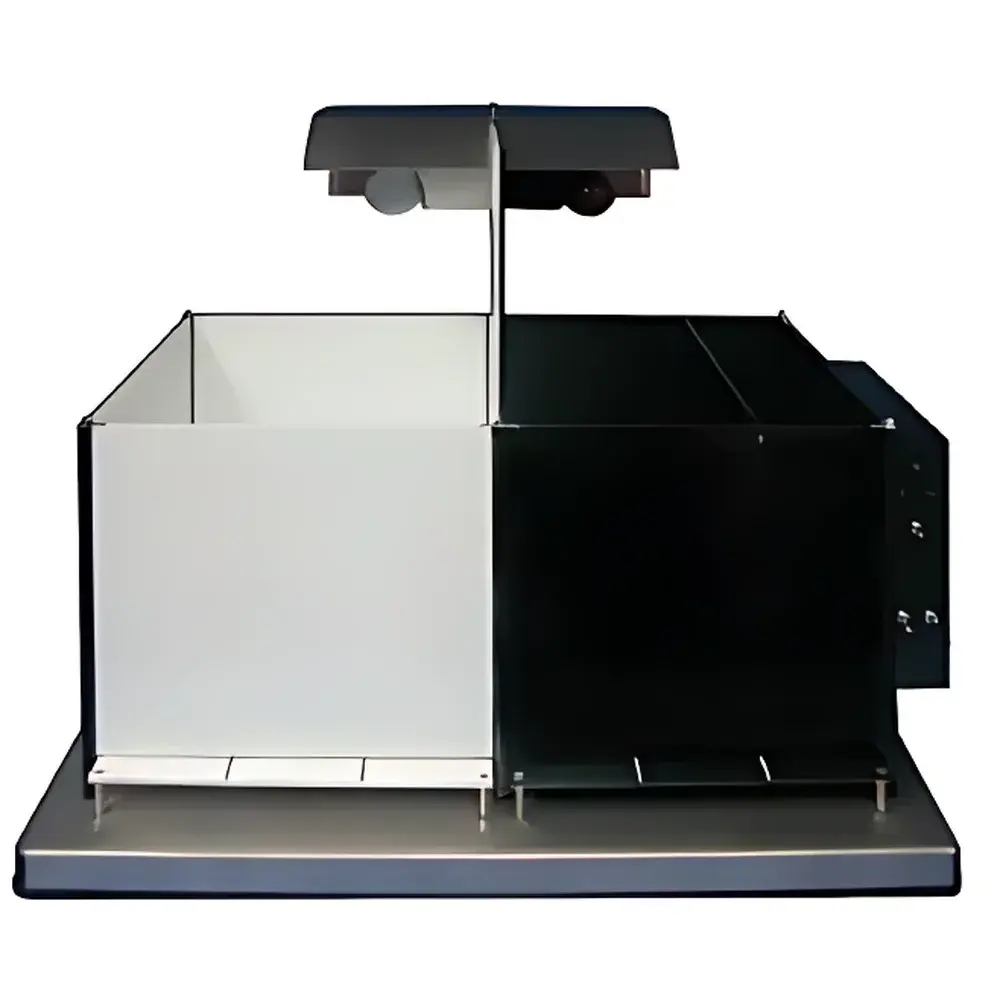
Panlab Harvard Apparatus LE810/812/816/818 Light-Dark Box System for Rodent Anxiety Assessment
| Brand | Harvard Apparatus |
|---|---|
| Origin | USA |
| Model | LE810 (mouse), LE812 (rat), LE816 (mouse, automated), LE818 (rat, automated) |
| Chamber Dimensions (mouse) | Light chamber 240 × 250 × 250 mm |
| Chamber Dimensions (rat) | Light chamber 240 × 310 × 310 mm |
| Detection | Load-cell-based position sensing |
| Interface | RS-232 serial communication |
| Software | PPCWIN v3.x (Windows-compatible) |
| Compliance | Designed for GLP-aligned behavioral phenotyping workflows |
Overview
The Panlab Harvard Apparatus Light-Dark Box System (Models LE810, LE812, LE816, LE818) is a standardized, ethologically grounded apparatus engineered for the quantitative assessment of unconditioned anxiety-related behavior in rodents. Based on the natural aversion to brightly illuminated spaces and the innate preference for enclosed, dimly lit environments, this two-compartment test exploits the conflict between exploratory drive and light-avoidance motivation. Unlike shuttle-box paradigms requiring aversive stimuli such as foot shock, the light-dark box relies solely on ambient illumination contrast—white light (100 W cool-white lamp) in the open, spacious light chamber versus red light (40 W deep-red lamp, λ > 620 nm) in the smaller, partially enclosed dark chamber—to elicit measurable behavioral responses. The system operates under the principle that increased time spent in or transitions into the aversive light compartment reflect reduced anxiety-like behavior, whereas prolonged latency to first entry and preferential retention in the dark chamber indicate heightened anxiety states. Its design adheres to established rodent behavioral testing guidelines (e.g., OECD TG 425, NIH Behavioral Test Battery recommendations) and supports reproducible, observer-independent data acquisition.
Key Features
- Modular, tool-free chamber assembly with reversible panel configuration—enabling rapid disassembly, thorough cleaning, and cross-species adaptation between mouse and rat protocols.
- Load-cell–based detection system providing high-resolution, contactless spatial tracking without visual occlusion or animal restraint—ensuring minimal experimental artifact and superior signal-to-noise ratio compared to infrared beam or video-based alternatives.
- Dual-wavelength illumination architecture: calibrated white-light source (CCT ≈ 5000 K, photopic lux ≥ 300 at floor level) and spectrally filtered red-light source (peak emission > 620 nm, scotopic-compatible) to preserve rodent circadian integrity while maximizing contrast perception.
- Standardized aperture geometry (70 × 70 mm for mice; 100 × 100 mm for rats) aligned with IACUC-recommended transit thresholds—minimizing false-positive entries and ensuring consistent inter-laboratory comparability.
- RS-232 digital interface enabling real-time bidirectional communication with host PC—supporting synchronized stimulus control, timestamped event logging, and hardware-triggered protocol branching (e.g., conditional lighting changes upon first entry).
Sample Compatibility & Compliance
The system is validated for use with C57BL/6, BALB/c, Swiss Webster, Sprague-Dawley, and Wistar strains across standard age ranges (postnatal day 60–120). Chamber dimensions comply with NIH Office of Laboratory Animal Welfare (OLAW) space allowance standards and EU Directive 2010/63/EU Annex VIII requirements for behavioral housing during testing. All materials meet USP Class VI biocompatibility specifications and are autoclavable (up to 121°C, 15 psi). Data acquisition workflows support ALCOA+ principles (Attributable, Legible, Contemporaneous, Original, Accurate, Complete, Consistent, Enduring, Available) and are compatible with 21 CFR Part 11–compliant audit trail extensions when deployed with validated PPCWIN configurations.
Software & Data Management
PPCWIN v3.x provides a dedicated, experiment-centric interface for defining session parameters (duration: 1–30 min; sampling rate: 10 Hz), calibrating load-cell baselines, and generating standardized output metrics—including latency to first light-chamber entry, total time in each compartment (s), number of transitions, duration of first dark-chamber exit, and velocity-corrected path efficiency. Raw binary sensor logs are stored in HDF5 format for traceability; summary reports export to CSV, Excel, and PDF with embedded metadata (operator ID, animal ID, date/time stamp, environmental conditions). Software validation documentation (IQ/OQ/PQ protocols) is available upon request for GCP/GLP-regulated studies.
Applications
This system is routinely employed in preclinical pharmacology for screening anxiolytic and anxiogenic compounds (e.g., benzodiazepines, SSRIs, CRF antagonists), genetic model characterization (e.g., knockout/knock-in lines with altered HPA axis function), neurodevelopmental disorder modeling (e.g., prenatal stress, maternal separation), and chronic stress paradigm validation (e.g., social defeat, restraint). It serves as a Tier-1 assay in integrated behavioral batteries alongside elevated plus maze, open field, and novelty-suppressed feeding tests—providing orthogonal validation of anxiety-related endophenotypes.
FAQ
What is the recommended acclimation period prior to testing?
Animals should be habituated to the testing room for ≥ 60 minutes under controlled ambient lighting (≤ 100 lux) to minimize acute stress confounds.
Can the system be used for longitudinal repeated-measures designs?
Yes—provided chambers are thoroughly cleaned between sessions with 70% ethanol followed by distilled water rinse to eliminate olfactory cues; inter-session interval must exceed 48 hours to avoid residual memory effects.
Is PPCWIN compatible with modern Windows OS versions?
PPCWIN v3.4.2 supports Windows 10 (64-bit) and Windows 11 via native .NET Framework 4.8 runtime; virtualization options (e.g., VMware Workstation) are validated for legacy OS dependency scenarios.
How is calibration performed for the load-cell array?
Calibration uses factory-provided reference weights (10 g, 50 g, 200 g); full procedure is documented in the Hardware Maintenance Manual (Rev. D) and requires ≤ 5 minutes per unit.
Does the system support integration with third-party video tracking platforms?
While PPCWIN operates independently, analog TTL sync pulses (0–5 V) are available via DB9 breakout for frame-locked synchronization with EthoVision XT, Noldus AnyMaze, or custom MATLAB/Python acquisition pipelines.



