
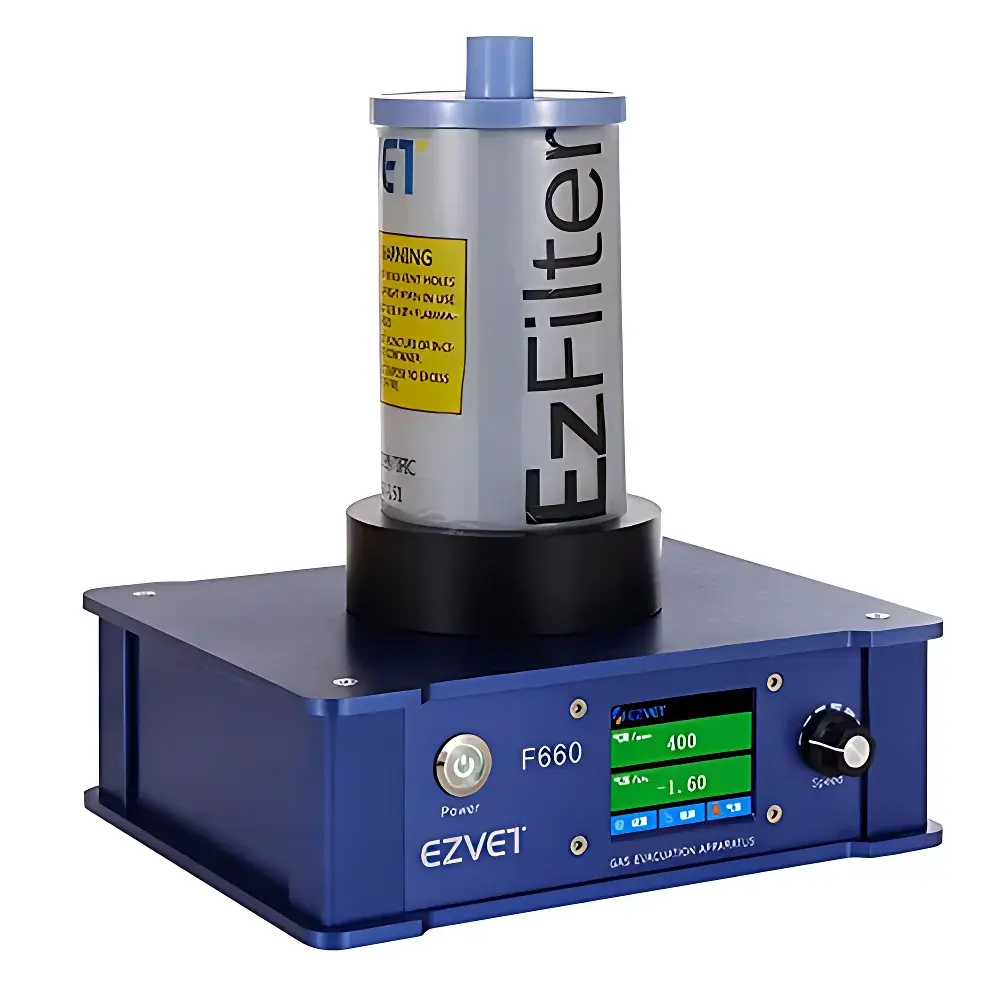
Animal Anesthesia Waste Gas Scavenging System F660
| Origin | Beijing, China |
|---|---|
| Manufacturer Type | Authorized Distributor |
| Product Origin | Domestic (China) |
| Model | F660 |
| Price Range | USD 140 – 700 |
| Filtration Capacity | Fluosorber™ Sorbent Cartridge (Initial Mass: 1200 g |
| Replacement Threshold | ≥1400 g) |
| Absorbed Agents | Sevoflurane, Isoflurane, Halothane (CF₃CHClBr) |
| Not Absorbed | Nitrous Oxide (N₂O) |
| Flow Rate Range | 8–60 L/min |
| Noise Level | <20 dB(A) |
| Display | Color Touchscreen with Real-time Flow & Pressure Monitoring |
| Compliance | Designed for alignment with OSHA 1910.134, NIOSH REL (2 ppm TWA for isoflurane/sevoflurane), and institutional EH&S requirements |
Overview
The Animal Anesthesia Waste Gas Scavenging System F660 is an engineered engineering solution for the safe capture and chemical adsorption of volatile halogenated anesthetic agents—primarily sevoflurane, isoflurane, and halothane—released during small-animal inhalation anesthesia procedures. Operating on negative-pressure scavenging principles, the F660 integrates a high-efficiency air pump with a replaceable Fluosorber™ sorbent cartridge to actively draw exhaled or leaked anesthetic-laden air from induction chambers, nose cones, or semi-closed breathing circuits. Unlike passive charcoal filters, this system employs flow-controlled active extraction, ensuring consistent removal efficiency across variable experimental setups. Its design directly addresses occupational exposure risks identified by NIOSH, where time-weighted average (TWA) exposure limits for isoflurane and sevoflurane are set at 2 ppm over an 8-hour workday. Detection of odor—a reliable sensory indicator—correlates with concentrations exceeding this threshold and may precede symptoms such as dizziness, headache, or nausea in laboratory personnel.
Key Features
- Negative-pressure scavenging architecture with adjustable flow control (8–60 L/min) via precision Speed dial and real-time LED display
- Fluosorber™-based sorbent cartridge (initial mass: 1200 g) optimized for selective chemisorption of sevoflurane, isoflurane, and halothane; not effective for nitrous oxide (N₂O)
- Weight-based end-of-life monitoring: automatic alert triggered when cartridge mass reaches ≥1400 g, indicating saturation
- Ultra-low-noise operation (<20 dB[A]) achieved through quadruple acoustic damping and vibration-isolated motor mounting
- Full-color capacitive touchscreen interface displaying instantaneous flow rate, static pressure differential, and system status
- One-touch mute function to suppress audible alerts during weight-alarm events without disabling safety monitoring
- Compact footprint and modular housing compatible with standard lab benchtops and animal procedure stations
- Interoperable with third-party anesthesia machines—including VetEquip, Kent Scientific, and SurgiVet systems—via standardized 22 mm OD tubing connections
Sample Compatibility & Compliance
The F660 is validated for use with standard rodent and lagomorph inhalation anesthesia workflows utilizing isoflurane or sevoflurane delivered via calibrated vaporizers. It supports both induction chamber and nose-cone delivery configurations and maintains performance under variable backpressure conditions typical of semi-open or non-rebreathing circuits. The system does not interfere with anesthetic agent concentration delivery to the subject. From a regulatory standpoint, the F660 supports institutional compliance with OSHA Respiratory Protection Standard (29 CFR 1910.134), NIOSH Recommended Exposure Limits (RELs), and internal Environmental Health & Safety (EH&S) protocols governing airborne anesthetic agent monitoring. While the device itself is not FDA-cleared or CE-marked as a medical device, its operational parameters and sorbent chemistry align with GLP-aligned laboratory infrastructure requirements for occupational hazard mitigation.
Software & Data Management
The F660 operates as a standalone hardware platform with embedded firmware—no external PC or proprietary software installation required. All operational data (flow rate, pressure delta, runtime hours, and alarm history) are stored locally in non-volatile memory and accessible via the touchscreen interface. Timestamped event logs—including cartridge weight alerts and mute activations—are retained for up to 30 days and can be exported via USB-C for audit trail documentation. The system supports 21 CFR Part 11–compatible audit logging when integrated into institutional LIMS or EH&S reporting platforms using manual export protocols. No cloud connectivity or remote telemetry is implemented, preserving data sovereignty and network security in regulated research environments.
Applications
- Routine inhalational anesthesia in academic and pharmaceutical preclinical research involving mice, rats, and rabbits
- Long-duration surgical procedures requiring stable anesthetic maintenance and minimal operator exposure
- Core facility shared-use labs where cross-study contamination control and staff rotation necessitate standardized scavenging protocols
- Teaching laboratories conducting hands-on animal anesthesia training under IACUC-approved SOPs
- Facility-wide EH&S initiatives targeting measurable reduction in ambient anesthetic gas concentrations (verified via periodic NIOSH Method 5031 sampling)
FAQ
What anesthetic agents does the F660 effectively remove?
The F660 is validated for sevoflurane, isoflurane, and halothane (CF₃CHClBr). It does not adsorb nitrous oxide (N₂O) due to fundamental differences in molecular polarity and binding affinity with the Fluosorber™ sorbent matrix.
How often must the Fluosorber™ cartridge be replaced?
Replacement is determined by mass gain—not time. The cartridge must be changed when its total weight reaches or exceeds 1400 g, indicating full saturation. Initial mass is 1200 g; weight tracking is performed manually using a calibrated analytical balance prior to installation and at routine intervals.
Can the F660 be used with non-standard anesthesia delivery systems?
Yes. The unit accepts standard 22 mm OD flexible tubing and accommodates inlet pressures typical of veterinary-grade vaporizers. Compatibility testing is recommended for custom-built or legacy anesthesia rigs.
Does the F660 require calibration or preventive maintenance?
No scheduled calibration is required. Routine visual inspection of tubing integrity, filter housing seals, and pump intake grilles is advised biweekly. Motor brushes are rated for >20,000 hours of continuous operation.
Is the F660 suitable for use in biosafety cabinets or ventilated enclosures?
It is not designed for integration inside Class II BSCs due to airflow interference. However, it may be positioned externally with ducting routed through dedicated wall ports to maintain cabinet face velocity and containment integrity.






