
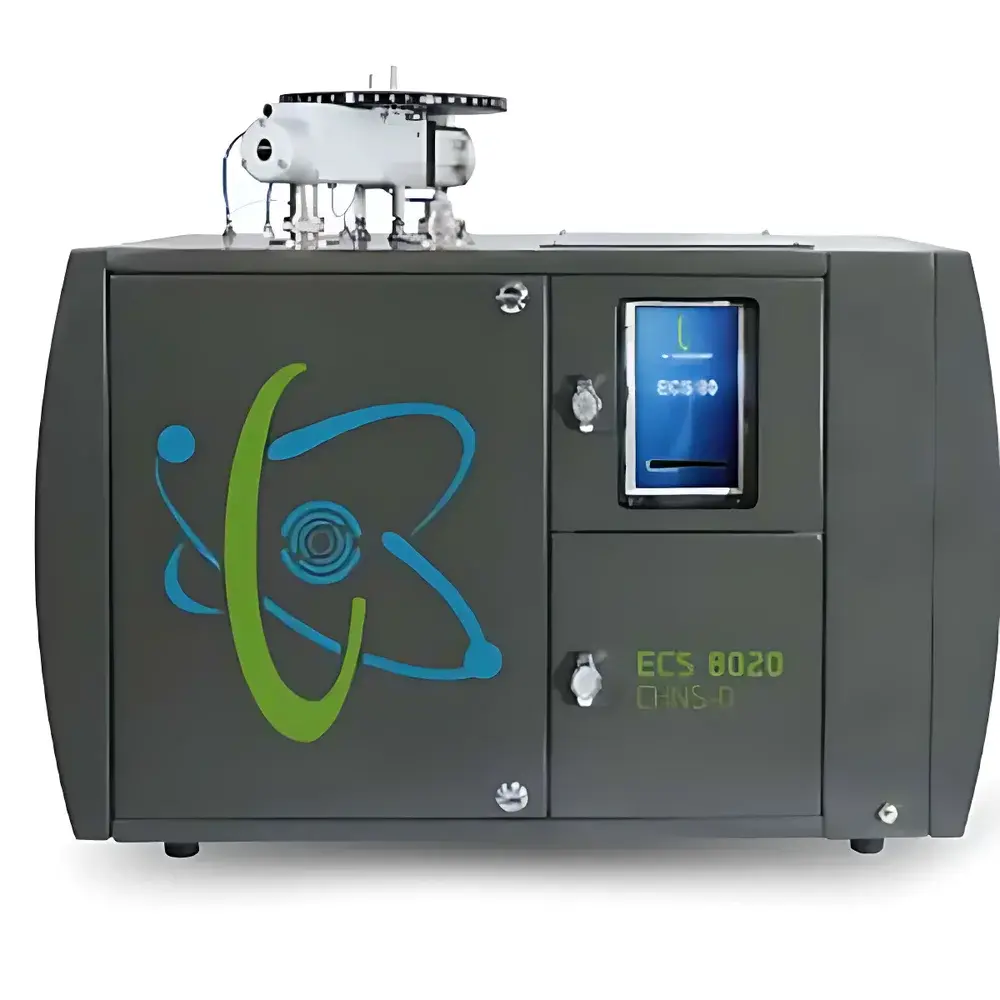
NC Technologies ECS 8020 CHNS-O Organic Elemental Analyzer
| Brand | NC Technologies |
|---|---|
| Origin | Italy |
| Model | ECS 8020 CHNS-O Organic Elemental Analyzer |
| Measurement Principle | Dumas combustion coupled with gas chromatographic separation and thermal conductivity detection (TCD) |
| Elemental Modes | CHNS, CHN, CN, CNS, O |
| Sample Types | Solid and liquid |
| Sample Weight Range | C/H/N/S: 0.002–20 mg |
| O | 0.002–2 mg |
| Analysis Time | CHN: 5 min |
| CHNS | 10–25 min |
| O | 4 min |
| Accuracy | <0.2% (certified reference materials, purity >99.9%) |
| Precision (RSD) | <0.1% |
| Dual Combustion Furnaces | Max. 1100 °C each |
| Separation Oven Temp. | Up to 110 °C |
| Carrier Gas | Helium |
| Oxygen Delivery | Integrated mass-flow controlled O₂ dosing |
| GC Column Length | 0.8–4 m |
| Detector | High-sensitivity TCD, reference-gas-free operation |
| Autosamplers | Pneumatic (147 positions), electronic (32/50/100 positions), manual |
| Software | EAS Clarity v.x.x with linear/quadratic/cubic calibration, active recalibration, audit trail, GLP-compliant data handling |
| Compliance | Designed for ISO 17025, ASTM D5291, ASTM D7622, USP <28>, EN 15407, and FDA 21 CFR Part 11-ready configurations |
Overview
The NC Technologies ECS 8020 CHNS-O Organic Elemental Analyzer is a high-performance, Dumas combustion-based instrument engineered for the precise quantification of carbon (C), hydrogen (H), nitrogen (N), sulfur (S), and oxygen (O) in organic matrices. It operates on the principle of flash combustion at controlled high temperatures (up to 1100 °C per furnace), followed by catalytic oxidation, selective gas separation via dedicated capillary or packed GC columns (0.8–4 m), and quantitative detection using a high-sensitivity, reference-gas-free thermal conductivity detector (TCD). Unlike Kjeldahl or classical wet-chemistry methods, the ECS 8020 eliminates hazardous reagents, reduces analyst exposure, and delivers rapid, reproducible results across heterogeneous sample types—including pharmaceuticals, polymers, agrochemicals, foodstuffs, soils, and biofuels—without matrix-specific method development.
Key Features
- Dual independent combustion furnaces (left/right), each rated to 1100 °C, enabling optimized catalyst staging and complete oxidation of refractory compounds including nitrates, sulfones, and heterocyclics.
- Integrated, mass-flow-controlled oxygen dosing system with real-time O₂ volume calculation—eliminating manual calibration and ensuring stoichiometric combustion consistency across sample loads.
- Modular gas separation module with temperature-stabilized oven (up to 110 °C) and application-tuned GC columns for baseline-resolved elution of CO₂, H₂O, N₂, SO₂, and CO (for O determination via pyrolysis).
- Reference-gas-free TCD architecture—reducing consumable dependency, minimizing baseline drift, and enhancing long-term signal stability under routine QC conditions.
- Three autosampler options: pneumatic (147-position carousel), electronic (32/50/100 positions), and manual—supporting unattended overnight runs and seamless integration into regulated lab workflows.
- Touchscreen HMI with real-time catalyst status monitoring, gas consumption tracking, and dynamic power management—including low-energy standby mode that preserves furnace conditioning while reducing He and O₂ consumption by >65% during idle periods.
Sample Compatibility & Compliance
The ECS 8020 accommodates solid powders, pellets, films, tablets, and homogeneous liquids without derivatization or pre-treatment. Sample weights range from 0.002 mg to 20 mg depending on element and matrix, with O-mode requiring lower mass loading (0.002–2 mg) due to pyrolytic conversion efficiency constraints. The system meets methodological requirements of ASTM D5291 (petroleum products), ASTM D7622 (biofuels), EN 15407 (solid recovered fuels), ISO 17025 (testing laboratory competence), and USP (elemental impurities in pharmaceuticals). Its software architecture supports 21 CFR Part 11-compliant user authentication, electronic signatures, and full audit trail logging—including parameter changes, calibration events, and raw detector output archives—for GxP and GLP environments.
Software & Data Management
EAS Clarity software provides comprehensive control, calibration, and reporting functionality. Users select from linear, quadratic, or cubic calibration models; apply active recalibration based on recent CRM injections; and generate ISO/IEC 17025-compliant certificates of analysis with uncertainty estimation. All raw chromatograms, peak integrations, and system logs are stored in a secure, timestamped database with role-based access controls. Export formats include CSV, PDF, and XML for LIMS integration. Optional add-ons enable direct coupling to isotope-ratio mass spectrometers (IRMS) via heated transfer lines for δ¹³C, δ¹⁵N, δ³⁴S, and δ¹⁸O stable isotope analysis.
Applications
The ECS 8020 serves critical quality control and R&D functions across multiple regulated sectors: verification of API elemental composition in pharmaceutical manufacturing; certification of nutrient content (N, C) in fertilizers and animal feed; quantification of heteroatoms in polymer additives and flame retardants; validation of elemental purity in battery cathode precursors (e.g., LiCoO₂, NMC); and compliance testing for heavy metal co-contaminants in environmental solids per EPA Method 5050. Its CHNS-O flexibility enables cross-method harmonization—e.g., replacing separate CHN and oxygen analyzers with a single platform—reducing footprint, training overhead, and maintenance scheduling complexity.
FAQ
What combustion principle does the ECS 8020 employ?
It utilizes high-temperature Dumas combustion (not Kjeldahl), with dual-zone furnaces and staged catalyst beds to ensure complete oxidation of all organic C, H, N, S, and O species.
Can the instrument analyze oxygen without a separate module?
Yes—oxygen is determined via high-temperature pyrolysis in a dedicated quartz reactor, followed by CO conversion and TCD detection; no external O₂ analyzer is required.
Is the TCD detector truly reference-gas-free?
Yes—the detector uses a matched pair of thermistors in differential mode with active thermal compensation, eliminating the need for reference gas streams and associated flow controllers.
How does the system handle sulfur-containing samples that may deactivate catalysts?
The dual-furnace design isolates sulfur oxide formation in the second furnace, and the integrated catalyst health monitor triggers alerts when conversion efficiency drops below user-defined thresholds.
Does EAS Clarity support automated report generation for regulatory submissions?
Yes—it generates fully traceable, 21 CFR Part 11-ready reports with embedded chromatograms, calibration curves, uncertainty budgets, and electronic signature fields compliant with FDA, EMA, and PMDA expectations.
Related Products





