
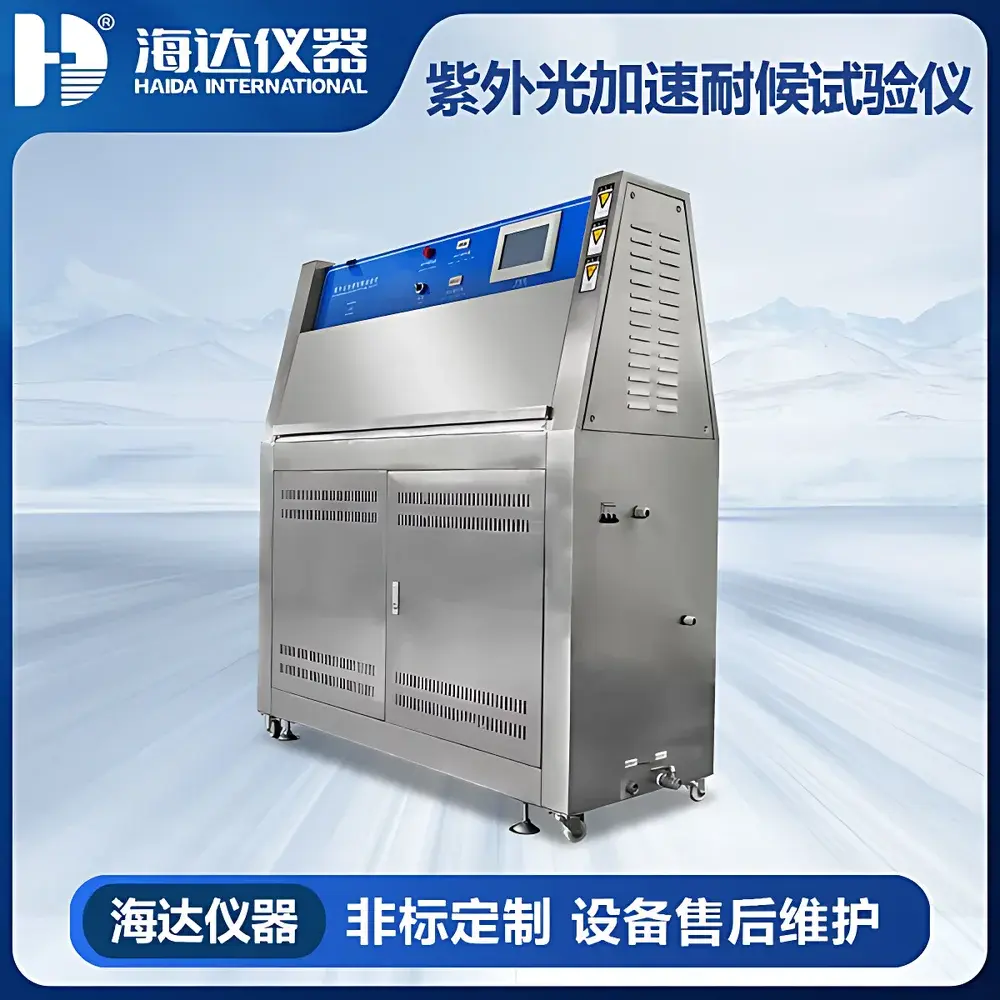
HAIDA HD-E802-2 Tilted-Tower UV Aging Test Chamber
| Brand | HAIDA INTERNATIONAL |
|---|---|
| Origin | Guangdong, China |
| Manufacturer Type | Direct Manufacturer |
| Model | HD-E802-2 |
| Humidity Range | Ambient to 70°C |
| UV Lamp Power | 40 W per lamp |
| Max Data Logging Duration | 60 days (at 1.5-min sampling interval) |
| Irradiation Temperature Range | Ambient to 70°C |
| UV Wavelength Range | 200–480 nm |
| Chamber Internal Dimensions (W×H×D) | 1300 × 1480 × 550 mm |
| Sample Rack Configuration | Tilted tower, 4 racks × 493 × 300 mm each |
| Sample Size per Rack | 75 × 150 mm (2 slots per rack) |
| Lamp Quantity | 8 fluorescent UV lamps (4 front + 4 rear) |
| Lamp Center-to-Center Spacing | 70 mm |
| Sample Surface-to-Lamp Distance | 50 ± 3 mm |
| Spray Nozzles | 8 (4 front + 4 rear), adjustable pressure 70–200 kPa |
| Lamp Length | 1220 mm |
| Lamp Lifetime | ≥1600 h |
| Temperature Resolution | 0.01°C |
| Temperature Uniformity | ±2°C |
| Temperature Fluctuation | ±1°C |
| Temperature Deviation | ±1°C |
| Control System | Q-TEST touchscreen PID controller with RS-232 interface |
| Compliance Standards | GB/T 23987–2009, ISO 11507:2007, GB/T 14522–2008, GB/T 16422.3–2014, ISO 4892-3:2006, ASTM G154, ASTM G153, IEC 61215:2005 (Clause 10.10) |
Overview
The HAIDA HD-E802-2 Tilted-Tower UV Aging Test Chamber is an engineered solution for accelerated weathering evaluation of polymeric, coating, and composite materials under controlled ultraviolet irradiation, thermal stress, and cyclic moisture exposure. It operates on the principle of fluorescent UV lamp-based spectral simulation—specifically replicating the damaging UV-A (315–400 nm) and UV-B (280–315 nm) bands of terrestrial sunlight—combined with precisely regulated condensation, spray, and dark cycles. Unlike broad-spectrum xenon arc systems, this chamber leverages standardized fluorescent UV sources (e.g., UVA-340 or UVB-313 lamps) to deliver reproducible, high-intensity irradiance in narrow spectral windows defined by ISO 4892-3 and ASTM G154. The tilted-tower sample rack design ensures optimal angular exposure geometry, minimizing shadowing effects and enhancing irradiance uniformity across all test specimens. This architecture enables direct correlation between laboratory exposure and real-world outdoor degradation mechanisms—including photooxidation, chain scission, chalking, gloss loss, cracking, and delamination—while compressing years of natural aging into weeks of controlled testing.
Key Features
- Tilted-tower stainless steel sample rack system (SUS304) with four independently accessible 493 × 300 mm platforms, each accommodating twelve 75 × 150 mm specimens via spring-clamp fixation
- Eight high-stability 40 W fluorescent UV lamps (UVA-340 standard configuration; UVB-313 optional), arranged symmetrically front-and-rear with precise 70 mm center-to-center spacing and 50 ± 3 mm sample-to-lamp distance
- Dual-mode moisture simulation: programmable condensation cycle (RT–60°C, ≥85% RH) and calibrated water spray (room temperature, 70–200 kPa adjustable pressure, 8 nozzles)
- Integrated Q-TEST touchscreen controller supporting up to 120 multi-segment test programs, 1200 total segments, and PID-regulated control of irradiation temperature (ambient–70°C), condensation temperature (RT–60°C), and cycle timing
- Real-time irradiance monitoring capability (optional TEMI-UVI radiometer, 200–480 nm range, 0.4–1.6 W/m² sensitivity) with closed-loop feedback to maintain setpoint accuracy
- Robust thermal management: finned-sheath heating elements, multi-wing centrifugal air circulation, and P.I.D.-controlled steam generation for condensation
- Comprehensive safety architecture including overtemperature cutoff, low-water level detection, pump dry-run protection, SSR-controlled heating, and grounded TN-S/TT power compliance (AC 220 V ±10%, 50 ±0.5 Hz)
Sample Compatibility & Compliance
The HD-E802-2 accommodates flat, rigid, or semi-flexible specimens up to 75 × 150 mm per slot, with total capacity of 48 samples per full run. Its chamber geometry and irradiance distribution meet the spatial uniformity requirements specified in ISO 4892-3 Annex B and ASTM G154 Section 7.2. The system is validated for conformance with multiple international standards governing UV-accelerated weathering, including but not limited to: GB/T 23987–2009 (equivalent to ISO 11507:2007) for coatings; GB/T 14522–2008 for industrial plastics, paints, and elastomers; GB/T 16422.3–2014 (ISO 4892-3:2006); ASTM G154 (Standard Practice for Operating Fluorescent Ultraviolet (UV) Lamp Apparatus for Exposure of Non-Metallic Materials); ASTM G153 (Standard Practice for Operating Enclosed Carbon-Arc Lamps Apparatus for Exposure of Non-Metallic Materials); and IEC 61215:2005 Clause 10.10 for UV preconditioning of photovoltaic modules. All operational parameters—including irradiance intensity, temperature setpoints, humidity profiles, and cycle sequencing—are traceable to NIST-traceable calibration protocols when equipped with optional radiometric sensors.
Software & Data Management
The embedded Q-TEST controller features a 7-inch capacitive touchscreen interface with bilingual (English/Chinese) operation, password-protected parameter locking, and audit-ready data logging. It records temperature, irradiance (when sensor-equipped), spray/condensation status, and elapsed time at user-defined intervals down to 1.5 minutes, storing up to 60 days of continuous data in battery-backed RAM. Export is supported via RS-232 serial interface to external PCs running Windows-compatible acquisition software. The system supports GLP-compliant data integrity through timestamped event logging, operator ID tagging (via optional login module), and non-erasable history buffers. All test programs—including ramp rates, dwell times, and conditional branching—are fully editable, duplicable, and recallable. Optional integration with LIMS or MES platforms is achievable via Modbus RTU or custom API development upon request. Firmware updates are performed offline using USB memory devices, ensuring operational continuity during validation maintenance.
Applications
This chamber serves as a core qualification tool in R&D laboratories, quality assurance departments, and third-party testing facilities across industries where long-term outdoor durability is mission-critical. Typical use cases include: evaluating UV stabilizer efficacy in automotive interior trim and exterior fascias; validating weather resistance of architectural coatings and façade sealants; screening encapsulant and backsheet materials for solar PV module certification; assessing colorfastness and gloss retention of textile and printing inks; verifying functional integrity of medical device polymer housings under regulatory aging protocols; and benchmarking comparative degradation kinetics between alternative formulations in paint, plastic, and rubber compound development. Its ability to isolate UV-driven degradation pathways—decoupled from visible light or IR thermal loading—makes it particularly valuable for failure root-cause analysis and predictive lifetime modeling based on Arrhenius-type acceleration factors.
FAQ
What UV lamp types are supported, and how do they differ in application?
Standard configuration includes eight UVA-340 lamps, optimized to match terrestrial solar UV below 400 nm. UVB-313 lamps are available as an option for more aggressive, short-wavelength acceleration—commonly used in rapid screening per ASTM G153 or for highly UV-sensitive substrates.
Is the irradiance level adjustable, and how is it verified?
Yes—irradiance is continuously adjustable within defined ranges (0–0.95 W/m² @ 340 nm for UVA; 0.35–0.80 W/m² @ 313 nm for UVB). Calibration and verification require optional TEMI-UVI radiometer with NIST-traceable certificate; field checks may be performed using calibrated reference sensors.
Can the chamber operate unattended for extended periods?
Yes—the system supports autonomous execution of multi-week test sequences with built-in safeguards (e.g., auto-shutdown on water depletion, thermal runaway, or communication loss). Scheduled start/stop and power-failure recovery modes (hot/cold start options) ensure uninterrupted operation.
What maintenance is required to sustain measurement accuracy?
Lamp replacement every 1600 hours (or per radiometric decay threshold), quarterly calibration of PT100 temperature sensors, biannual verification of spray nozzle flow rates and pressure consistency, and annual full-system performance validation against ISO 4892-3 reference materials are recommended.
Does the system support 21 CFR Part 11 compliance for pharmaceutical applications?
Out-of-the-box, the controller provides electronic signatures, audit trails, and data immutability—but full Part 11 readiness requires site-specific validation documentation, role-based access control implementation, and integration with enterprise-level electronic record systems. HAIDA provides IQ/OQ templates and supports vendor qualification audits.



