
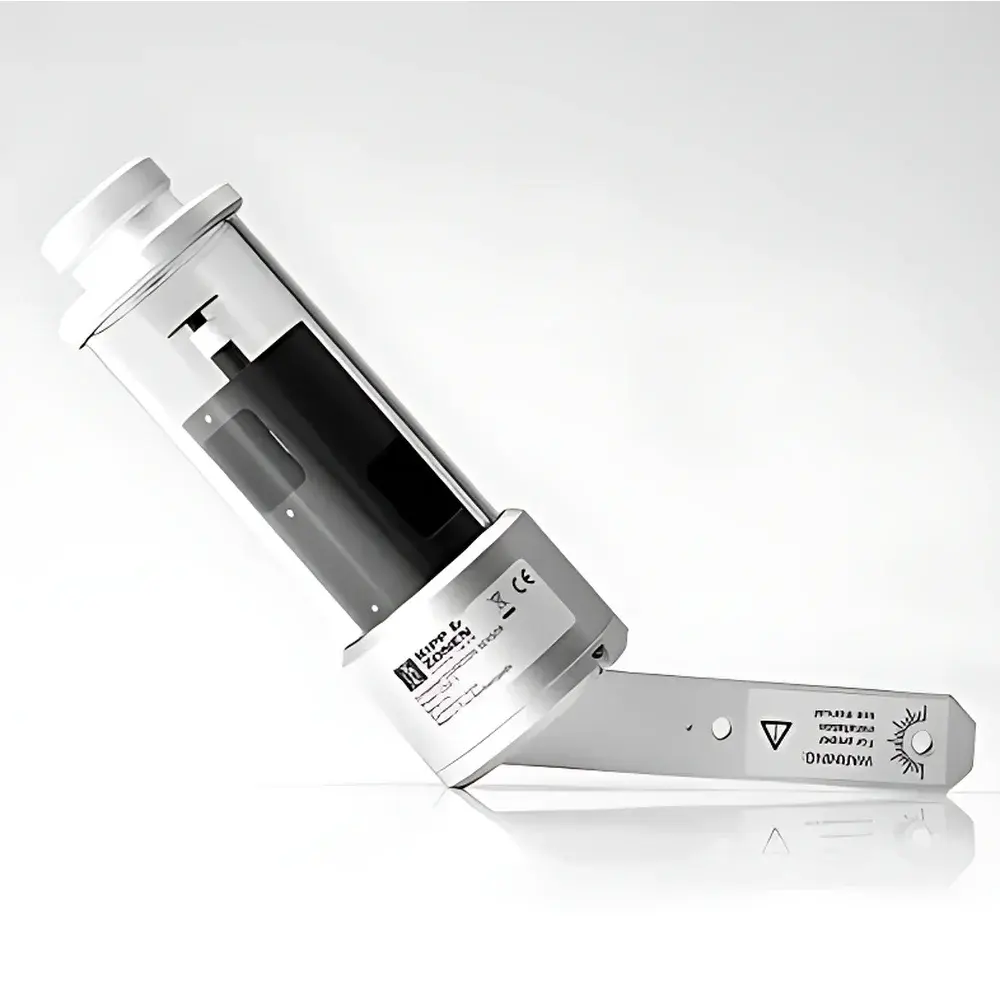
CSD3 Sunshine Duration Sensor by Kipp & Zonen
| Brand | Kipp & Zonen |
|---|---|
| Origin | Netherlands |
| Model | CSD3 |
| Spectral Range | 400–1100 nm |
| Operating Temperature | -40 to +70 °C |
| Sunshine Signal Output | 1 ± 0.1 V (for direct irradiance > 120 W/m²) |
| Accuracy | >90% (monthly sunshine hours) |
| Accuracy | >90% (clear-sky direct signal) |
| Analog Output | 1 mV/(W/m²) |
| Long-term Drift | <2 %/year |
| Thermal Response | <0.1 °C |
| Response Time | <1 ms |
| Power Supply | 12 VDC |
| Integrated Heater | Yes |
| Desiccant Indicator | Visual humidity indicator |
| Connector | Waterproof M12 plug/socket |
Overview
The CSD3 Sunshine Duration Sensor, engineered by Kipp & Zonen (Netherlands), is a solid-state, maintenance-optimized instrument designed for continuous, high-reliability measurement of sunshine duration in accordance with the World Meteorological Organization (WMO) definition: the cumulative time during which direct solar irradiance exceeds 120 W/m². Unlike traditional Campbell-Stokes recorders or rotating-shadow-band instruments, the CSD3 employs a passive optical architecture—featuring three spectrally matched silicon photodiodes coupled with precision-engineered diffusers—to generate a robust analog signal proportional to direct normal irradiance (DNI). Its absence of moving parts ensures long-term stability and minimal calibration drift, making it suitable for unattended operation in remote climatological stations, solar resource assessment campaigns, and national meteorological networks requiring WMO-compliant sunshine data.
Key Features
- Solid-state design with no mechanical components—eliminates wear, alignment drift, and seasonal recalibration needs.
- Triple photodiode configuration with custom scattering optics optimized for spectral response across 400–1100 nm, ensuring fidelity to the solar spectrum under varying atmospheric conditions.
- Integrated 12 VDC-powered heater prevents precipitation accumulation (rain, snow) and frost formation on the optical surface—critical for maintaining signal integrity in sub-zero or high-humidity environments.
- Optional internal thermostat enables automatic heater activation based on sensor body temperature, improving energy efficiency without compromising optical clarity.
- Visual humidity indicator on the desiccant cartridge provides immediate field verification of silica gel saturation—enabling proactive maintenance before moisture ingress affects optical transmission.
- Large-threaded desiccant housing simplifies replacement and extends service intervals; compatible with standard replaceable desiccant cartridges meeting IEC 60068-2-30 humidity test requirements.
- IP67-rated waterproof M12 connector ensures secure, corrosion-resistant cable termination—facilitating rapid installation, field servicing, and modular system integration.
Sample Compatibility & Compliance
The CSD3 is designed for outdoor deployment on meteorological masts, solar monitoring platforms, and automated weather stations (AWS). It complies with WMO Guide to Instruments and Methods of Observation (CIMO Guide, Chapter 7) for sunshine duration measurement and meets the functional specifications outlined in ISO 9060:2018 (Class C secondary standard for solar irradiance sensors) for spectral responsivity and linearity. While not a primary standard pyrheliometer, its calibrated analog output (1 mV per W/m²) allows traceable derivation of DNI when paired with site-specific calibration coefficients. The sensor’s thermal response (<0.1 °C) and fast temporal resolution (<1 ms) support high-frequency data logging for cloud-edge detection and irradiance variability analysis. No regulatory certification (e.g., CE, UKCA) is required for standalone use, but system-level integration into GMP/GLP or ISO/IEC 17025-accredited monitoring setups must include documented sensor calibration history and environmental validation per ASTM E892 or IEC 61724-1.
Software & Data Management
The CSD3 delivers two parallel outputs: a digital sunshine status signal (TTL-compatible 1 V high/low switch) indicating real-time exceedance of the 120 W/m² threshold, and an analog voltage proportional to instantaneous DNI. These signals interface directly with industry-standard data loggers (e.g., Campbell Scientific CR series, Onset HOBO, Delta-T DL2e) supporting differential voltage input and programmable threshold logic. When integrated into SCADA or cloud-based environmental monitoring platforms (e.g., MeteoHub, WeatherLink Cloud), the sensor supports automated calculation of daily/monthly sunshine hours, percentage of possible sunshine, and statistical irradiance quartiles. Firmware-level timestamping and linearized output scaling are handled externally by the logger—no embedded microprocessor or firmware updates are required. For audit-trail compliance (e.g., FDA 21 CFR Part 11), users must configure the data acquisition system to record raw voltage values, applied calibration factors, and environmental metadata (temperature, heater status, desiccant age) with immutable logging.
Applications
- Long-term climate monitoring networks requiring WMO-compliant sunshine duration records.
- Solar photovoltaic (PV) and concentrating solar power (CSP) site feasibility studies and performance ratio validation.
- Agricultural meteorology—evapotranspiration modeling, phenological stage tracking, and crop yield correlation studies.
- Aviation weather reporting (METAR/SPECI) at regional airports where sunshine duration informs ceiling and visibility assessments.
- Urban heat island research and building energy simulation inputs requiring validated solar exposure metrics.
- Educational atmospheric science laboratories emphasizing hands-on radiometric principles and instrument uncertainty analysis.
FAQ
What is the WMO-defined threshold for sunshine duration measurement?
The WMO defines sunshine duration as the total time during which direct solar irradiance exceeds 120 W/m² on a horizontal surface. The CSD3 implements this threshold electronically via its analog-to-digital switching circuitry.
Does the CSD3 require annual recalibration?
While long-term drift is specified at 90% monthly accuracy compliance.
Can the CSD3 operate without the heater in mild climates?
Yes—the heater is optional for operation above freezing and low-humidity conditions; however, continuous heater use is advised if dew or light frost occurrence is possible, as condensation degrades optical transmission even below visible fog thresholds.
How is the desiccant cartridge replaced?
The large-threaded housing allows tool-free removal; replacement takes <90 seconds and requires only a new silica gel cartridge (Kipp & Zonen part #CSD3-DESIC-REFILL), with no optical realignment needed.
Is the analog output linear across the full irradiance range?
Yes—the 1 mV/(W/m²) output is factory-linearized from 0 to 1400 W/m², with nonlinearity <±0.5 % FS, verified per ISO 9060:2018 Annex E test procedures.
Related Products







