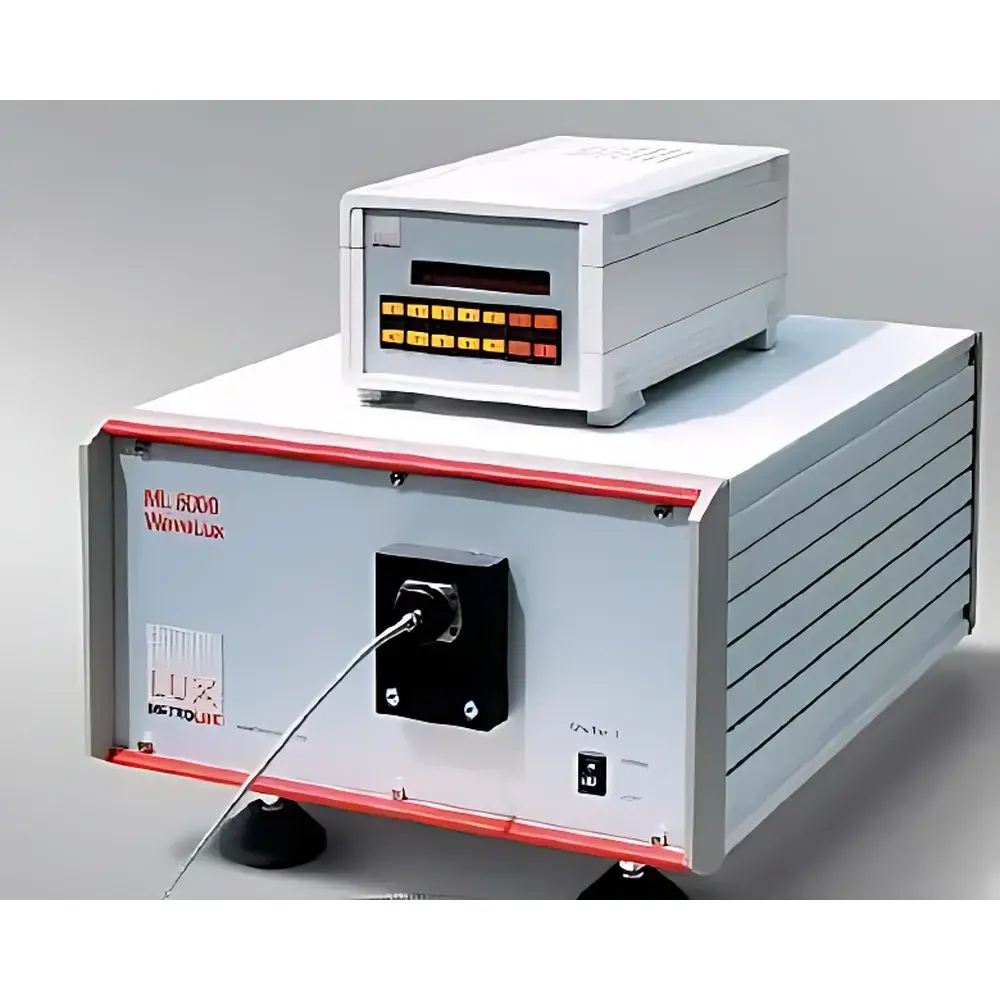
Metrolux ML 6020 High-Precision Laser Wavelength Meter
| Brand | Metrolux |
|---|---|
| Origin | Germany |
| Model | ML 6020 |
| Wavelength Range | 400–1800 nm |
| Absolute Accuracy | typ. 5 × 10⁻⁷ |
| Relative Accuracy | 1 × 10⁻⁶ – 1 × 10⁻⁷ |
| Laser Linewidth | < 8 GHz |
| Measurement Rate | 8.3 Hz |
| Minimum Input Power | 100 µW |
| Maximum Input Power | 1.5 mW |
| Integrated He–Ne Reference Wavelength | 632.8 nm |
| Interface | IEC 625 (IEEE-488) GPIB |
Overview
The Metrolux ML 6020 is a high-precision, benchtop laser wavelength meter engineered for traceable, real-time metrology of continuous-wave (CW) and pulsed lasers across the visible to near-infrared spectrum. It operates on the principle of scanning Michelson interferometry, where the unknown laser beam is coherently compared against a stabilized internal helium–neon (He–Ne) reference laser at 632.8 nm. This dual-beam, heterodyne-capable architecture ensures long-term stability and minimizes drift-related uncertainty. Unlike grating-based or dispersive spectrometers, the ML 6020 delivers absolute wavelength measurements without calibration transfer or spectral interpolation—making it suitable for primary-level laboratory applications requiring SI-traceable results. Its design adheres to fundamental principles outlined in ISO/IEC 17025 for calibration laboratories and supports compliance with laser safety and characterization protocols defined in IEC 60825-1 and ANSI Z136.1.
Key Features
- Real-time measurement capability at 8.3 Hz update rate, enabling dynamic monitoring of wavelength drift during laser warm-up, mode hopping, or external cavity tuning.
- Integrated, thermally stabilized He–Ne reference laser (632.8 nm) with active frequency locking, eliminating need for external references or periodic recalibration.
- Dual-range optical input optimized for low-noise detection: supports both CW and Q-switched pulsed lasers with pulse widths down to 10 ns and repetition rates up to 10 kHz.
- High-resolution digital signal processing (DSP) backend delivering typ. absolute accuracy of 5 × 10⁻⁷ (≈ ±0.001 nm at 633 nm) and relative stability better than 1 × 10⁻⁷ over 1-hour intervals.
- GPIB (IEC 625 / IEEE-488) interface standard; optional USB-to-GPIB adapters available for seamless integration into automated test environments.
- Front-panel LED display showing wavelength (nm), wavenumber (cm⁻¹), or optical frequency (THz)—user-selectable units with automatic unit conversion.
Sample Compatibility & Compliance
The ML 6020 accepts free-space collimated beams with diameters between 1 mm and 8 mm and divergence ≤ 1.5 mrad. It is compatible with single longitudinal mode (SLM) lasers, distributed feedback (DFB) diodes, external cavity diode lasers (ECDLs), Ti:sapphire oscillators, and fiber-coupled sources (with optional FC/PC or SMA input adapters). The instrument meets CE marking requirements under the EU Electromagnetic Compatibility Directive 2014/30/EU and Low Voltage Directive 2014/35/EU. Its optical path is sealed and purged-ready for inert-gas operation in oxygen-sensitive environments. For regulated industries, measurement data logs—including timestamps, operator ID, and environmental metadata—can be exported in CSV or XML format to support GLP/GMP documentation workflows and FDA 21 CFR Part 11-compliant audit trails when used with validated acquisition software.
Software & Data Management
The ML 6020 operates stand-alone via front-panel controls but is fully programmable via SCPI commands over GPIB. Metrolux provides Windows-compatible configuration and acquisition software (ML-Control Suite v3.x) supporting real-time plotting, statistical analysis (mean, std dev, min/max, Allan deviation), batch logging, and export to MATLAB, LabVIEW, or Excel. All measurement sessions include embedded metadata: ambient temperature, internal cavity pressure (if equipped with optional barometric sensor), and He–Ne reference lock status. Raw interferogram data can be retrieved for offline Fourier analysis, facilitating uncertainty budgeting per GUM (JCGM 100:2019) guidelines. Firmware updates are delivered via secure HTTPS portal with SHA-256 signature verification.
Applications
- Calibration and verification of tunable laser sources in national metrology institutes (NMIs) and accredited calibration labs.
- Characterization of semiconductor laser diodes during R&D and production screening—especially for telecom-band (1310/1550 nm) and sensing-grade (760/1530 nm) devices.
- Monitoring wavelength stability of ultrafast oscillators and optical parametric oscillators (OPOs) in nonlinear optics laboratories.
- Validation of wavelength-locked systems in atomic physics setups (e.g., rubidium or cesium D-line spectroscopy, optical lattice clocks).
- Supporting ISO 10110-5 surface specification testing where laser source wavelength directly impacts interferometric fringe resolution.
FAQ
What is the minimum required input power for reliable measurement?
The ML 6020 achieves optimal signal-to-noise ratio at ≥500 µW for CW lasers and ≥1 mJ/pulse for nanosecond pulses. Stable operation is guaranteed from 100 µW (CW) or 10 µJ/pulse (Q-switched), though measurement uncertainty increases by ~2× below nominal power levels.
Can the ML 6020 measure multi-mode or broadband sources?
No—it is designed exclusively for narrow-linewidth lasers (<8 GHz). Broadband emitters (e.g., LEDs, SLEDs, or ASE sources) fall outside its operational envelope due to coherence-length limitations inherent to Michelson interferometry.
Is vacuum or nitrogen purging supported?
Yes—the optical head includes dedicated purge ports compatible with dry N₂ or Ar. Purging reduces water vapor absorption lines in the 1350–1450 nm and 1800–1900 nm regions, improving accuracy for critical NIR measurements.
Does the instrument require annual recalibration?
While the He–Ne reference is factory-stabilized and drift-compensated, Metrolux recommends biennial verification against a NIST-traceable wavelength standard (e.g., iodine-stabilized He–Ne at 632.991 nm) to maintain ISO/IEC 17025 accreditation.
How is traceability to SI units established?
The internal He–Ne reference is calibrated against a primary frequency standard prior to shipment. Wavelength values are derived from the speed of light (c = 299 792 458 m/s, exact) and measured optical frequency, ensuring direct SI traceability per CIPM MRA guidelines.