
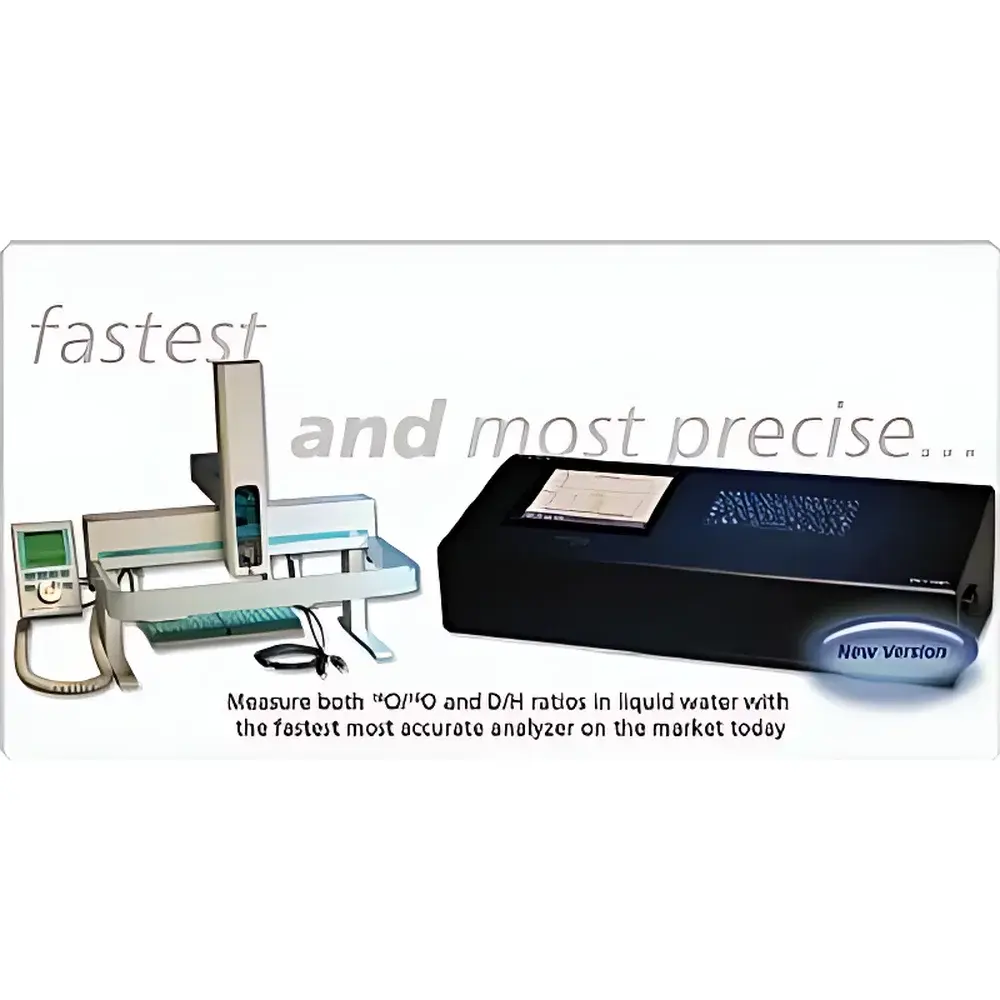
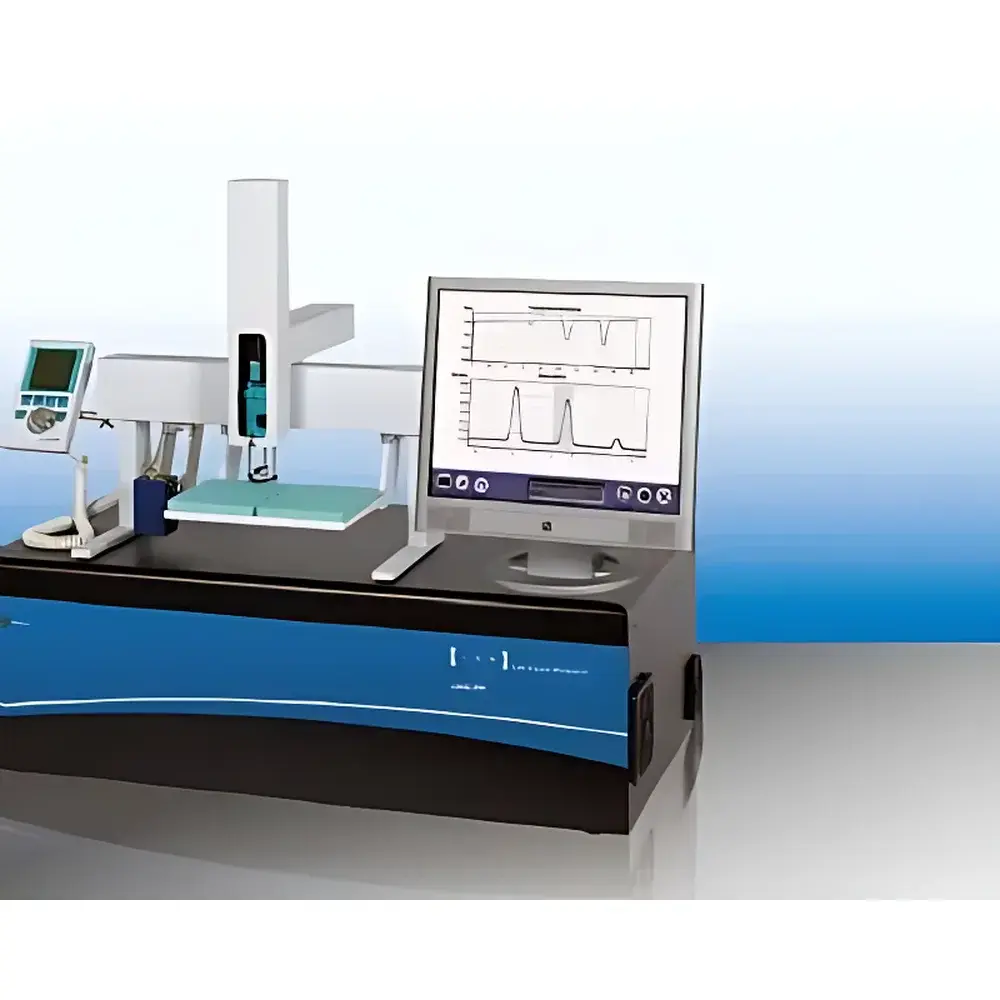
LGR Model 908-0008 / 912-0008 Liquid Water Isotope Analyzer (OA-ICOS)
| Brand | LGR |
|---|---|
| Origin | USA |
| Model | 908-0008, 912-0008 |
| Measurement Principle | Off-Axis Integrated Cavity Output Spectroscopy (OA-ICOS) |
| Isotopes Measured | δ²H and δ¹⁸O in liquid water |
| Precision (High-Accuracy Mode, 1σ) | δ²H < 0.3‰, δ¹⁸O < 0.1‰ |
| Precision (High-Throughput Mode, 1σ) | δ²H < 0.6‰, δ¹⁸O < 0.2‰ |
| Sample Volume per Injection | < 1 µL (adjustable) |
| Max. Daily Injections | 1080 |
| Unknown Samples per Day | 150 (high-throughput), 30 (high-accuracy) |
| Salinity Tolerance | < 4% w/w |
| Operating Temperature | 5–45 °C |
| Sample Temperature Range | 0–50 °C |
| Output Interfaces | RS-232, Ethernet, USB |
| Power | 115/230 VAC, 50/60 Hz, 150 W |
| Dimensions | 25.4 cm (H) × 96.5 cm (W) × 35.6 cm (D) |
| Weight | 27 kg |
Overview
The LGR Model 908-0008 and 912-0008 Liquid Water Isotope Analyzers are high-performance, laser-based analytical instruments engineered for precise, automated measurement of stable hydrogen (δ²H) and oxygen (δ¹⁸O) isotope ratios in liquid water samples. Utilizing Off-Axis Integrated Cavity Output Spectroscopy (OA-ICOS), a highly sensitive absorption spectroscopy technique, these analyzers achieve exceptional signal-to-noise ratios without requiring vacuum systems or ionization sources typical of traditional isotope ratio mass spectrometry (IRMS). OA-ICOS enables direct, real-time quantification of isotopic composition via high-resolution near-infrared spectral analysis of water vapor generated from micro-volume liquid injections. Designed in collaboration with the International Atomic Energy Agency (IAEA), the platform has been rigorously validated across global reference laboratories and is recognized for its robustness in environmental, hydrological, ecological, and geochemical research. Its field-deployable architecture supports both laboratory-based high-throughput operation and unattended continuous monitoring in remote settings—making it a foundational tool for modern stable isotope hydrology and climate proxy studies.
Key Features
- IAEA-endorsed design with documented validation against international reference materials (VSMOW, SLAP, GISP)
- Dual operational modes: High-throughput (150 unknown samples/day) and high-accuracy (δ²H < 0.3‰, δ¹⁸O < 0.1‰, 1σ)
- LGR-patented Spectral Contamination Identification (SCI) algorithm for automatic correction of organic vapor interferences
- Minimal sample consumption: <1 µL per injection, adjustable via integrated syringe pump
- Full automation capability with optional autosampler (908-0008-9001) and manual vapor inlet kit (908-0008-9014)
- Integrated diagnostics including real-time cavity alignment monitoring, laser wavelength tracking, and absorption line shape validation
- Compliant with ISO/IEC 17025 requirements for calibration traceability and measurement uncertainty reporting
Sample Compatibility & Compliance
The analyzer accommodates a broad range of aqueous matrices—including precipitation, groundwater, surface water, plant xylem sap, and biological fluids—with salinity tolerance up to 4% w/w NaCl. Samples exceeding this threshold require more frequent maintenance intervals but remain measurable with appropriate dilution or filtration (0.45 µm filter recommended). All measurements adhere to IAEA-defined protocols for δ²H and δ¹⁸O reporting relative to VSMOW. The system supports dual-standard calibration sequences (positive and negative reference waters) and maintains full audit trails compliant with GLP and FDA 21 CFR Part 11 when used with validated software configurations. Instrument performance is routinely verified using IAEA-certified reference materials, and raw spectral data files retain complete metadata for third-party reprocessing and inter-laboratory comparison.
Software & Data Management
- Embedded firmware with real-time spectral acquisition, peak fitting, and baseline correction
- Post-processing software for batch calibration, drift correction, outlier detection, and uncertainty propagation
- Spectral Pollution Diagnostic (SPD) module providing high-resolution spectral visualization and interference quantification
- Export formats compatible with common data analysis environments (CSV, HDF5, NetCDF)
- Remote monitoring and control via Ethernet interface with secure SSH/TLS support
- Full compliance with ISO/IEC 17025 documentation requirements for instrument qualification (IQ/OQ/PQ)
Applications
This analyzer serves as a core instrumentation platform in multiple domains requiring high-fidelity stable isotope data. In hydrology, it enables watershed-scale tracing of evapotranspiration, recharge pathways, and mixing dynamics. In paleoclimatology, it supports high-resolution δ¹⁸O analysis of ice core meltwater and speleothem fluid inclusions. Ecologists apply it to quantify plant water use efficiency and source partitioning in mixed-canopy systems. Atmospheric scientists integrate it into flux tower networks for eddy-covariance-coupled isotope flux analysis. Regulatory and forensic labs utilize its precision for origin authentication of beverages, pharmaceuticals, and agricultural products. Its compact footprint and low power demand further facilitate deployment aboard mobile laboratories, research vessels, and polar field stations.
FAQ
What is the fundamental measurement principle employed by this analyzer?
It uses Off-Axis Integrated Cavity Output Spectroscopy (OA-ICOS), a laser absorption technique that measures isotopic ratios through high-finesse optical cavity-enhanced absorption of H₂¹⁶O, H₂¹⁸O, and HD¹⁶O vapor species.
How does the SCI algorithm improve data reliability?
The Spectral Contamination Identification algorithm detects and quantifies spectral distortions caused by volatile organic compounds (e.g., ethanol, acetone) co-evaporating with water, enabling mathematically grounded corrections without manual intervention.
Is the system suitable for regulatory-compliant testing under GLP or GMP frameworks?
Yes—when configured with validated software, electronic signatures, and audit-trail-enabled data handling, it meets essential elements of GLP (OECD Series 1, Annex 5) and FDA 21 CFR Part 11 for regulated environments.
What maintenance is required for long-term operational stability?
Routine replacement of air filters, septa, and 10 µm inline filters is recommended every 3–6 months depending on ambient particulate load; cavity mirrors and laser diodes are rated for >20,000 hours of continuous operation.
Can the instrument be integrated into automated lab workflows?
Yes—via RS-232 or Ethernet, it accepts ASCII command protocols for synchronization with LIMS, robotic liquid handlers, and environmental sensor networks.





