
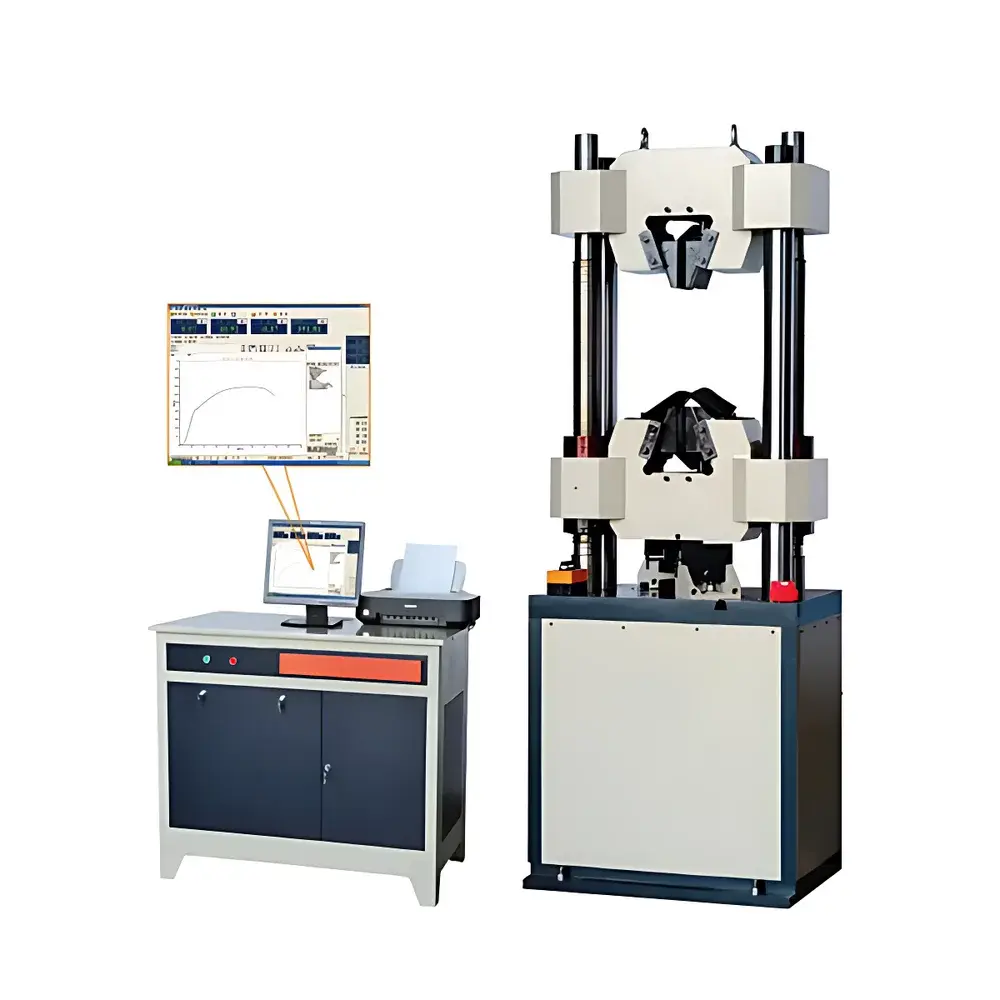
YANRUN WAW-300B Electro-Hydraulic Servo Universal Testing Machine
| Brand | YANRUN |
|---|---|
| Origin | Shanghai, China |
| Manufacturer Type | Direct Manufacturer |
| Country of Origin | China |
| Model | WAW-300B |
| Instrument Category | Universal Testing Machine (UTM) |
| Maximum Test Load | 300 kN |
| Force Range | 6–300 kN |
| Force Accuracy | ±1% or ±0.5% of full scale (FS) |
| Force Resolution | 0.002 kN |
| Displacement Resolution | 0.01 mm |
| Deformation Measurement Accuracy | 0.005 mm |
| Control Modes | Constant Force / Constant Displacement / Constant Strain (0.4–100% FS) |
| Control Accuracy | ±1.0% of set value when <10% FS |
| Tensile Space | 650 mm |
| Compression Space | 550 mm |
| Piston Stroke | 200 mm |
| Round Specimen Clamping Diameter | Φ6–Φ26 mm |
| Flat Specimen Clamping Thickness | 0–15 mm |
| Bending Span (Two-Point) | 350 mm |
| Bending Support Roller Width | 140 mm |
| Bending Support Roller Diameter | Φ30 mm |
| Max Bending Deflection | 150 mm |
| Max Piston Speed | 50 mm/min |
| Gripping Method | Hydraulic |
| Host Dimensions (W×D×H) | 850 × 580 × 2150 mm |
| Oil Source Dimensions (W×D×H) | 950 × 700 × 1150 mm |
| Weight | 2150 kg |
Overview
The YANRUN WAW-300B Electro-Hydraulic Servo Universal Testing Machine is a high-performance, load-frame-based mechanical testing system engineered for precision static mechanical characterization of metallic, polymeric, composite, and ceramic materials. It operates on the principle of closed-loop electro-hydraulic servo control, where real-time feedback from high-resolution load cells, displacement transducers, and extensometers drives proportional valve actuation to maintain target test conditions—whether constant force, constant displacement, or constant strain—across the full 6–300 kN operational range. Designed to meet ISO 7500-1 Class 0.5 and ASTM E4 verification standards, the WAW-300B delivers traceable force accuracy of ±0.5% FS and displacement resolution down to 0.01 mm, enabling compliance with international material qualification protocols in R&D, quality assurance, and third-party certification laboratories.
Key Features
- Bottom-mounted heavy-duty frame architecture with optimized rigidity-to-mass ratio, minimizing deflection during high-load compression and bending tests.
- High-fidelity 24-bit A/D conversion module offering true 1/500,000 internal resolution—no range switching required across the entire 6–300 kN span.
- Dual-safety protection system: hardware-based overload cutoff and programmable stroke limit logic prevent mechanical overtravel and protect servo-valve integrity.
- Stabilized hydraulic power unit with low-noise vane pump, temperature-compensated pressure regulation, and multi-stage filtration (β≥1000 @ 5 µm), ensuring long-term fluid cleanliness and flow repeatability.
- Force measurement capability validated from 2% to 100% FS without recalibration—critical for low-force preloading and high-force fracture testing within a single test sequence.
- Hydraulically actuated wedge-type grips with self-aligning jaw geometry, supporting round specimens (Φ6–Φ26 mm) and flat specimens (0–15 mm thick) with uniform stress distribution and minimal slippage.
- Configurable machine color scheme (RAL-coded options available) for integration into ISO 17025-accredited lab environments with documented change control procedures.
Sample Compatibility & Compliance
The WAW-300B accommodates standardized tensile bars (ASTM E8, ISO 6892-1), compression cylinders (ASTM C39, ISO 7500-1 Annex B), and three/four-point bend specimens (ASTM D7264, ISO 14125). Its 650 mm tensile space and 550 mm compression height support extended gage-length testing per ASTM E111 and ISO 527-2. All force and displacement channels are calibrated per ISO/IEC 17025 requirements, with as-delivered uncertainty budgets traceable to NIM (National Institute of Metrology, China) or equivalent national metrology institutes. The system supports GLP-compliant operation through audit-trail-enabled software configuration, user access levels, and electronic signature workflows aligned with FDA 21 CFR Part 11 expectations.
Software & Data Management
Control and analysis are executed via YANRUN’s proprietary TestMaster V5.x platform—a Windows-based application compliant with IEC 61508 SIL1 functional safety principles. The software provides real-time PID tuning, multi-channel synchronized acquisition (load, displacement, strain, temperature), and automated test sequencing (e.g., cyclic loading, creep hold, ramp-to-failure). Raw data is stored in HDF5 format with embedded metadata (operator ID, calibration certificate ID, environmental conditions), enabling seamless import into MATLAB, Python (via h5py), or LIMS systems. Export options include CSV, PDF reports with embedded stress–strain curves, and XML files conforming to ASTM E1434 data exchange schema.
Applications
- Mechanical property validation of structural steels, aluminum alloys, and titanium grades per ASME BPVC Section II and EN 10002-1.
- Quality conformance testing of welded joints and heat-affected zones under ISO 15614-1.
- Creep rupture analysis of high-temperature superalloys at sustained loads up to 300 kN (with optional furnace).
- Bending stiffness and flexural modulus determination of fiber-reinforced polymer laminates (ASTM D7264).
- Calibration reference for secondary force standards in metrology labs accredited to ISO/IEC 17025.
- Teaching and demonstration of fundamental solid mechanics concepts—including Hooke’s law, yield point detection, strain hardening exponent (n-value), and fracture toughness estimation via J-integral methods.
FAQ
What international standards does the WAW-300B comply with for force verification?
It meets ISO 7500-1 Class 0.5 and ASTM E4 requirements for static force calibration, with documented uncertainty ≤0.25% FS at 95% confidence.
Can the system be integrated into an existing laboratory network with centralized data archiving?
Yes—TestMaster supports OPC UA server mode and RESTful API endpoints for bidirectional communication with LIMS, MES, or cloud-based QA platforms.
Is third-party calibration and certification available prior to installation?
Certified calibration by CNAS-accredited providers (including full uncertainty budget and traceability documentation) is offered as an optional service.
Does the hydraulic system require special fluid or maintenance intervals?
It uses ISO VG 46 anti-wear hydraulic oil; recommended filter replacement every 2,000 operating hours and full fluid exchange every 8,000 hours or biannually, whichever occurs first.
Are extensometers and environmental chambers supported?
Yes—the system features dual analog/digital channels compatible with clip-on, video, and laser extensometers (e.g., Zwick Roell XScale, MTS 632 series), and integrates with temperature-controlled chambers (-70°C to +300°C) via analog I/O and CAN bus.
Related Products



