
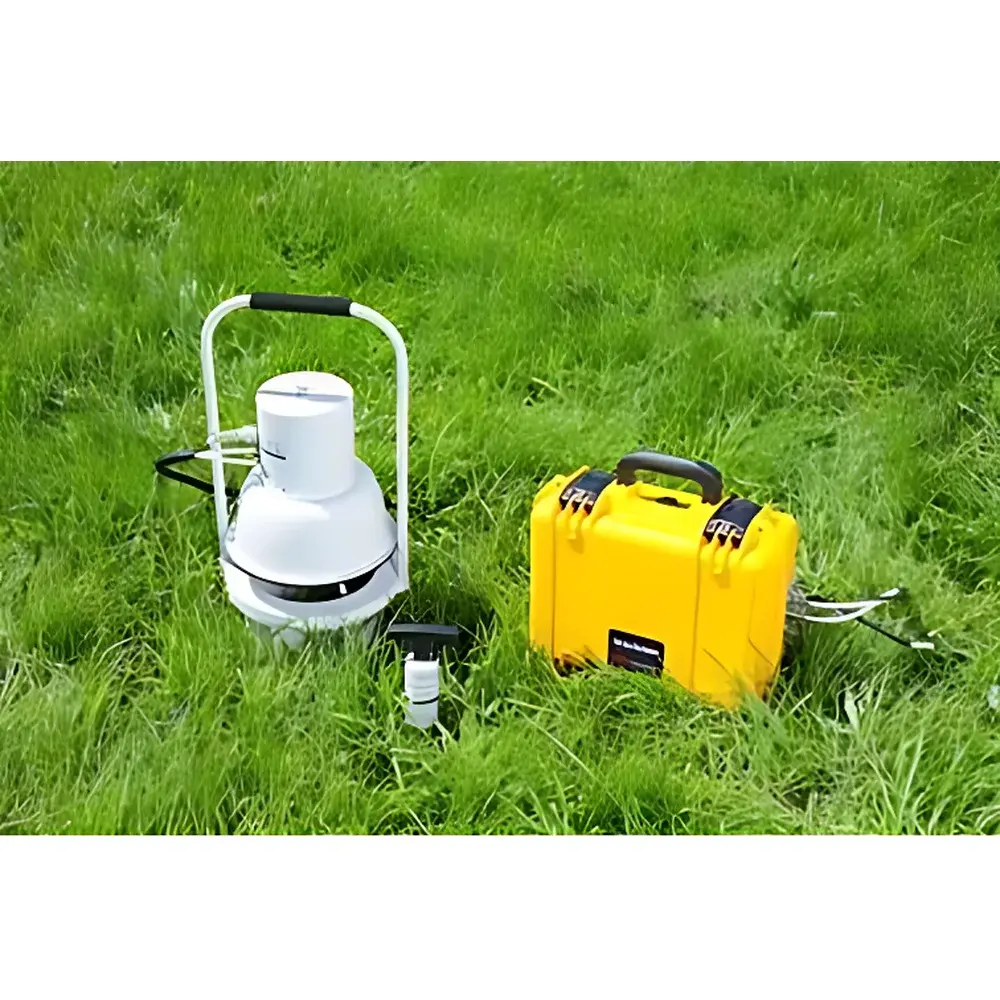
LICA PS-9000 Portable Soil Carbon Flux Measurement System
| Brand | LICA |
|---|---|
| Model | PS-9000 |
| Measurement Principle | Dynamic Closed-Chamber Method (NDIR-based) |
| CO₂ Range | 0–6000 ppm |
| H₂O Range | 0–60000 ppm |
| Accuracy | <1% of reading |
| Repeatability | <1 ppm |
| Operating Temperature | −20 to +60 °C |
| Power Consumption | <40 W (controller), <2.2 W (SC-12N chamber) |
| Battery | 24 V / 8 Ah Li-ion |
| Runtime | 3–4 h per charge |
| Dimensions (controller) | 37 × 30 × 16 cm |
| Weight (controller, with battery) | 6.8 kg |
| Chamber Type | SC-12N portable soil respiration chamber |
| Chamber Area | 276.27 cm² |
| Chamber Volume | 3451 cm³ |
| Cable Length | 2 m |
| Soil Sensor | Volumetric Water Content (0.00–0.70 m³/m³ in mineral soils |
| 0.0–1.0 m³/m³ in substrates), Temp Range | −40 to +60 °C, Temp Accuracy: ±1 °C (−40 to 0 °C), ±0.5 °C (0 to 60 °C) |
| Communication | Wi-Fi, RS-232, SDI-12 |
| Data Storage | microSD card |
| Flow Rate | 3 L/min |
| Pump Supply | 12 V, <0.5 A |
Overview
The LICA PS-9000 Portable Soil Carbon Flux Measurement System is a field-deployable, NDIR-based instrument engineered for high-reproducibility quantification of soil CO₂ efflux using the dynamic closed-chamber method. It implements real-time, non-steady-state gas exchange modeling—calculating flux rates from the temporal slope of CO₂ concentration rise within a sealed, temperature-stabilized chamber, corrected for concurrent measurements of air temperature, atmospheric pressure, soil temperature, and volumetric water content. Unlike static chambers requiring post-hoc linear regression or arbitrary time-window selection, the PS-9000 applies first-order mass balance equations with integrated environmental compensation, minimizing artifacts from chamber-induced microclimate perturbation. Its modular architecture separates the main controller unit from interchangeable chamber configurations—including the standard SC-12N rigid chamber, a manual transparent chamber for light-response studies, and a buoyant floating chamber for aquatic or saturated soil interfaces—enabling consistent methodology across heterogeneous terrain and ecosystem types.
Key Features
- Integrated NDIR gas analyzer with dual-range detection (CO₂: 0–6000 ppm; H₂O: 0–60000 ppm), calibrated traceably to NIST-traceable standards
- Onboard environmental sensing suite: high-accuracy thermistor-based soil temperature probe (±0.5 °C above 0 °C), dielectric permittivity-based soil moisture sensor with medium-specific calibration options
- Field-rugged controller housing (IP54-rated) with sunlight-readable OLED display and intuitive touch interface—operable via dedicated handheld controller with wireless Wi-Fi linkage
- Low-power design optimized for extended autonomous operation: <40 W peak draw; compatible with external 24 V DC sources or dual-battery hot-swap configuration for multi-day campaigns
- No post-processing dependency: raw sensor streams, chamber pressure/temperature transients, and flux values are computed, timestamped, and stored onboard in CSV-compliant format on removable microSD card
- Configurable measurement protocols—including user-defined chamber closure duration, sampling interval, and automatic zero/span validation cycles—supporting both rapid surveys and long-term diel monitoring
Sample Compatibility & Compliance
The PS-9000 accommodates diverse edaphic matrices without hardware modification: mineral soils (sand to clay loam), organic substrates (peat, compost), rhizosphere zones, and flooded/saturated interfaces via the optional floating chamber. All sensor outputs comply with ISO 17025-accredited calibration practices; CO₂ and H₂O channels are validated against certified gas standards per ASTM D6348. The system supports GLP-aligned data integrity through immutable timestamping, operator ID tagging (via controller login), and audit-trail-enabled parameter change logging. While not FDA 21 CFR Part 11-certified out-of-the-box, its data export structure (UTF-8 CSV with metadata headers) meets FAIR principles and integrates natively with USDA ARS, FLUXNET, and ICOS-approved data ingestion pipelines.
Software & Data Management
Data acquisition, visualization, and basic QA/QC are handled entirely onboard—no laptop or proprietary software required during field operation. Exported datasets include synchronized timestamps (UTC), chamber geometry metadata (area/volume), environmental covariates, and calculated flux (µmol CO₂·m⁻²·s⁻¹) with associated uncertainty estimates derived from NDIR noise floor and thermal drift models. Optional PC-based LICA FieldLink Desktop application (Windows/macOS) enables batch processing, outlier flagging based on R² thresholds and residual analysis, and direct upload to cloud repositories including Zenodo and NOAA’s NGEE-Tropics archive. All firmware updates are delivered via signed OTA packages over Wi-Fi, ensuring version traceability and cryptographic integrity.
Applications
- Soil respiration response to climate variables (e.g., temperature sensitivity Q₁₀ estimation, moisture limitation thresholds)
- Carbon budget validation in restored wetlands, afforested lands, and agricultural no-till systems
- In situ root/rhizomicrobial respiration partitioning when combined with root-exclusion collars
- Long-term flux monitoring networks requiring low-maintenance, solar-rechargeable deployment
- Evaluation of biochar amendment effects on heterotrophic vs. autotrophic CO₂ production
- Methodological intercomparison studies with eddy covariance or gradient-based approaches
FAQ
What chamber configurations are supported by the PS-9000?
The system natively supports three chamber types: the SC-12N rigid aluminum chamber (276.27 cm² area), a manually deployed transparent acrylic chamber for photosynthetic inhibition experiments, and a buoyant floating chamber (803.84 cm²) for paddy fields or inundated peatlands.
Does the PS-9000 meet international flux measurement standards?
Yes—the dynamic chamber methodology aligns with the core principles outlined in ISO 18512:2018 (Soil quality — Determination of carbon dioxide evolution) and complements FAO’s Global Soil Laboratory Network (GLOSOLAN) recommended protocols for in situ respiration assessment.
Can the system operate unattended for >24 hours?
With external 24 V power or dual-battery configuration and reduced sampling frequency (e.g., one measurement per hour), continuous operation exceeding 48 hours is achievable. Internal thermal management maintains NDIR stability across diurnal temperature swings.
Is soil moisture sensor calibration transferable between soil types?
No—while a universal mineral-soil calibration is provided (±0.03 m³/m³), optimal accuracy requires medium-specific calibration using gravimetric or neutron probe reference data, especially for high-organic or saline substrates.
How is data security ensured during wireless transmission?
Wi-Fi communication uses WPA2-PSK encryption; all parameter changes and measurement triggers are logged with digital signatures and cannot be altered retroactively in the onboard audit trail.







