
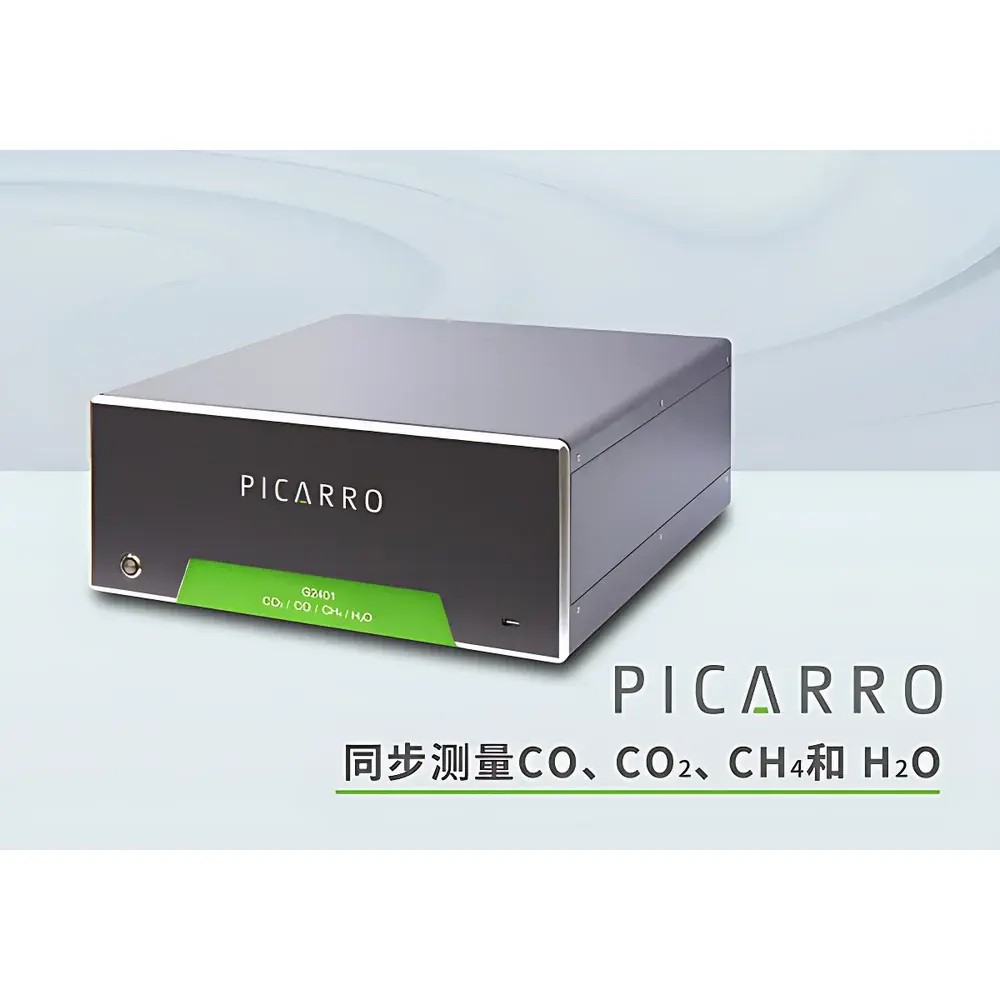
Picarro G2401-m Aviation-Optimized Cavity Ring-Down Spectroscopy (CRDS) Multi-Gas Analyzer
| Brand | Picarro |
|---|---|
| Origin | USA |
| Model | G2401-m |
| Instrument Type | Portable |
| Detection Targets | CO, CO₂, CH₄, H₂O |
| Response Time | ≤ 3.5 s |
| Measurement Principle | Cavity Ring-Down Spectroscopy (CRDS) |
| Operating Temperature Range | 10–35 °C |
| Sample Pressure Range | 250–1000 Torr (40–133 kPa) |
| Sample Flow Rate | < 0.6 slm at >250–1000 Torr |
| Weight | 31.75 kg (incl. external pump) |
| Dimensions (Analyzer) | 44.6 × 17.8 × 43.2 cm |
| Power Requirement | 100–240 VAC, 47–63 Hz |
Overview
The Picarro G2401-m is a field-deployable, aviation-optimized cavity ring-down spectroscopy (CRDS) analyzer engineered for high-precision, simultaneous quantification of carbon monoxide (CO), carbon dioxide (CO₂), methane (CH₄), and water vapor (H₂O) in ambient air. Designed explicitly for airborne atmospheric research, the instrument meets stringent mechanical and environmental stability requirements for operation aboard fixed-wing aircraft and unmanned aerial systems (UAS). Its CRDS measurement architecture employs ultra-stable optical cavities with high-finesse mirrors (>10,000), enabling part-per-trillion (ppt)-level effective sensitivity and sub-ppb precision for trace gas detection without chemical conversion or catalytic scrubbing. The system delivers continuous, real-time measurements at up to 20 Hz sampling frequency, with response times ≤3.5 seconds for all four gases—ensuring fidelity during rapid vertical profiling, urban plume transects, and boundary-layer characterization.
Key Features
- Flight-hardened mechanical design: Vibration-tested to 20 Hz at 1 g acceleration over 5 minutes; validated for pitch, roll, and yaw dynamics typical of research aircraft operations
- Active thermal and pressure stabilization: Optical cavity temperature controlled to ±0.005 °C; cavity pressure regulated to ±0.0002 atm—critical for minimizing spectral baseline drift under dynamic flight conditions
- Automated water vapor correction: Integrated H₂O measurement enables real-time dry-air mole fraction calculation for CO, CO₂, and CH₄ per ISO 8573-1 and WMO GAW recommendations
- Low-drift performance: 24-hour zero drift at STP ≤15 ppb (CO), ≤200 ppb (CO₂), ≤1.5 ppb (CH₄); temperature-induced drift ≤1.5 ppb/°C (CO), ≤0.05 ppb/°C (CH₄)
- No consumables or calibration gases required during standard operation: Self-referencing CRDS eliminates need for span gas cylinders or frequent manual recalibration
- Robust sample handling: Accepts unfiltered sample streams across 250–1000 Torr (40–133 kPa); operates reliably at relative humidity <99% RH (non-condensing) and ambient temperatures from –10 °C to +45 °C
Sample Compatibility & Compliance
The G2401-m is compatible with ambient air, stack effluents (when diluted and filtered), and chamber-based emission studies. It complies with key regulatory and scientific frameworks including EPA Method TO-15 (for VOC-influenced CO/CH₄ interference assessment), ISO 14644-1 (cleanroom air monitoring compatibility), and WMO Global Atmosphere Watch (GAW) compatibility guidelines for greenhouse gas observatories. Its dry-mole-fraction reporting aligns with NOAA ESRL and AGAGE network data submission standards. The instrument’s analog and digital I/O interfaces support integration into FAA-certified avionics data acquisition systems (e.g., via RS-232 or Ethernet TCP/IP), and its firmware supports time-synchronized GPS stamping for georeferenced vertical profiles.
Software & Data Management
Picarro’s proprietary Analyzers Control Software (ACS) provides real-time visualization, automated baseline correction, and on-board water-vapor-corrected dry-gas reporting. All raw ring-down decay times, cavity pressure/temperature logs, and diagnostic flags are stored with microsecond timestamp resolution. Data export formats include CSV, NetCDF4, and HDF5—structured to meet FAIR (Findable, Accessible, Interoperable, Reusable) principles. Audit trails comply with GLP and 21 CFR Part 11 requirements when operated with optional user authentication and electronic signature modules. Remote configuration and firmware updates are supported over secure HTTPS or SSH connections.
Applications
- Airborne urban emissions mapping: High-temporal-resolution CO/CH₄ ratio analysis to distinguish biogenic vs. fossil fuel sources
- Vertical atmospheric profiling: Quantifying boundary layer height, entrainment fluxes, and stratosphere-troposphere exchange events
- Volcanic and industrial plume tracking: Simultaneous CO₂/CH₄/H₂O ratios used to constrain degassing mechanisms and combustion efficiency
- Calibration transfer validation: Serving as a mobile reference standard for ground-based TCCON and NDACC FTIR stations
- Carbon cycle model evaluation: Providing column-integrated, aircraft-derived constraints for regional inverse modeling (e.g., CarbonTracker, TM5)
FAQ
Is the G2401-m certified for use in FAA-approved research aircraft?
Yes—the mechanical housing, power supply, and EMI shielding meet RTCA DO-160G Section 21 Category M (vibration) and Section 22 (shock) requirements for airborne equipment. Full certification documentation is available under NDA.
Does the analyzer require periodic calibration with certified gas standards?
No—its CRDS architecture provides intrinsic long-term stability. However, annual verification using NIST-traceable standards is recommended for compliance with ISO/IEC 17025 laboratory accreditation.
Can the G2401-m operate at high altitude where ambient pressure drops below 500 Torr?
Yes—it maintains full specification performance down to 250 Torr (≈10,000 m ASL), with active pressure control compensating for rapid barometric changes during ascent/descent.
How is water vapor interference mitigated for CO, CO₂, and CH₄ measurements?
The integrated H₂O channel feeds a physics-based correction algorithm that computes dry-mole fractions in real time using measured cavity pressure, temperature, and spectroscopic line broadening coefficients per HITRAN2020.
What data output protocols are supported for integration with third-party DAQ systems?
RS-232 (ASCII), Ethernet (TCP/IP with Picarro Binary Protocol), USB (virtual COM port), and optional 0–10 V analog outputs—all configurable for synchronous timestamp alignment with external IMU/GPS units.







