
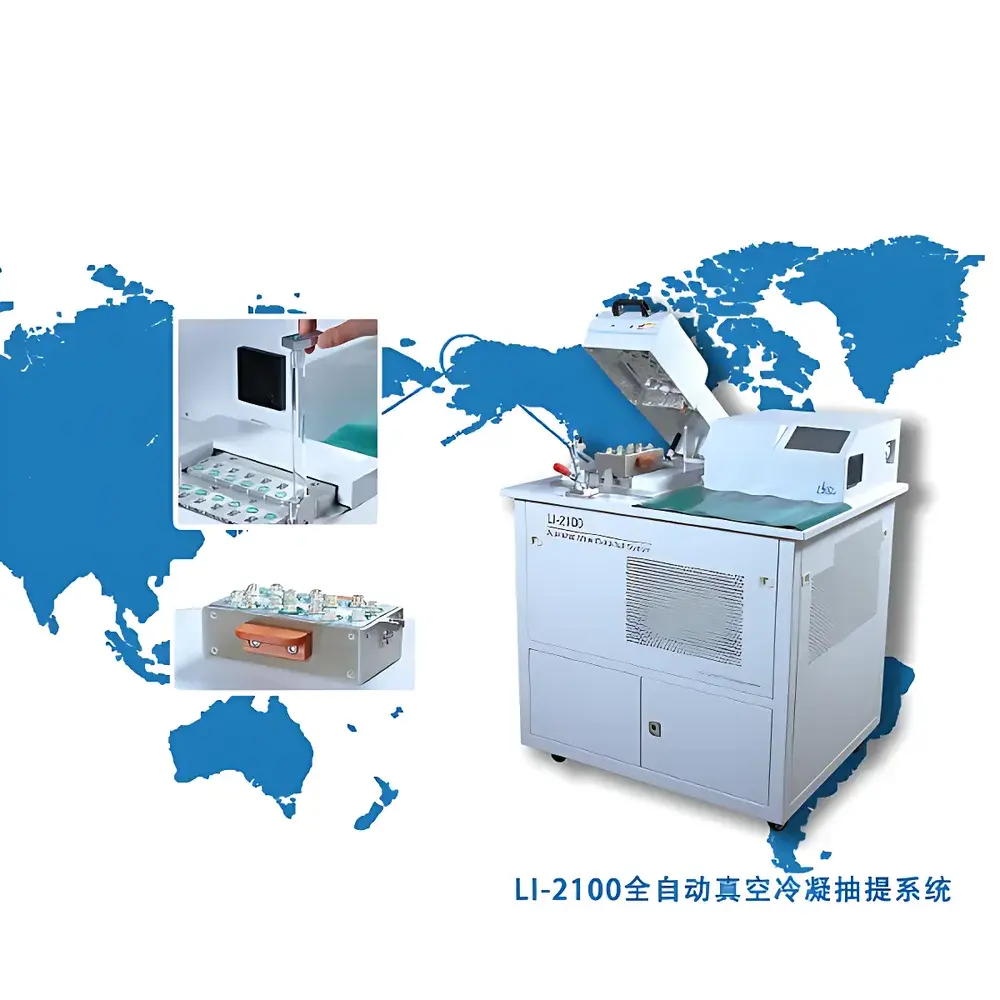
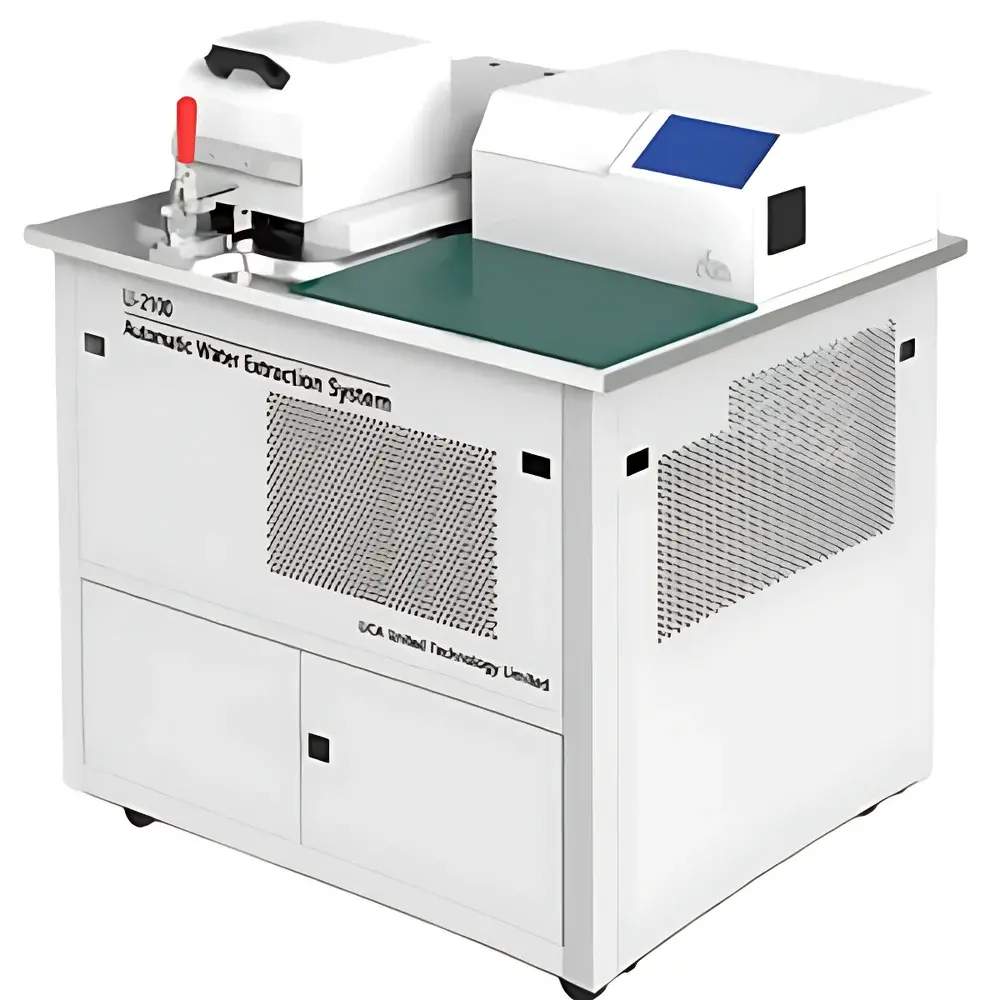
LICA LI-2100 Fully Automated Vacuum Cryo-Condensation Extraction System
| Brand | LICA |
|---|---|
| Origin | Beijing, China |
| Manufacturer Type | Authorized Distributor |
| Country of Origin | China |
| Model | LI-2100 |
| Price | USD 30,500 (FOB Beijing) |
| Vacuum Level | <1000 Pa |
| Leak Rate | <1 Pa/s |
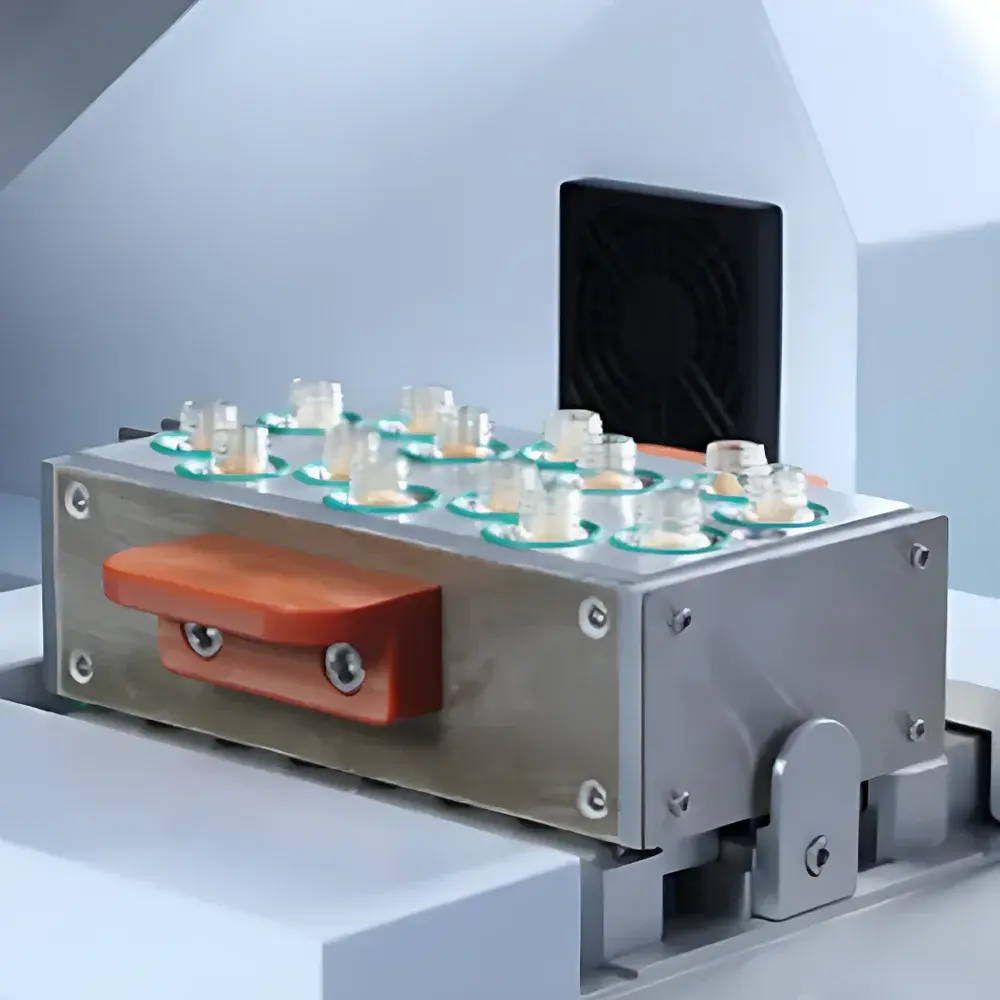
| Extraction Capacity | 14 samples per run |
| Throughput | >110 samples/day |
| Extraction Efficiency | >98% |
| Water Recovery Rate | 99–101% |
| Vacuum Pump | 5 L/min, 24 V DC, Max Pressure 5 mbar |
| Cooling | Compressor-coupled cryogenic trap, Min Temp −95 °C |
| Heating | Resistive cartridge heating, Max Temp 190 °C |
| Display | 7″ TFT LCD (800×480, 65K colors), touch-enabled HMI |
| Safety | Overtemperature cutoff, auto-alarm for cooling failure & vacuum breach |
| Dimensions (H×W×D) | 90 × 74 × 110 cm |
| Weight | 120 kg |
Overview
The LICA LI-2100 Fully Automated Vacuum Cryo-Condensation Extraction System is an engineered solution for quantitative, isotopically faithful extraction of water from plant tissue and soil matrices. It operates on the principle of ultra-low-pressure vacuum distillation coupled with cryogenic condensation — a physically grounded method that avoids kinetic isotope fractionation by eliminating phase-transfer artifacts associated with boiling-point elevation or rapid vaporization. Unlike conventional liquid-nitrogen–cooled systems, the LI-2100 integrates a high-efficiency compressor-driven cold trap capable of sustaining −95 °C, ensuring complete condensation of evolved water vapor without thermal shock or isotopic skew. The system maintains sub-1000 Pa operating vacuum with leak integrity <1 Pa/s, enabling reproducible, low-energy phase separation under near-equilibrium conditions. Designed for integration with isotope ratio mass spectrometers (IRMS) and cavity ring-down spectroscopy (CRDS) analyzers, the LI-2100 delivers high-purity, volume-quantified water extracts suitable for δ²H and δ¹⁸O analysis in compliance with ISO 11277, ASTM D4318, and IAEA guidelines for stable isotope hydrology.
Key Features
- Fully automated batch processing: Unattended operation for up to 14 samples per cycle, with programmable temperature ramping, vacuum profiling, and timed condensation phases
- Cryogenic condensation without liquid nitrogen: Integrated two-stage compressor refrigeration system achieves stable −95 °C cold trap performance, eliminating cryogen logistics, handling hazards, and thermal instability
- High-fidelity water recovery: ≥98% extraction efficiency and 99–101% volumetric recovery across diverse sample types (e.g., woody xylem, fibrous roots, clay-rich soils, organic horizons)
- Robust process control: Real-time monitoring of vacuum pressure, cold trap temperature, heater surface temperature, and system integrity; automatic shutdown upon deviation from user-defined thresholds
- Compliance-ready architecture: CE-marked design with electromagnetic compatibility (EMC) per EN 61326-1 and safety certification per EN 61010-1; supports audit trails compatible with GLP/GMP workflows
- Intuitive human-machine interface: 7-inch capacitive-touch TFT display with graphical workflow navigation, parameter logging, and event-triggered diagnostic reporting
Sample Compatibility & Compliance
The LI-2100 accommodates solid-phase environmental samples including fresh/frozen plant tissues (leaves, stems, roots), air-dried or field-moist soils (sand to clay loam), sediments, and hydromorphic organic matter. Sample vessels are standardized 12 mL borosilicate glass tubes with PTFE-lined caps, ensuring inert contact surfaces and minimal memory effects. Extraction protocols align with ISO/TC 190/SC 3 standards for soil water characterization and IAEA Technical Document No. 1783 on isotopic water tracing. The system meets essential requirements for traceability under FDA 21 CFR Part 11 when paired with validated LICA DataLink software (v3.2+), providing electronic signatures, change logs, and secure user access levels.
Software & Data Management
Control and data acquisition are managed via LICA ControlSuite v4.1 — a Windows-based application supporting method template creation, real-time sensor visualization (vacuum, temperature, time), and CSV-exportable raw logs with timestamped metadata (operator ID, sample ID, start/stop times, alarm events). All system parameters are stored with SHA-256 checksum integrity; audit trails record configuration changes, calibration entries, and emergency stops. Optional integration with LIMS platforms is available via OPC UA or RESTful API endpoints, enabling automated sample registration and result forwarding to IRMS data reduction pipelines (e.g., Isodat, Delta Ray).
Applications
- Plant water source partitioning using dual-isotope (δ²H–δ¹⁸O) mixing models
- Soil water movement quantification across hydraulic gradients and depth profiles
- Evapotranspiration component separation (soil evaporation vs. plant transpiration) in eddy covariance validation studies
- Groundwater recharge assessment via isotopic fingerprinting of infiltrating precipitation and snowmelt
- Paleohydrological reconstruction using δ¹⁸O in cellulose-bound water from tree rings or sedimentary archives
- Method validation for USP residual solvent testing where water activity and isotopic composition inform stability predictions
FAQ
What vacuum level is required to prevent isotopic fractionation during extraction?
A sustained pressure below 1000 Pa minimizes vapor-phase diffusion gradients and ensures equilibrium-controlled phase transition — critical for preserving natural δ²H and δ¹⁸O signatures.
Can the LI-2100 process samples with high organic content or coarse particulates?
Yes; optimized heating profiles (up to 190 °C) and adjustable vacuum ramp rates accommodate lignin-rich wood, peat, and gravelly soils without charring or splattering.
How is system performance verified between runs?
Built-in reference checks include blank tube runs, certified water standard extractions (IAEA VSMOW2, GISP), and periodic vacuum integrity tests logged automatically in the audit trail.
Is remote monitoring supported?
Ethernet-enabled firmware allows secure SSH access and live dashboard viewing via institutional networks; no cloud dependency or third-party hosting.
What maintenance intervals are recommended for long-term reliability?
Vacuum pump oil replacement every 6 months, cold trap defrosting after 500 cycles, and annual calibration of temperature sensors against NIST-traceable references.



