
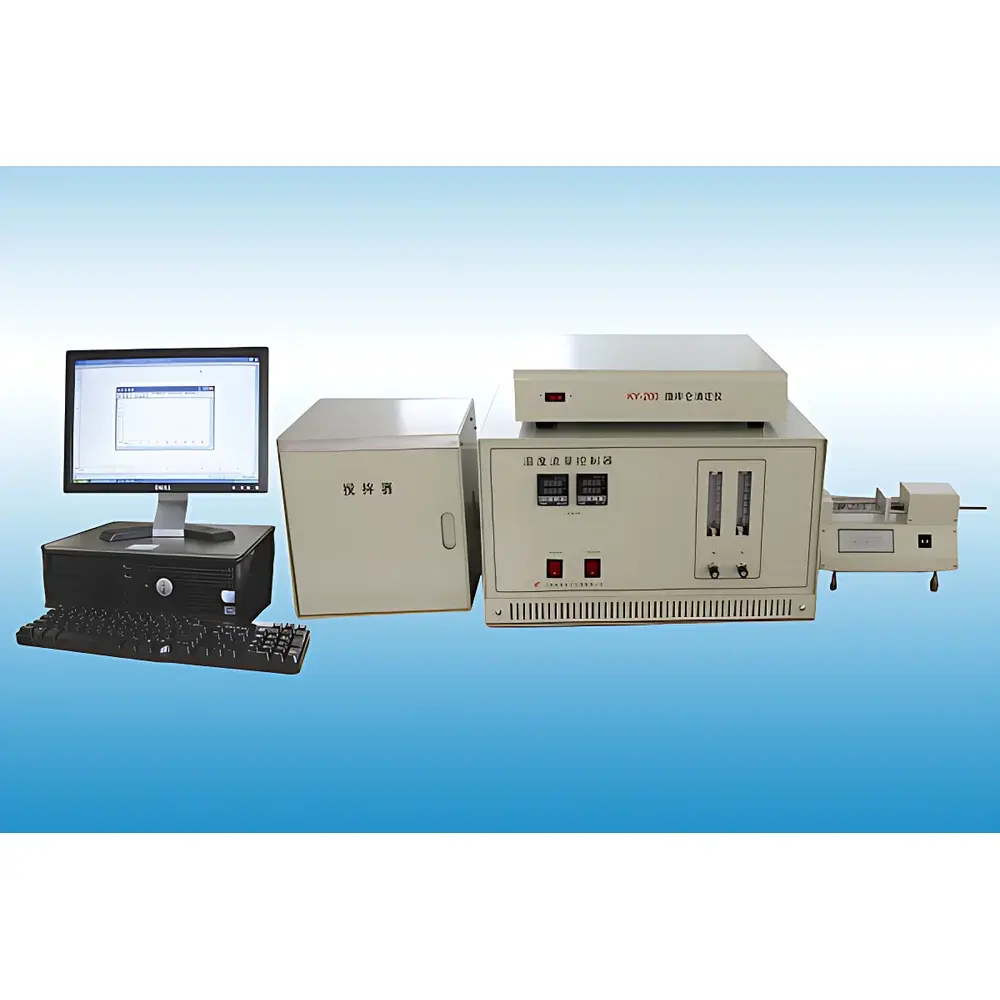
Kyoyuan KY-200 Microcoulometric Sulfur Analyzer
| Brand | Kyoyuan |
|---|---|
| Origin | Jiangsu, China |
| Manufacturer Type | Direct Manufacturer |
| Country of Origin | China |
| Model | KY-200 |
| Price Range | USD 2,800 – 7,000 |
| Measurement Principle | Microcoulometric Titration (Electrolytic Iodine Generation) |
| Sample Forms | Liquid, Solid, Gas (with optional injectors) |
| Analyte | Total Sulfur (S) |
| Detection Range | 0.1 mg/L – 10,000 mg/L |
| LOD (S) | 0.1 mg/L |
| Repeatability | As per SH/T 0253 (Cv ≤ 3% at >10 mg/L |
| Temperature Control | Ambient to 1100 °C, ±1 °C |
| Carrier Gases | Industrial-grade N₂ and O₂ |
| Cooling Method | Intelligent Fan-based Air Cooling |
| Power Rating | 1500 W |
| Compliance Standards | SH/T 0253, GB/T 11061.4, SH/T 0222, GB/T 3208, SH/T 1147 |
Overview
The Kyoyuan KY-200 Microcoulometric Sulfur Analyzer is a precision electrochemical instrument engineered for trace-level total sulfur quantification in hydrocarbon matrices using the microcoulometric titration principle. In operation, samples—liquid, solid, or gaseous—are introduced into a high-temperature combustion zone (up to 1100 °C) under controlled N₂/O₂ atmosphere, where all organic and inorganic sulfur species are quantitatively converted to sulfur dioxide (SO₂). The SO₂ is carried by gas stream into a dual-electrode titration cell, where electrolytically generated iodine (I₂) reacts stoichiometrically with SO₂ according to the reaction: SO₂ + I₂ + 2H₂O → H₂SO₄ + 2HI. The coulombic charge consumed during iodine regeneration is measured in real time; based on Faraday’s law of electrolysis, the instrument calculates sulfur mass directly from integrated current over time. This method delivers inherent linearity, high specificity for sulfur, and minimal matrix interference—making it suitable for regulatory-compliant analysis in refinery QC, petrochemical R&D, and third-party testing laboratories.
Key Features
- Digitally controlled microcoulometer architecture with embedded PID temperature regulation (±1 °C stability across 0–1100 °C), ensuring consistent pyrolysis efficiency and SO₂ yield.
- Automated sample introduction via programmable liquid/gas/solid autosamplers—reducing operator dependency and improving inter-run reproducibility.
- Intelligent air-cooling system with thermally triggered fan activation/deactivation, eliminating water-cooling infrastructure and enhancing long-term operational reliability.
- Real-time status monitoring via Windows-based control software: displays combustion temperature, cell voltage, electrolysis current, integration curve, and endpoint detection logic.
- Modular furnace design with quartz combustion tube and corrosion-resistant titration cell—optimized for repeated exposure to aggressive sulfur oxides and halogenated byproducts.
- Low-power consumption architecture (1500 W max) with internal surge protection and thermal cutoff safeguards, compliant with IEC 61010-1 safety requirements.
Sample Compatibility & Compliance
The KY-200 accommodates diverse sample types without chemical pre-treatment: gasoline, diesel, naphtha, LPG, natural gas condensates, lubricants, catalysts, and polymer feedstocks. Solid samples—including catalyst powders and rubber compounds—are analyzed using boat-style solid injectors; gaseous samples require pressure-regulated gas sampling valves. All analytical protocols adhere strictly to internationally recognized standard methods: SH/T 0253 (light distillates), GB/T 11061.4 (natural gas), SH/T 0222 (LPG), GB/T 3208 (benzene derivatives), and SH/T 1147 (aromatic hydrocarbons). Data integrity meets GLP and ISO/IEC 17025 documentation requirements; audit trails, user access logs, and electronic signatures can be implemented via optional software modules aligned with FDA 21 CFR Part 11 readiness.
Software & Data Management
The KY-200 operates under Kyoyuan’s proprietary CoulSoft v3.2 platform—a Windows 10/11 compatible application supporting method setup, sequence programming, real-time signal visualization, and automated report generation (PDF/CSV/XLSX). Calibration curves support multi-point linear and quadratic regression with residual error reporting. Raw coulombic integrals, baseline correction parameters, and cell conditioning cycles are stored with timestamped metadata. Exported datasets include full chromatographic-like integration traces, enabling retrospective reprocessing and uncertainty propagation analysis per ISO/IEC Guide 98-3 (GUM). Software updates are delivered via secure HTTPS channel with SHA-256 signature verification.
Applications
- Refinery process control: Monitoring sulfur breakthrough in hydrotreater effluents and product slates per ASTM D3227 and U.S. EPA Tier 3 gasoline specifications.
- Petrochemical QA/QC: Verification of ultra-low-sulfur diesel (ULSD, <15 ppm S) and jet fuel (ASTM D1319, D4294) compliance.
- Environmental testing labs: Quantification of sulfur in soil extracts, wastewater, and flue gas simulants per EPA Method 1664B adaptations.
- Academic research: Kinetic studies of sulfur retention in zeolite catalysts and speciation modeling of organosulfur compounds under oxidative pyrolysis.
- Contract testing organizations: Accredited sulfur analysis for ISO 8217 marine fuel certification and ASTM D7169 extended boiling point characterization.
FAQ
What sample matrices are supported without derivatization?
Liquid fuels, liquefied petroleum gas (LPG), natural gas condensates, solid catalysts (via ceramic boat), and aromatic solvents—all analyzed directly per applicable standard methods.
Is the instrument compatible with existing laboratory information management systems (LIMS)?
Yes. CoulSoft supports ASTM E1384-compliant data export and optional OPC UA server integration for bidirectional LIMS communication.
How is system suitability verified before sample analysis?
Built-in calibration verification using certified sulfur standards (e.g., dibenzothiophene in toluene) checks recovery accuracy, electrode response time, and cell background stability per SH/T 0253 Annex B.
Can the same titration cell be used for chlorine analysis?
No. Sulfur and chlorine require separate electrolyte formulations and electrode configurations due to differing redox potentials and reaction kinetics; dedicated cells are supplied for each analyte.
What maintenance intervals are recommended for routine operation?
Quartz combustion tube cleaning every 200 injections; titration cell electrolyte replacement every 30 days or after 500 analyses; annual calibration verification against NIST-traceable reference materials.
Related Products




