
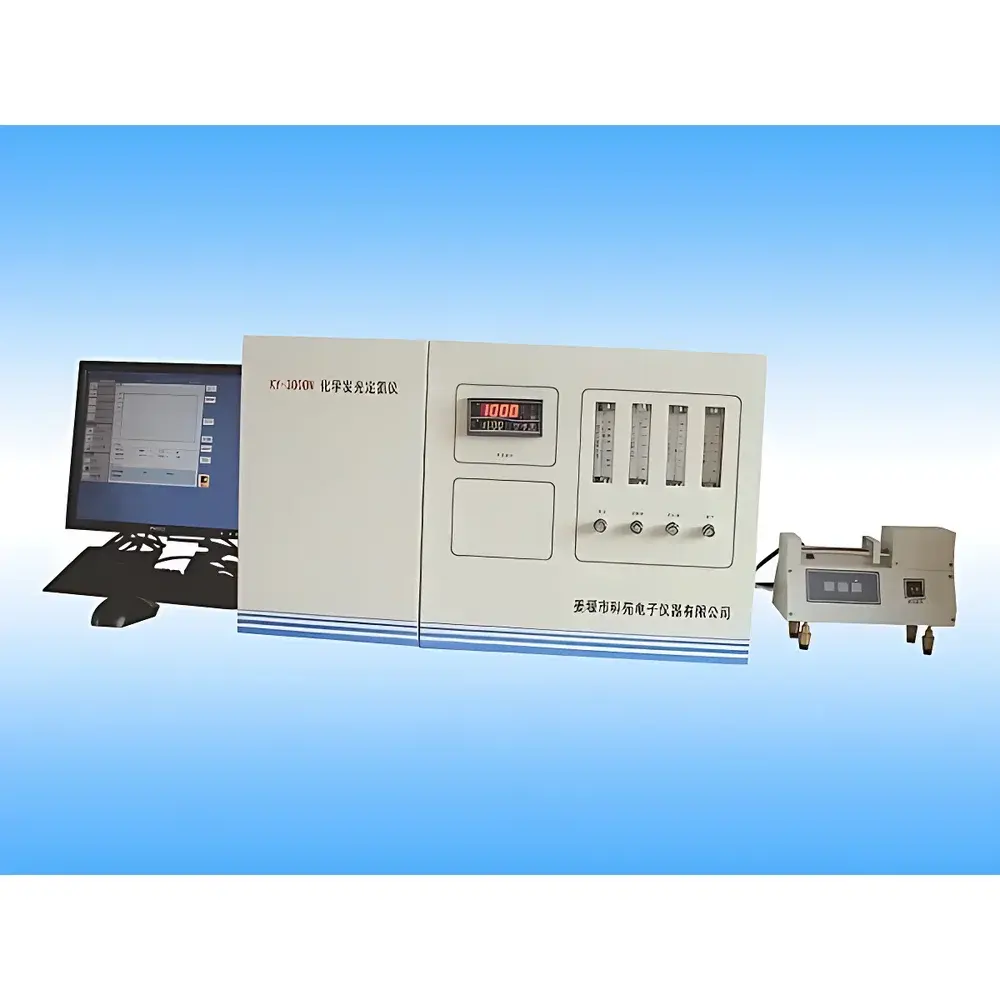
KY-3000S UV Fluorescence Sulfur Analyzer by Keyuan Instruments
| Brand | Keyuan Instruments |
|---|---|
| Origin | Jiangsu, China |
| Manufacturer Type | Direct Manufacturer |
| Country of Origin | China |
| Model | KY-3000S |
| Price Range | USD 7,000 – 14,000 |
| Detection Principle | Ultraviolet Fluorescence (UVF) for Total Sulfur |
| Compliance Standards | SH/T 0689, ASTM D5453, GB/T 34100-2017 |
| Sample Forms | Liquid, Solid, Gas (with optional injectors) |
| Detection Range | 0.2 mg/L to 5000 ppm (equivalent to 0.00002–0.5 wt%) |
| LOD | 0.2 mg/L (as S) |
| Repeatability | ±0.2 mg/L at 1.0 mg/L |
| Furnace Temp Control | Ambient to 1300 °C, ±1 °C stability |
| Carrier & Oxidant Gases | High-purity O₂ (≥99.98%), high-purity Ar (≥99.98%) |
| Power Requirement | 2 kW |
| Data Acquisition | 24-bit ADC, USB 2.0 interface, minimum detectable signal <1 µV |
| PMT Voltage | Adjustable, software-controlled |
| Calibration Modes | Single-point or multi-point linear/nonlinear curve fitting |
| Software Compatibility | Windows 7/10/11, macOS (via Wine-compatible runtime), Linux (CLI support) |
Overview
The KY-3000S UV Fluorescence Sulfur Analyzer is a benchtop elemental analyzer engineered for precise, trace-level quantification of total sulfur in hydrocarbon-based matrices using the ultraviolet fluorescence detection principle. Upon high-temperature combustion in an oxygen-rich quartz furnace (up to 1300 °C), sulfur-containing compounds are converted quantitatively to sulfur dioxide (SO₂). The SO₂ molecules are then carried into a reaction chamber where they are excited by pulsed UV light (190–230 nm); subsequent emission of characteristic fluorescence at ~340 nm is detected by a low-noise photomultiplier tube (PMT). Signal intensity is directly proportional to sulfur concentration, enabling calibration against certified reference materials traceable to NIST or CRM standards. Designed for compliance with SH/T 0689, ASTM D5453, and GB/T 34100-2017, the KY-3000S delivers metrologically sound results required for refinery process control, fuel specification verification (e.g., ULSD, jet fuel, gasoline), petrochemical feedstock screening, and regulatory reporting under ISO 8217, EN 590, or EPA Method IP 526.
Key Features
- High-stability quartz combustion furnace with programmable temperature ramping (ambient to 1300 °C, ±1 °C precision) and dual-zone thermal insulation for complete oxidation of refractory sulfur species (e.g., thiophenes, benzothiophenes)
- Optimized UV excitation source and cooled PMT detector with adjustable high-voltage bias (0–1000 V), enabling dynamic range extension and signal-to-noise ratio enhancement
- 24-bit analog-to-digital conversion with USB 2.0 interface ensures sub-microvolt signal resolution and immunity to electromagnetic interference in industrial lab environments
- Modular sample introduction system supporting liquid autosampler (10–100 µL loop), solid combustion boat module (for polymers, catalysts, coal), and gas sampling valve (for LPG, natural gas, refinery off-gas)
- Real-time background subtraction and pulse-height discrimination algorithms minimize quenching effects and hydrocarbon matrix interference
- Fully configurable method templates for routine QC checks, calibration validation, and instrument performance qualification (IPQ) per ASTM D7097 guidelines
Sample Compatibility & Compliance
The KY-3000S accommodates diverse sample types without chemical pretreatment: liquid fuels (gasoline, diesel, kerosene, biodiesel blends), crude oils, lubricants, solvents, plastics (e.g., polyethylene, polypropylene), catalysts, and gaseous hydrocarbons. Solid samples require ash-free quartz boats and optional catalyst-assisted combustion (e.g., tungsten trioxide). All measurements adhere to the fundamental requirements of ISO/IEC 17025:2017 for testing laboratories, including documented uncertainty budgets, traceable calibration, and periodic system suitability testing. The analyzer supports audit-ready data integrity through secure user access levels, electronic signatures, and immutable audit trails—aligning with FDA 21 CFR Part 11 and EU Annex 11 expectations for regulated environments.
Software & Data Management
The embedded KyAnalyze™ software (v4.x) provides full lifecycle data handling: method setup, real-time chromatogram visualization, peak integration with baseline correction, calibration curve generation (linear, quadratic, or cubic), and QC flagging per ASTM D6299 criteria. Raw data files (.kyd) are stored in open binary format with embedded metadata (operator ID, timestamp, instrument serial, gas pressures, furnace profile). Export options include CSV, PDF reports (with customizable headers/footers), and direct LIMS integration via ASTM E1394 or HL7-compliant APIs. Software validation documentation (IQ/OQ/PQ protocols) is available upon request for GLP/GMP implementation.
Applications
- Refinery quality assurance: monitoring sulfur removal efficiency across hydrotreating units (HDS)
- Fuel certification labs: verifying compliance with Euro 5/6, Tier 3, and IMO 2020 marine fuel limits (0.50 wt% max)
- Petrochemical R&D: kinetic studies of sulfur speciation during catalytic cracking or alkylation
- Plastics manufacturing: quantifying residual sulfur from vulcanization agents or stabilizers
- Environmental testing labs: analyzing soil extracts or wastewater effluents per EPA SW-846 Method 9071B adaptations
- Academic research: method development for ultra-low-sulfur diesel (ULSD) or biofuel blends
FAQ
What combustion gases are required, and why must purity be ≥99.98%?
High-purity oxygen (≥99.98%) ensures complete oxidation of organic sulfur to SO₂ without side reactions; argon (≥99.98%) serves as inert carrier gas to prevent PMT window contamination and maintain stable fluorescence quantum yield.
Can the KY-3000S measure nitrogen simultaneously?
No—the KY-3000S is dedicated to sulfur analysis via UV fluorescence. For combined S/N determination, Keyuan offers the KY-3000SN variant, which integrates chemiluminescence detection for nitrogen.
Is third-party certification available for method validation?
Yes—Keyuan Instruments provides optional NIST-traceable calibration verification kits and collaborates with accredited ISO/IEC 17025 labs for method transfer and cross-validation studies.
How often does the PMT require recalibration?
Under normal operation (≤8 h/day), PMT gain drift is negligible over 6 months; annual verification against factory baseline is recommended, supported by built-in diagnostic routines.
Does the system support remote diagnostics or preventive maintenance alerts?
Yes—via optional Ethernet module and KyRemote™ cloud service, users receive automated notifications for consumables depletion (quartz liner, desiccant), gas pressure thresholds, and furnace thermocouple degradation trends.
Related Products





