
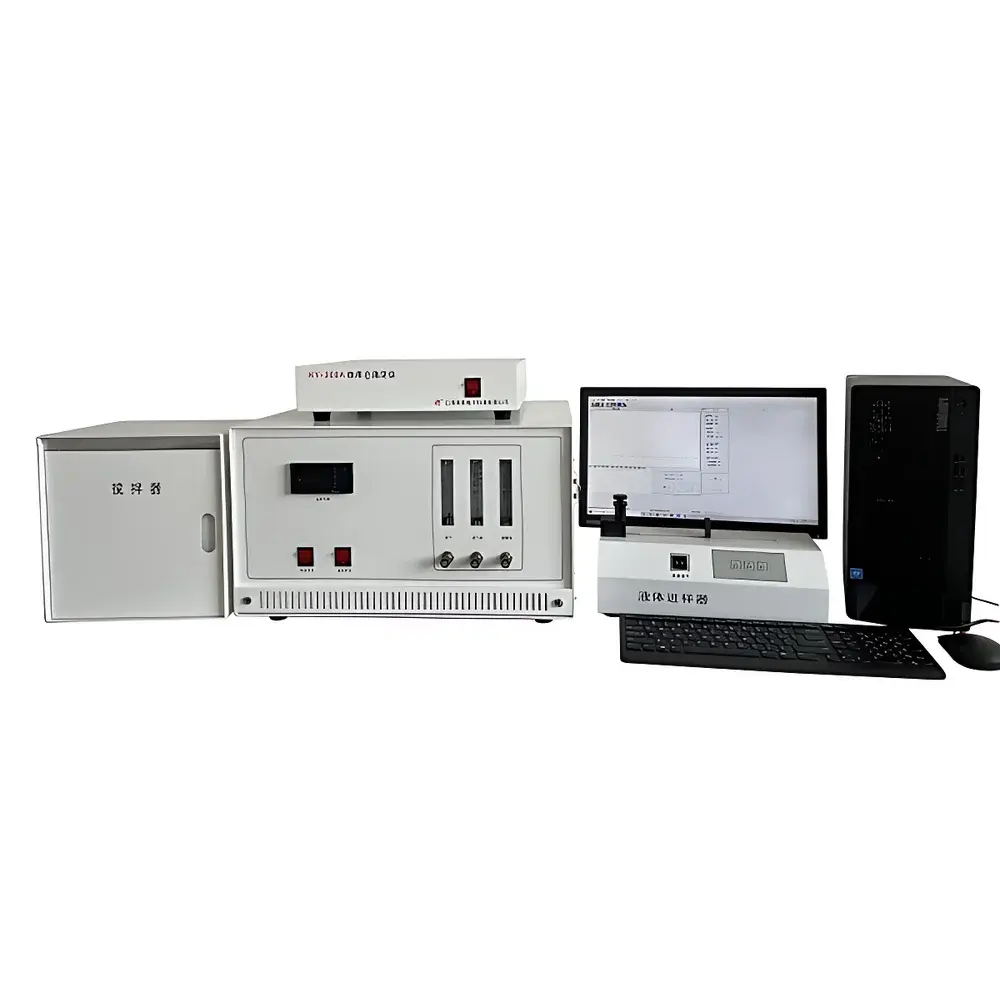
KY-200 Microcoulometric Sulfur and Chlorine Analyzer
| Brand | Keyuan Instruments |
|---|---|
| Origin | Jiangsu, China |
| Manufacturer Type | Direct Manufacturer |
| Product Origin | Domestic (China) |
| Model | KY-200 |
| Pricing | Available Upon Request |
| Principle | Microcoulometric Titration (ASTM D3227, ASTM D5808, SH/T 0253–1992, GB/T 11061–1997, SH/T 0222–1992) |
| Sample Types | Liquid, Solid, Gas (with optional injectors) |
| Detection Method | Coulometric Generation of Titrant (I₂ for S |
| Sulfur Range | 0.2–10,000 mg/L |
| Chlorine Range | 0.3–10,000 mg/L |
| Bias Voltage Range | 0–500 mV |
| Furnace Temperature Range | Ambient to 1000 °C |
| Temperature Control Accuracy | ±5 °C |
| Power Consumption | 1500 W |
| Dimensions (W×D×H) | 530 × 500 × 340 mm |
| Cooling | Air-cooled Cracking System with Auto-Controlled Fan |
| Compliance | SH/T 0253–1992, GB/T 11061–1997, SH/T 0222–1992 |
| Standard Configuration | KY-200 Liquid Analysis System + PC Workstation |
| Optional Accessories | Solid Sampler, Light/Heavy Quartz Cracking Tubes, Certified Reference Materials |
Overview
The KY-200 Microcoulometric Sulfur and Chlorine Analyzer is a precision electrochemical instrument engineered for quantitative determination of total sulfur and total chlorine in petroleum, petrochemical, and environmental samples using the microcoulometric titration principle. Based on Faraday’s law of electrolysis, the analyzer quantifies analyte concentration by measuring the electric charge consumed during coulometric generation of active titrant—iodine (I₂) for sulfur oxidation and silver ions (Ag⁺) for chloride precipitation. Samples are thermally cracked in a high-temperature quartz furnace (up to 1000 °C) under controlled nitrogen/oxygen carrier gas flow, converting organic and inorganic sulfur species to SO₂ and chlorine species to HCl. The gaseous effluent is swept into a dual-mode coulometric titration cell, where real-time electrochemical detection and charge integration occur. Fully automated operation—including sample introduction, cracking, titration, data acquisition, and result calculation—is managed via dedicated Windows-based software compliant with GLP documentation requirements.
Key Features
- Dual-analyte capability: Simultaneous or independent measurement of sulfur and chlorine content using interchangeable electrode configurations and optimized cell chemistry.
- High-temperature programmable furnace: Precisely regulated from ambient to 1000 °C (±5 °C), supporting complete conversion of refractory sulfur compounds (e.g., thiophenes, sulfides) and organochlorides.
- Auto-balancing coulometric cell: Maintains stable bias voltage (0–500 mV range) and ensures rapid response and baseline stability during titration.
- Air-cooled cracking system: Integrated intelligent fan control eliminates water cooling infrastructure, reducing maintenance and enhancing operational safety.
- Modular sample introduction: Supports liquid syringe injection (standard), solid sampling via ceramic boat injector (optional), and gas analysis via pressurized loop (optional).
- Full digital signal processing: 24-bit ADC resolution, real-time charge integration, and drift-compensated baseline correction ensure reproducible quantification across wide dynamic ranges.
Sample Compatibility & Compliance
The KY-200 accommodates diverse matrices including gasoline, diesel, jet fuel, naphtha, LPG, natural gas condensates, lubricating oils, catalysts, and wastewater extracts. Its analytical performance meets or exceeds internationally recognized standards: SH/T 0253–1992 (light distillates), GB/T 11061–1997 (natural gas), and SH/T 0222–1992 (LPG). Method validation includes linearity assessment (r² ≥ 0.999 over 0.2–10,000 mg/L), repeatability (RSD ≤ 5% at low concentrations; ≤10% above 10 mg/L for sulfur), and recovery testing per ISO/IEC 17025 guidelines. The system supports audit-ready electronic records, with timestamped raw charge curves, calibration logs, and user action trails—fully compatible with FDA 21 CFR Part 11 requirements when deployed with validated software configuration and access controls.
Software & Data Management
The KY-200 is operated via Keyuan’s proprietary MicroCoulSoft v3.2, a Windows 10/11-compatible application designed for laboratory informatics integration. The interface provides real-time monitoring of furnace temperature, bias voltage, electrolysis current, and titration endpoint dynamics. All analytical runs are stored with metadata (operator ID, sample ID, method file, calibration date, instrument status flags). Data export supports CSV, PDF, and XML formats for LIMS ingestion. Built-in calibration management allows multi-point standardization using certified SRMs (e.g., dibenzothiophene, chlorobenzene), with automatic curve fitting and outlier rejection. Audit trail functionality logs all critical events—including parameter changes, calibration updates, and report generation—with immutable timestamps and user authentication.
Applications
- Refinery QC/QA: Monitoring sulfur levels in finished fuels to meet Euro 5/6, Tier 3, and IMO 2020 marine bunker specifications.
- Petrochemical R&D: Quantifying chlorine impurities in ethylene feedstocks and catalyst poisons in reforming units.
- Environmental compliance: Measuring total chlorine in wastewater effluents and soil extracts per EPA Method 9056A analog protocols.
- Research laboratories: Studying desulfurization efficiency of novel adsorbents or oxidative catalysts via precise sulfur mass balance.
- Contract testing labs: Delivering accredited test reports traceable to NIST SRMs and aligned with ISO/IEC 17025 clause 7.7 (uncertainty estimation).
FAQ
What detection principles does the KY-200 employ for sulfur and chlorine?
It uses microcoulometric titration: SO₂ is titrated with electrogenerated iodine; HCl is titrated with electrogenerated silver ions—both governed by Faraday’s law.
Can the same hardware analyze both sulfur and chlorine in one sequence?
No—separate cell configurations and electrolyte systems are required; switching involves physical replacement of electrodes and reconditioning per manufacturer protocol.
Is the system compliant with regulatory data integrity requirements?
Yes, when configured with role-based user accounts, electronic signatures, and enabled audit-trail logging, it satisfies FDA 21 CFR Part 11 and EU Annex 11 expectations.
What maintenance intervals are recommended for the quartz cracking tube?
Typical service life is 3–6 months under continuous operation; visual inspection for discoloration or cracking is advised prior to each batch run.
Does the analyzer support unattended overnight operation?
Yes—integrated auto-shutdown, thermal fault protection, and gas-flow monitoring enable safe extended runs with up to 48-sample autosampler compatibility (optional add-on).





