
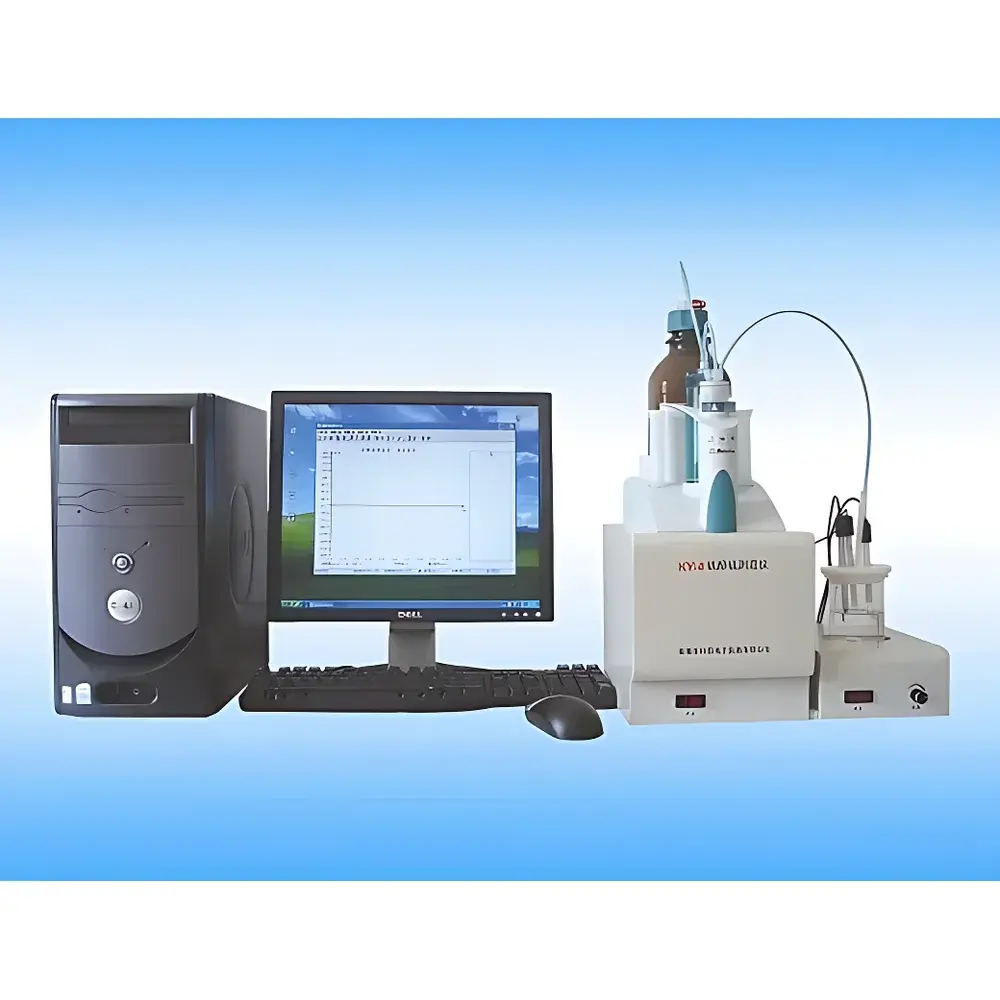
Kyuyuan KY-403B Automatic Potentiometric Titrator
| Origin | Jiangsu, China |
|---|---|
| Manufacturer Type | Authorized Distributor |
| Origin Category | Domestic (PRC) |
| Model | KY-403B |
| Pricing | Available Upon Request |
| Sample Type | Liquid |
| Sulfur Alcohol (Mercaptan Sulfur) Measurement Range | 0.0001–0.01 % (m/m) |
| Titration Method | Potentiometric Titration |
| Burette Capacity | 10 mL |
| Minimum Dispensed Volume | 0.01 mL |
| Potential Measurement Range | ±1999.5 mV |
| Burette Accuracy | ±0.1 % F.S. |
| Electronic Unit Basic Error | ±0.1 % of full scale + 0.5 mV |
| Relative Error | ≤5 % |
| Input Impedance | ≥1 × 10¹² Ω |
| Compliance | JJG 814–2015 Verification Regulation for Automatic Potentiometric Titrators |
Overview
The Kyuyuan KY-403B Automatic Potentiometric Titrator is a dedicated analytical instrument engineered for the precise quantification of mercaptan sulfur (thiol sulfur) in petroleum products—primarily gasoline, jet fuel, naphtha, and distillates—according to standardized electrochemical titration principles. It operates on the potentiometric endpoint detection method, where the potential difference between a reference electrode (e.g., Ag/AgCl) and an indicator electrode (e.g., silver or sulfide-selective) is continuously monitored during titrant addition. As the stoichiometric endpoint is approached, a sharp inflection in the E–V curve occurs; the KY-403B employs digital signal processing to smooth raw potential data and apply second-derivative or fixed-slope algorithms for robust endpoint localization. This eliminates subjective visual interpretation and significantly improves inter-operator reproducibility—critical for regulatory reporting under ASTM D3229, IP 57, and GB/T 1792.
Key Features
- Imported high-precision burette assembly with integrated stepper motor drive and glass syringe-type delivery mechanism, ensuring volumetric accuracy within ±0.1 % F.S. across the full 10 mL range.
- Dual high-impedance (>1 × 10¹² Ω) analog front-end circuitry minimizing electrode polarization effects and enabling stable mV readings even in low-conductivity hydrocarbon matrices.
- Automated liquid handling sequence: auto-refill, fixed-volume dosing, and real-time potential feedback control—eliminating manual intervention during titration cycles.
- Endpoint recognition algorithm dynamically adjusts sensitivity based on slope magnitude and noise threshold, reducing false positives in samples with slow potential transitions or background drift.
- Compliance with JJG 814–2015, the national metrological verification regulation for automatic potentiometric titrators in China, covering linearity, repeatability, resolution, and system blank assessment protocols.
Sample Compatibility & Compliance
The KY-403B is optimized for liquid-phase analysis of refined petroleum fractions without derivatization or extraction pretreatment. Its low detection limit (0.0001 % m/m) meets specification requirements for ultra-low-sulfur fuels. The instrument supports standard electrode configurations—including silver indicator electrodes and double-junction reference electrodes with non-aqueous electrolytes—to maintain stability in organic solvents such as isopropanol–toluene mixtures. While not certified to ISO/IEC 17025 or FDA 21 CFR Part 11 out-of-the-box, its hardware architecture and data logging structure are compatible with laboratory quality management systems implementing GLP/GMP-aligned audit trails when paired with validated third-party LIMS integration.
Software & Data Management
Control and data acquisition are performed via a Windows-based application that records raw potential (mV) vs. volume (mL) data at configurable sampling intervals (10–100 ms). Each titration run generates a timestamped .csv file containing raw measurements, smoothed derivative curves, calculated endpoint volumes, and final concentration results traceable to user ID and sample ID. All data entries are immutable post-acquisition; modification history is logged only in administrator-accessible audit logs. Export options include PDF reports compliant with internal QA templates and Excel-compatible formats for statistical process control (SPC) analysis. The software supports calibration verification checks per JJG 814–2015 Annex A, including electrode offset validation and buffer solution response verification.
Applications
- Quantitative determination of reactive sulfur species in refinery intermediate streams and finished fuels per ASTM D3229 (Standard Test Method for Mercaptans in Gasoline by Potentiometric Titration).
- Quality control of jet fuel per IP 57 (Determination of Mercaptan Sulphur in Petroleum Products) and GB/T 1792 (Petroleum Products—Determination of Mercaptan Sulphur).
- Method development and validation studies requiring high-resolution endpoint detection in low-conductivity media.
- Supporting R&D efforts in catalyst deactivation research, where trace sulfur poisoning mechanisms are investigated through controlled spiking experiments.
- Training platform for analytical chemistry laboratories focusing on electroanalytical fundamentals, including Nernst equation application, junction potential correction, and electrode maintenance protocols.
FAQ
What electrode types are recommended for optimal performance with the KY-403B?
Silver indicator electrodes (solid-state or wire) paired with double-junction reference electrodes filled with saturated KNO₃ in isopropanol are recommended for mercaptan sulfur analysis in hydrocarbons.
Does the KY-403B support multi-step titration sequences (e.g., back-titration or potentiometric redox titrations)?
Yes—the firmware allows programmable stepwise addition modes and conditional endpoint triggers, enabling implementation of ASTM D2429 (back-titration for total sulfur) with appropriate reagent selection.
Is the instrument suitable for use in explosion-proof environments?
No—the KY-403B is designed for general laboratory use and lacks intrinsic safety certification (e.g., ATEX or IECEx); external ventilation or fume hood integration is required when handling volatile petroleum samples.
How often must the burette be calibrated according to JJG 814–2015?
Verification is required before first use, after any mechanical maintenance affecting dispensing accuracy, and at intervals not exceeding 12 months—or more frequently if usage exceeds 500 titrations per month.
Can raw mV vs. volume data be exported for independent curve-fitting using external software?
Yes—full-resolution time-stamped datasets are exported in plain-text CSV format, preserving all acquired points prior to onboard smoothing or derivative calculation.
Related Products





