
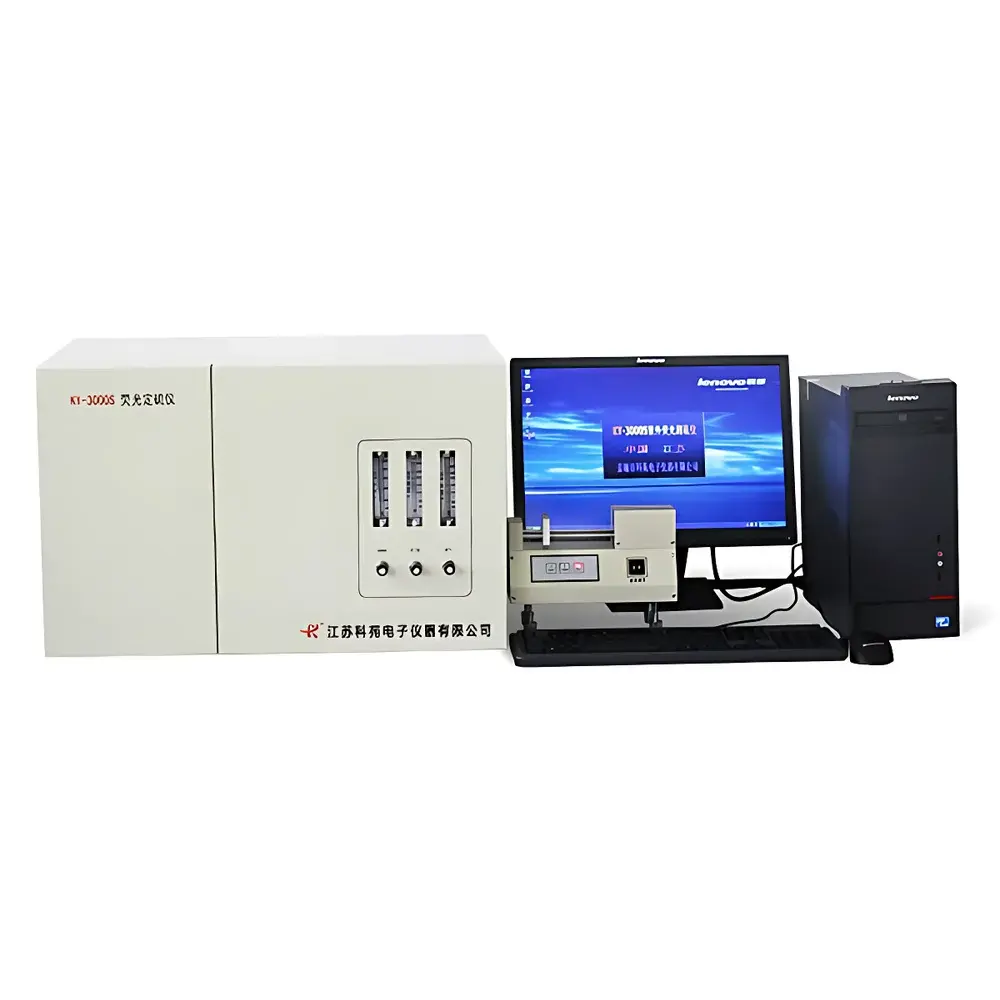
Kyuan KY-3000SA UV Fluorescence Sulfur Analyzer
| Brand | Kyuan Instruments |
|---|---|
| Origin | Jiangsu, China |
| Manufacturer Type | Direct Manufacturer |
| Country of Origin | China |
| Model | KY-3000SA |
| Detection Principle | UV Fluorescence |
| Portability | Benchtop (Non-portable) |
| Analyte | Total Sulfur |
| Measurement Range | 0.2 mg/L to 5000 ppm to % (w/w) |
| Analysis Time | <10 min |
| Detection Limit | 0.2 mg/L |
| Accuracy | ±0.1 mg/L for 0.2 mg/L ≤ X < 1.0 mg/L |
| Repeatability | CV ≤10% (1.0–100 mg/L), CV ≤5% (100–10,000 mg/L) |
| Temperature Control Range | Ambient to 1300 °C |
| Temperature Stability | ±3 °C |
| Power Consumption | 2 kW |
| Gas Requirements | High-purity O₂ (≥99.98%), High-purity Ar (≥99.98%) |
| Data Acquisition | 24-bit ADC, USB Interface |
| PMT Voltage | Adjustable |
| Calibration Modes | Single-point or multi-point calibration |
| Compliance Standards | SH/T 0689, ASTM D5453, GB/T 34100–2017 |
Overview
The Kyuan KY-3000SA UV Fluorescence Sulfur Analyzer is a benchtop laboratory instrument engineered for the precise, trace-level quantification of total sulfur in petroleum-based and hydrocarbon-rich matrices. It operates on the principle of ultraviolet fluorescence detection: samples are combusted at high temperature (up to 1300 °C) in an oxygen-rich environment to convert all sulfur species into sulfur dioxide (SO₂); the SO₂ is then carried by inert argon gas into a reaction chamber where it is excited by pulsed UV light; the resulting fluorescent emission at ~340 nm is detected by a photomultiplier tube (PMT), with signal intensity linearly proportional to sulfur concentration. This method delivers high specificity for sulfur—free from interference by nitrogen, carbon, or halogen compounds—and meets the fundamental metrological requirements for regulatory compliance in fuel quality control, refinery process monitoring, and R&D laboratories.
Key Features
- High-temperature combustion furnace with programmable temperature control (ambient to 1300 °C) and thermal stability of ±3 °C, ensuring complete oxidation of refractory sulfur compounds including thiophenes and sulfides.
- 24-bit analog-to-digital data acquisition system interfaced via standard USB 2.0, enabling sub-microvolt signal resolution and long-term baseline stability.
- Adjustable high-voltage supply for the photomultiplier tube, allowing optimization of signal-to-noise ratio across wide dynamic ranges—from trace-level gasoline (<1 mg/L) to high-sulfur residual fuels (up to % w/w).
- Flexible calibration architecture supporting both single-point verification and multi-point linear/nonlinear curve fitting, with automatic drift correction and integration of internal standard normalization.
- Benchtop mechanical design with modular gas handling subsystems (O₂/Ar dual-channel mass flow control), ceramic combustion tube, and quartz reaction cell—all constructed from high-purity, low-background materials to minimize memory effects and cross-contamination.
- Firmware and software architecture compliant with audit-trail requirements per FDA 21 CFR Part 11 when deployed in GLP/GMP environments, including user access levels, electronic signatures, and immutable raw-data logging.
Sample Compatibility & Compliance
The KY-3000SA accommodates liquid, solid, and gaseous samples through interchangeable injection modules: liquid autosamplers (with syringe or loop injection), solid sample boats with controlled pyrolysis staging, and pressurized gas sampling valves. It is validated for use with gasoline, diesel, jet fuel, naphtha, crude oil, lubricants, petrochemical feedstocks, and polymer extracts. The analyzer fully conforms to internationally recognized test methods—including ASTM D5453 (Standard Test Method for Determination of Total Sulfur in Light Hydrocarbons, Motor Fuels and Oils by Ultraviolet Fluorescence), SH/T 0689 (Chinese standard for total sulfur in light petroleum products), and GB/T 34100–2017 (determination of total sulfur in light hydrocarbons and engine fuels). Its measurement uncertainty profile satisfies ISO/IEC 17025 accreditation criteria for testing laboratories performing sulfur analysis in regulated fuel markets.
Software & Data Management
The instrument is operated via Kyuan’s proprietary SulfurView™ software, compatible with Windows 10/11 (64-bit) and virtualized environments. The application provides real-time chromatogram visualization, peak integration with customizable baseline algorithms, automated report generation (PDF/CSV/XLSX), and full traceability of instrument parameters, calibration history, and raw detector output. All data files are stored in a structured SQLite database with SHA-256 hashing for integrity verification. Audit logs record operator actions, method modifications, and result approvals with timestamps and user IDs. Exported datasets include metadata required for LIMS integration (ASTM E1578-compliant format) and support direct upload to enterprise QA/QC platforms.
Applications
- Regulatory compliance testing for ultra-low-sulfur diesel (ULSD, ≤10 ppm) and gasoline (Tier 3, ≤10 ppm) per EPA 40 CFR Part 1090 and EU EN 228/EN 590.
- Refinery process stream monitoring—from crude assay to hydrotreater effluent—to optimize HDS catalyst performance and hydrogen consumption.
- Quality assurance of aviation turbine fuels (Jet A-1, JP-8) per ASTM D1655 Annex A3 and DEF STAN 91-91.
- Research applications involving sulfur speciation modeling, catalyst poisoning studies, and alternative fuel sulfur profiling (e.g., bio-blends, synthetic fuels).
- Contract testing laboratories serving API-certified product certification, customs clearance, and third-party verification under ISO/IEC 17025 scope.
FAQ
What sample types can be analyzed without modification?
Liquid hydrocarbons (e.g., gasoline, kerosene, diesel) can be introduced directly via micro-syringe or loop injector. Solid samples (e.g., polymers, catalysts) require optional boat-loading accessories and pyrolysis protocol configuration.
Is the instrument suitable for ISO/IEC 17025 accreditation?
Yes—when operated with documented SOPs, calibrated reference standards (NIST-traceable SRMs), and enabled audit-trail functionality, the KY-3000SA meets technical requirements for accredited sulfur testing laboratories.
What gas purity specifications are mandatory for valid results?
Oxygen must be ≥99.98% pure (hydrocarbon-free); argon carrier gas must be ≥99.98% pure with dew point ≤−70 °C to prevent quenching of UV fluorescence and moisture-induced signal suppression.
How is system performance verified between calibrations?
Daily system suitability tests include analysis of a mid-range QC standard (e.g., 10 mg/L sulfur in toluene) and blank assessment; recovery must fall within ±5% of certified value, with RSD ≤3% over six replicate injections.
Can the software interface with laboratory information management systems (LIMS)?
Yes—SulfurView™ supports ASTM E1578-compliant data export and offers configurable ODBC connectivity for seamless integration with major LIMS platforms including LabWare, STARLIMS, and Thermo Fisher SampleManager.




