
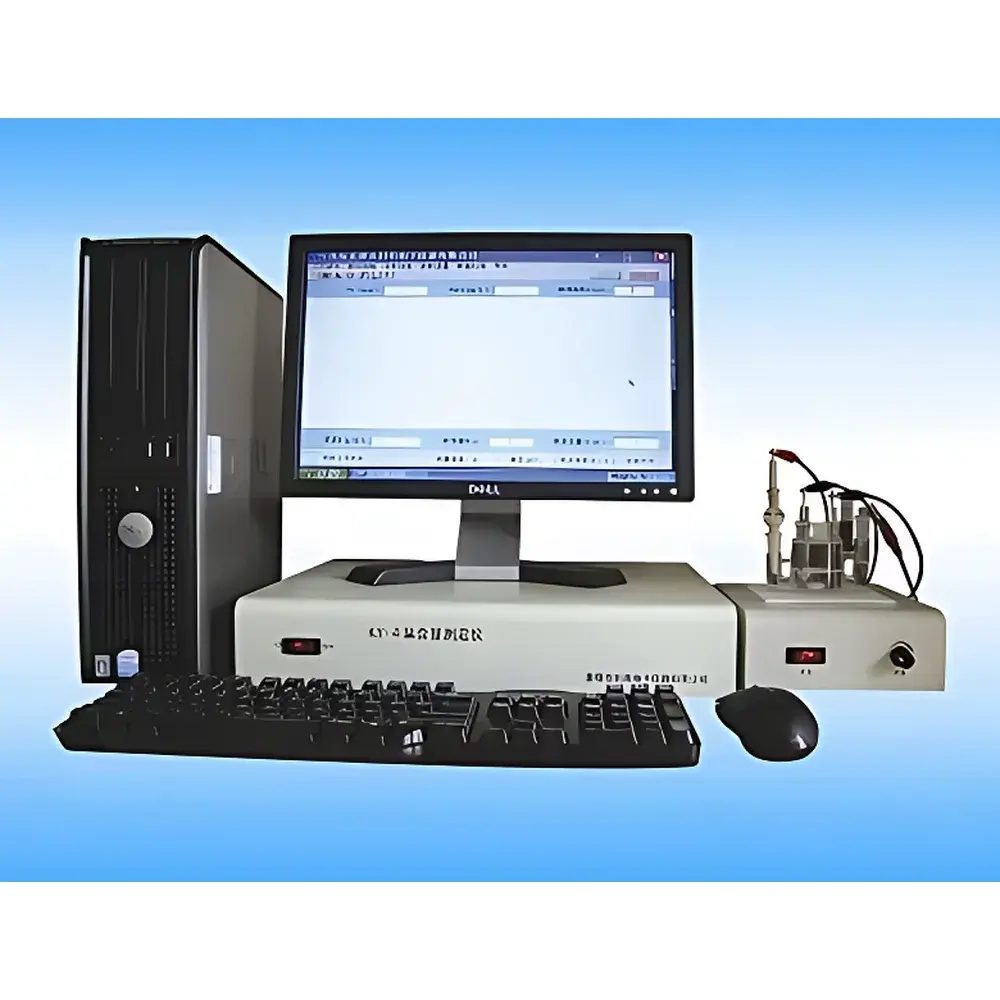
KY-210B Organic Chlorine Content Analyzer for Oilfield Chemicals (Method B)
| Brand | Keyuan Instruments |
|---|---|
| Origin | Jiangsu, China |
| Manufacturer Type | Direct Manufacturer |
| Product Category | Domestic |
| Model | KY-210B |
| Instrument Type | Universal Potentiometric Titrator |
| Application Scope | General-purpose |
| Bias Voltage Range | 0–500 mV (adjustable) |
| Chloride Ion Measurement Range | 0.1 ppm to full percentage content |
| Accuracy | < ±2% |
| Repeatability | ≤ ±0.1 mg NaCl/L (for samples ≤2 mg NaCl/L) |
| Detection Sensitivity | Cl⁻: 0.1 mg/L |
| Titration Cell Volume | 145 mL |
| Sample Mass | 0.02–0.05 g |
| Dimensions (W×D×H) | 465 × 280 × 195 mm |
| Power Consumption | 40 W |
| Operating Environment | 10–40 °C, RH ≤80%, low electromagnetic interference |
Overview
The KY-210B Organic Chlorine Content Analyzer for Oilfield Chemicals (Method B) is a dedicated potentiometric titration system engineered for the quantitative determination of organic chlorine in oilfield chemical additives—such as scale inhibitors, corrosion inhibitors, demulsifiers, and biocides—according to standardized combustion-based protocols. It implements the oxygen combustion flask method (ASTM D3229–17 equivalent principle), wherein sample combustion in a high-purity oxygen atmosphere quantitatively converts organically bound chlorine into chloride ions (Cl⁻). The resulting Cl⁻ is absorbed in dilute sodium hydroxide solution and subsequently titrated with standardized silver nitrate (AgNO₃) using a dual-ion-selective electrode (Ag/AgCl reference and silver indicator electrode). This electrochemical endpoint detection ensures high reproducibility and eliminates subjective visual interpretation. Unlike classical argentometric titrations, the KY-210B operates without manual standardization of titrant, reducing procedural drift and operator dependency. Its design complies with Q/SH1020 2093–2013 and SY/T 7329–2016—the primary Chinese petroleum industry standards governing organic chlorine analysis in field chemicals—making it suitable for quality control laboratories operating under ISO/IEC 17025 or internal GLP frameworks.
Key Features
- Combustion-integrated workflow: Integrated oxygen combustion flask interface enables complete oxidative mineralization of C–Cl bonds under controlled conditions, ensuring stoichiometric conversion to measurable Cl⁻.
- Patented titration cell architecture: Uses a custom-designed sintered glass frit (sand core) instead of conventional ion-selective membranes—eliminating membrane degradation, clogging, and associated baseline drift over extended operation.
- High-sensitivity potentiometric detection: Dual-electrode configuration delivers stable potential readings with resolution down to 0.1 mg/L Cl⁻, validated across trace (ppm-level) and bulk (%-level) concentration ranges.
- Microprocessor-controlled titration engine: Fully automated delivery, endpoint recognition via first-derivative (dE/dV) algorithm, and real-time potential curve visualization on integrated LCD display.
- Self-documenting operation: Built-in thermal printer outputs complete audit trails—including sample ID, mass, titrant volume, calculated organic chlorine %, bias voltage setting, and timestamp—supporting traceability requirements per 21 CFR Part 11 Annex 11 principles.
Sample Compatibility & Compliance
The KY-210B accommodates solid, liquid, and viscous oilfield chemical formulations—including polymer-based inhibitors, amine derivatives, quaternary ammonium salts, and solvent-diluted surfactants—within the recommended 0.02–0.05 g mass range. Samples must be free of interfering halides (e.g., bromide, iodide) or oxidizing agents that compromise combustion efficiency. The instrument’s measurement uncertainty (<±2%) and repeatability (≤±0.1 mg NaCl/L at low concentrations) meet the performance criteria specified in SY/T 7329–2016 for method validation. Its hardware and software architecture support routine calibration verification using certified NaCl reference standards traceable to NIST SRM 999b. While not FDA-cleared, its data integrity features—including immutable result logs and user-access logging—align with GMP-aligned QC lab practices for upstream chemical qualification.
Software & Data Management
The KY-210B operates via embedded firmware (no external PC required), featuring a menu-driven interface supporting multi-user access levels (operator, supervisor, administrator). All titration curves, raw potential values, and calculation parameters are stored internally (up to 500 test records) with timestamp and operator ID tagging. Export is enabled via RS-232 serial port to LIMS or Excel-compatible formats (.csv). Audit trail generation includes pre-run system checks (electrode impedance, blank titration), post-run residual error reporting, and automatic recalibration prompts after 20 runs or 72 hours of continuous use—ensuring sustained metrological confidence without manual intervention.
Applications
- Quantification of residual organic chlorine in amine-based corrosion inhibitors prior to field deployment.
- Batch release testing of demulsifier formulations to verify compliance with API RP 14E sulfur- and halogen-content limits.
- Stability monitoring of biocides during accelerated aging studies, tracking dehalogenation byproducts.
- Raw material screening of ethoxylated surfactants for unintended chlorinated impurities from synthesis pathways.
- Regulatory documentation for OSPAR/HSE chemical notification dossiers requiring speciation of total vs. organic chlorine.
FAQ
What combustion protocol does the KY-210B implement?
It follows the oxygen combustion flask method per SY/T 7329–2016: samples are sealed in a quartz combustion flask with oxygen, ignited electrically, and the effluent absorbed in NaOH solution for subsequent potentiometric titration.
Can the instrument distinguish between organic and inorganic chlorine directly?
No—it measures total chloride after combustion and requires a parallel direct extraction assay for inorganic chloride; organic chlorine is derived by difference, as defined in the standard method.
Is electrode maintenance required between analyses?
Yes: the silver indicator electrode must be rinsed with deionized water and blotted dry after each run; periodic polishing with alumina slurry (0.3 µm) is recommended every 50 tests to maintain response kinetics.
Does the system support external data integration?
Yes—via RS-232 serial output compatible with laboratory information management systems (LIMS) and SCADA interfaces using Modbus RTU protocol.
What is the minimum detectable organic chlorine level for a 0.03 g sample?
At 0.1 mg/L Cl⁻ sensitivity and 0.03 g sample mass, the practical lower limit is ~0.033 ppm organic chlorine (w/w), assuming 100% recovery during combustion and absorption.
Related Products






