
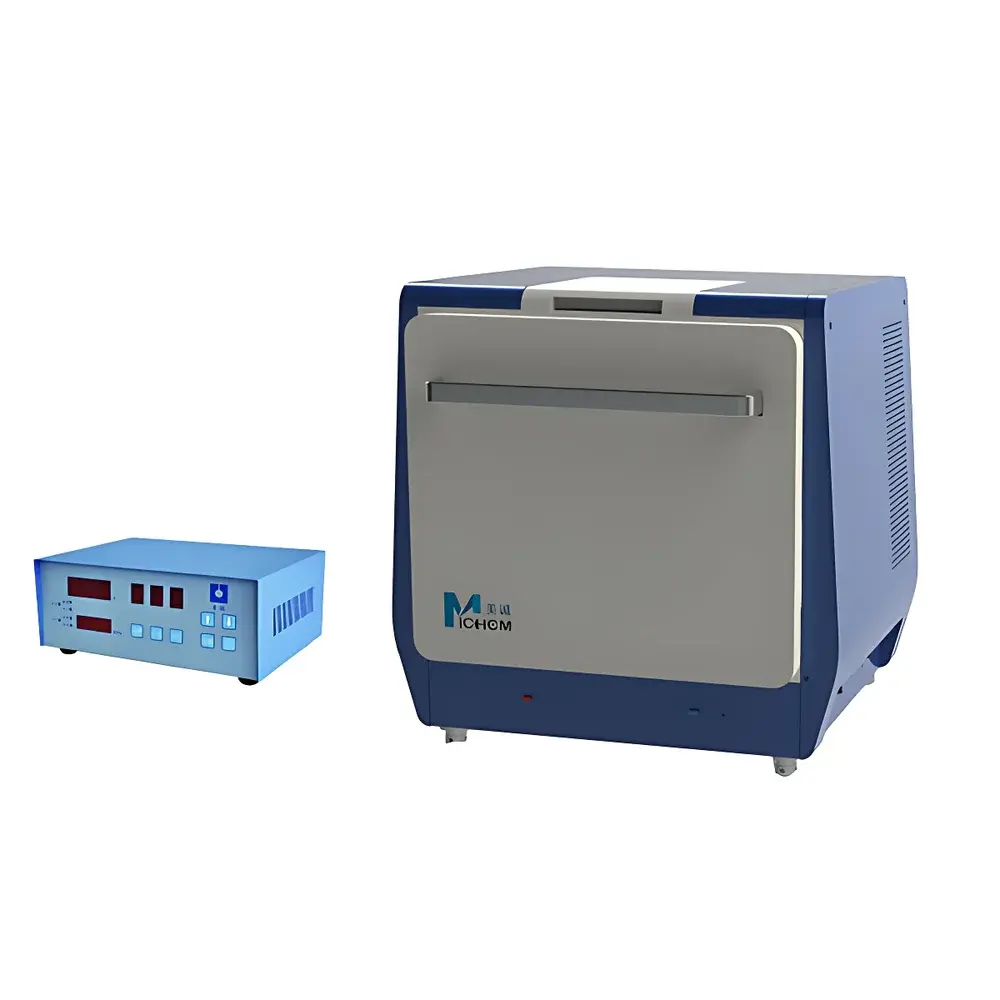
MICHEM MD6 Advanced Microwave Digestion System
| Brand | MICHEM |
|---|---|
| Origin | Beijing, China |
| Model | MD6 |
| Sample Capacity | 6–10 vessels |
| Microwave Source | Dual-Magnetron |
| Max Temperature | 260 °C |
| Max Pressure | 2200 psi |
| Cavity Lining | PFA-coated (DuPont™) |
| Temperature Control Range | 0–300 °C |
| Temp Accuracy | ±0.5 °C |
| Pressure Control Range | 0–6 MPa |
| Pressure Accuracy | ±0.01 MPa |
| Microwave Leakage | ≤0.3 mW/cm² |
| Output Power | 1200 W (0–100% PID-adjustable) |
| Cavity Volume | 45 L |
| Dimensions (W×D×H) | 490×610×610 mm |
| Weight | 48 kg |
| Cooling Airflow | 3 m³/min |
| Safety | Six-layer protection including dual-stage pressure relief, auto-locking blast-resistant door (Patent ZL 200420032536), rupture disc, and real-time Pt100/pressure dual-sensor feedback |
Overview
The MICHEM MD6 Advanced Microwave Digestion System is an industrial-grade, high-throughput sample preparation platform engineered for rapid, complete, and reproducible acid digestion of complex matrices under controlled high-temperature and high-pressure conditions. It operates on the principle of microwave-assisted closed-vessel digestion—where targeted dielectric heating induces rapid molecular agitation within sealed reaction vessels, accelerating oxidative decomposition of organic matter and mineral dissolution of inorganic components. Unlike conventional hotplate or block digesters, the MD6 delivers uniform energy distribution via a dual-magnetron source and a 360° bidirectional rotating turntable, ensuring consistent thermal and pressure profiles across all vessels in a batch. Its 45-L PFA-lined cavity (DuPont™ certified) resists concentrated HNO₃, HF, HCl, and aqua regia at temperatures up to 300 °C and pressures up to 6 MPa (870 psi real-time monitoring; 2200 psi burst rating), making it suitable for demanding applications in environmental, geological, clinical, and regulatory laboratories requiring trace-element analysis by ICP-MS, ICP-OES, AAS, or AFS.
Key Features
- Industrial-grade 45-L cavity with DuPont™ PFA interior coating—chemically inert, corrosion-resistant, and thermally stable to 300 °C
- Dual-magnetron microwave generation (2450 MHz ±13 MHz) with PID-controlled 0–100% power modulation for precise energy delivery
- Real-time dual-parameter monitoring: Pt100 platinum resistance thermometer (±0.5 °C accuracy) and direct-contact pressure transducer (±0.01 MPa resolution)
- Six-tier safety architecture: (1) active slope-controlled ramping to prevent thermal/pressure overshoot; (2) in-vessel temperature–pressure interlock shutdown; (3) calibrated rupture discs (200/400 psi thresholds); (4) patent-pending self-locking lateral-release blast door (ZL 200420032536); (5) cavity-integrated forced-air cooling (3 m³/min, achieving safe opening temperature within 20 min); (6) electromagnetic shielding reducing microwave leakage to ≤0.3 mW/cm² (well below IEC 61000-3-2 and GB 4706.21 limits)
- 360° reversible rotation system with optical encoder feedback ensures homogeneous microwave exposure across all vessels—critical for inter-vessel precision (RSD < 3% for multi-element recovery)
- Modular vessel configuration: accommodates 4–10 high-pressure digestion vessels (TFM inner liners + PEEK outer vessels rated to 10 MPa; optional 10–1500 mL volume range)
Sample Compatibility & Compliance
The MD6 supports a broad spectrum of solid, semi-solid, and liquid samples—including soils, sediments, biological tissues, foodstuffs, polymers, catalysts, and pharmaceutical excipients—across EPA Methods 3051A, 3052, ASTM D5511, ISO 11466, and USP . Vessels are constructed from imported TFM fluoropolymer (chemically resistant to HF, fuming acids, and organics) and reinforced PEEK composites (10% filler-enhanced thermal stability to 300 °C). The system complies with GLP/GMP documentation requirements when configured with A-type computer control: audit-trail-enabled software logs timestamps, setpoints, actual temperature/pressure curves, method parameters, and operator IDs—fully aligned with FDA 21 CFR Part 11 data integrity expectations. All pressure containment components undergo hydrostatic certification per ASME BPVC Section VIII Div. 1.
Software & Data Management
The MD6-A variant integrates a dedicated Windows-based control suite running on an included notebook PC. The software provides real-time graphical display of temperature and pressure trajectories for each vessel, supports unlimited method storage (up to 8-step programmable ramps per method), and exports ASCII- or CSV-formatted datasets compatible with LIMS and statistical analysis platforms (e.g., JMP, Minitab). Method validation reports include peak temperature/pressure values, hold times, energy consumption (kWh), and pass/fail flags against user-defined acceptance criteria. For regulated environments, electronic signatures, role-based access control, and automated backup to network drives are configurable. The MD6-C variant employs an embedded microcontroller with LED interface, storing 15 preloaded methods with 8-segment ramp logic—ideal for routine QC labs requiring deterministic operation without IT infrastructure dependencies.
Applications
The MD6 serves as a core sample preparation tool for elemental quantification workflows requiring low contamination risk and high analyte recovery. It is routinely deployed prior to ICP-MS analysis of heavy metals in soil (EPA 6020B), total mercury in fish tissue (EPA 7473), rare earth elements in ores (ASTM D8093), and leachable Cd/Pb/Cr in consumer products (CPSIA testing). Its versatility extends beyond digestion: the system supports microwave-assisted extraction (MAE) of PAHs from sediment (EPA 3546), protein hydrolysis for amino acid profiling, and solvent-free organic synthesis under controlled pressure—enabling green chemistry protocols compliant with ACS GCI Principles. Laboratories performing ISO/IEC 17025-accredited testing use the MD6’s documented repeatability (n = 6, RSD ≤ 2.8% for As in NIST SRM 2711a) to meet uncertainty budget requirements.
FAQ
What safety certifications does the MD6 hold?
The MD6 conforms to IEC 61010-1 (Safety Requirements for Electrical Equipment for Measurement, Control, and Laboratory Use) and meets electromagnetic compatibility (EMC) standards per IEC 61326-1. Its pressure vessels are manufactured and tested in accordance with PED 2014/68/EU Annex I essential safety requirements.
Can the MD6 be integrated into an automated lab workflow?
Yes—the A-type control system offers RS-232 and Ethernet interfaces for integration with robotic sample handlers and LIMS via Modbus TCP or custom API scripting. Optional barcode scanning support enables full chain-of-custody tracking.
What is the recommended maintenance schedule?
Daily visual inspection of door seal integrity and vent filter cleanliness; quarterly calibration verification of Pt100 sensor and pressure transducer using NIST-traceable references; annual cavity shielding integrity test using field-strength meter per IEC 62209-2.
Does MICHEM provide method development support?
Yes—application scientists offer remote and on-site method optimization services, including digestion matrix matching, acid selection guidance (e.g., HNO₃/HF ratios for silicate dissolution), and validation protocol design aligned with ISO 17025 clause 7.2.2.
Is training included with purchase?
All MD6 systems ship with a two-day onboarding workshop covering operational procedures, safety protocols, preventive maintenance, troubleshooting, and software navigation—delivered by MICHEM-certified application engineers.



