
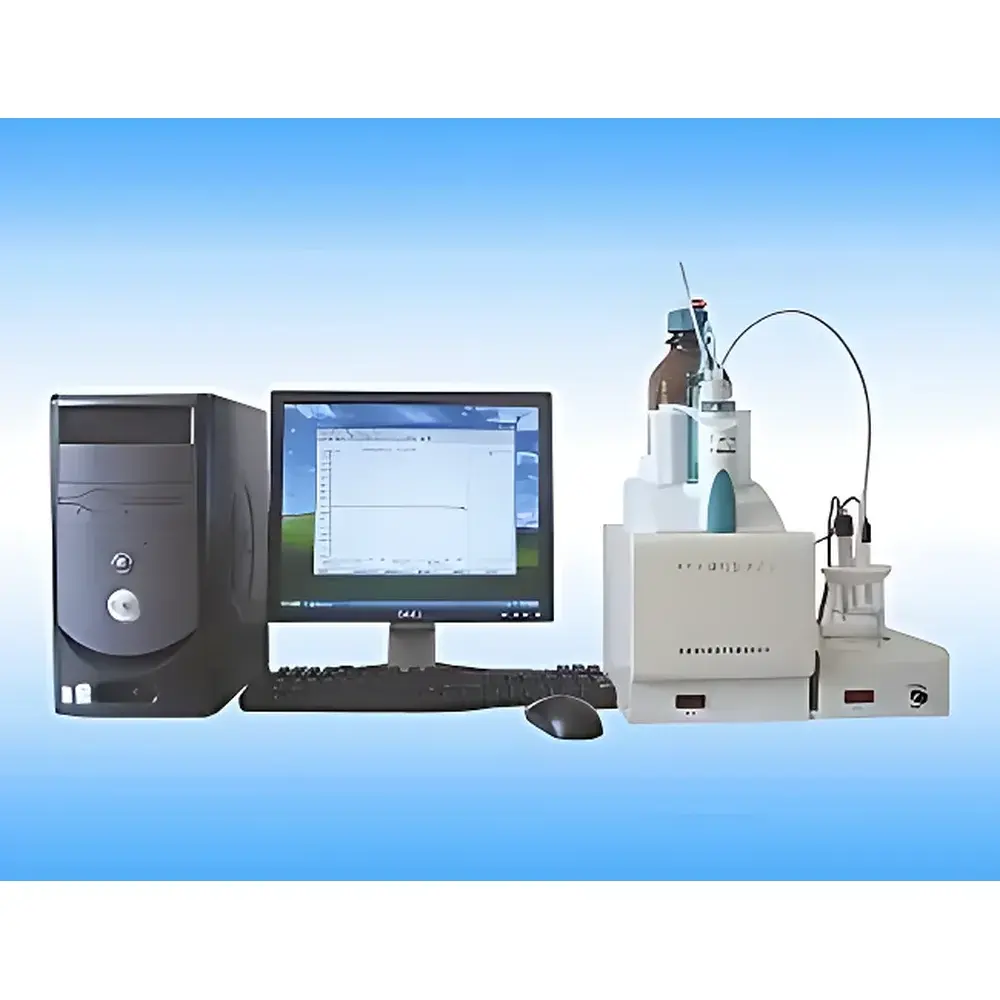
Kyuyuan KY-403 Automatic Acid Number Titrator
| Origin | Jiangsu, China |
|---|---|
| Manufacturer Type | Authorized Distributor |
| Region of Origin | Domestic (China) |
| Model | KY-403 |
| Pricing | Available Upon Request |
Overview
The Kyuyuan KY-403 Automatic Acid Number Titrator is a precision electrochemical analytical instrument engineered for the quantitative determination of acid number (AN) in petroleum products, crude oils, lubricants, and related hydrocarbon-based samples. It operates on the principle of potentiometric titration—measuring the potential change across a high-impedance pH or ion-selective electrode as a standardized potassium hydroxide (KOH) titrant is incrementally delivered into a sample dissolved in a toluene–isopropanol solvent mixture. This method conforms rigorously to internationally recognized standard test methods, including ASTM D664 (equivalent to GB/T 7304–2000) and ASTM D974 (aligned with GB/T 18609), ensuring regulatory acceptability in quality control, refinery process monitoring, and R&D environments. The system integrates a microprocessor-controlled burette drive, real-time potential acquisition, and adaptive endpoint detection algorithms that perform dynamic smoothing of titration curves and intelligent inflection point correction—minimizing operator bias and enhancing measurement reproducibility.
Key Features
- Windows-based embedded control software with intuitive graphical user interface (GUI), supporting step-by-step guided operation and multilingual display options (English default)
- Imported anti-diffusion titration head with integrated ceramic junction and low-drift reference electrode architecture, minimizing carryover and junction potential drift
- Automated fluid handling sequence: auto-purging, pre-rinse, precise fixed-volume dispensing, incremental titrant delivery, and post-titration cleaning—all programmable per method
- High-resolution potentiometric measurement: ±0.1 mV resolution over ±2000.0 mV range; input impedance ≥1 × 10¹² Ω ensures stable signal acquisition from low-conductivity organic media
- 10 mL calibrated glass burette with ±0.1% full-scale accuracy and minimum dispensing volume of 0.001 mL—enabling trace-level AN quantification down to 0.001 mg KOH/g
- Integrated thermal compensation and ambient temperature monitoring (operating range: 0–35 °C) to maintain volumetric and electrometric stability
Sample Compatibility & Compliance
The KY-403 is validated for use with samples soluble in toluene–isopropanol (1:1 v/v) mixtures—including gasoline, diesel, jet fuel, base oils, used lubricants, and crude oil fractions. It complies fully with GB/T 7304–2000 (“Standard Test Method for Acid Number of Petroleum Products and Lubricants by Potentiometric Titration”) and GB/T 18609–2001 (“Standard Test Method for Acid Number of Crude Oil by Potentiometric Titration”), both technically harmonized with ASTM D664 and ASTM D974. Data integrity meets GLP and GMP-aligned requirements: audit trail logging (user ID, timestamp, method version, raw potential vs. volume data), electronic signature support, and configurable report templates compliant with ISO/IEC 17025 documentation standards.
Software & Data Management
The instrument’s native software provides full method development, validation, and execution capabilities under Windows OS. Users define titration parameters—including solvent blank subtraction, equivalence point algorithm selection (first derivative, second derivative, or Gran plot), and acceptance criteria for replicate precision (per GB/T 18609). All raw sensor data (mV vs. mL), processed curves, and final reports are stored in encrypted binary format with optional export to CSV, PDF, or XML. Audit trails are immutable and time-stamped; system access requires role-based authentication. Optional 21 CFR Part 11 compliance packages include electronic signatures, event logs, and secure user management modules.
Applications
- Refinery QC labs: monitoring acid buildup during catalytic cracking, hydrotreating, and distillation processes
- Lubricant formulation & service life assessment: tracking oxidation-induced carboxylic acid formation in engine oils and industrial greases
- Crude assay laboratories: screening naphthenic acid content for corrosion risk evaluation (TAN mapping)
- Independent testing facilities: delivering accredited AN data for API MPMS Chapter 11.2 or ISO 4297 reporting
- Academic research: kinetic studies of acid-catalyzed degradation pathways in biofuels and synthetic hydrocarbons
FAQ
What solvent system is required for sample dissolution?
Toluene–isopropanol (1:1 v/v) is the specified solvent mixture per GB/T 7304 and ASTM D664.
Does the system support automatic blank correction?
Yes—software allows programmed solvent blank titration and automatic subtraction from sample results.
Can multiple samples be queued for unattended analysis?
The KY-403 supports batch processing with up to 24 positions when paired with an optional autosampler module (sold separately).
Is calibration traceable to national standards?
Electrode calibration uses NIST-traceable pH buffer solutions; burette calibration follows ISO 8655-3 using certified gravimetric standards.
What maintenance is required for long-term accuracy?
Daily electrode storage in KCl solution, weekly cleaning of the titration head with ethanol, and quarterly verification of burette linearity using certified water displacement protocols.







