
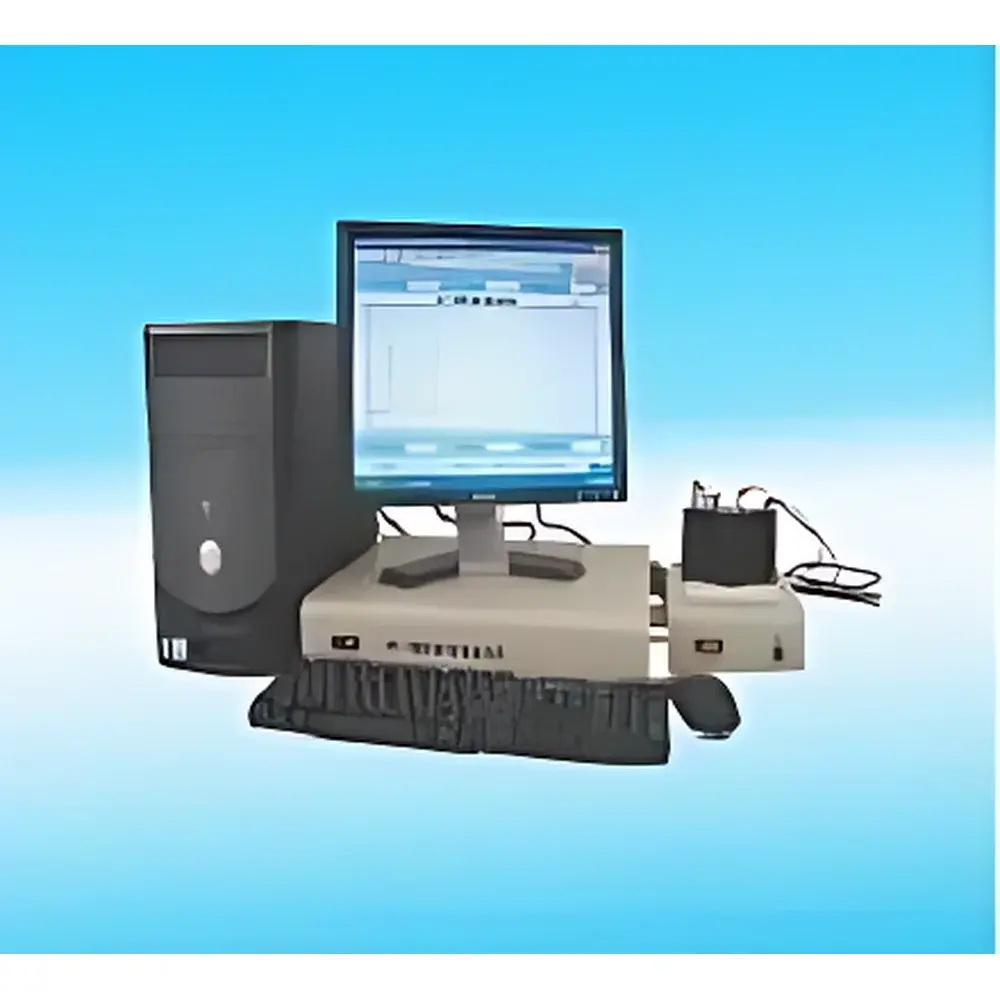
Kyuan KY-4As Arsenic Content Analyzer
| Origin | Jiangsu, China |
|---|---|
| Manufacturer Type | Authorized Distributor |
| Origin Category | Domestic (China) |
| Model | KY-4As |
| Pricing | Available Upon Request |
| Measurement Principle | Microcoulometric Titration |
| Sample Type | Liquid |
| Detection Method | Hydride Generation–Microcoulometric Detection |
| Bias Voltage Range | 0–500 mV |
| Measurement Range | 1 × 10⁻⁹ % (1 ppb) to % level |
| Input Impedance | ≥10⁶ Ω |
| Output Voltage | ±24 V |
| Baseline Drift | ≤5 µV / 20 min |
| Temperature Control Accuracy | ±0.5% or ±5 °C (whichever is greater) |
| Analysis Time (instrumental only) | 5–10 min |
| Detection Limit | 1 ppb As |
| Operating Humidity | <80% RH |
| Operating Temperature | 10–40 °C |
Overview
The Kyuan KY-4As Arsenic Content Analyzer is a dedicated microcoulometric instrumentation system engineered for the quantitative determination of total arsenic in complex hydrocarbon matrices and aqueous samples. It operates on the principle of hydride generation coupled with microcoulometric titration—a well-established electrochemical technique standardized in petroleum, environmental, and food testing laboratories. In this method, organic arsenic species are first decomposed under acidic oxidative conditions (typically using HNO₃/H₂SO₄ or microwave-assisted digestion), followed by reduction of liberated inorganic arsenic (As³⁺) to arsine gas (AsH₃) via sodium borohydride (NaBH₄). The gaseous AsH₃ is swept into a titration cell containing an iodine-based electrolyte; oxidation of AsH₃ consumes iodine, and the resulting deficit is replenished electrochemically. The charge (in coulombs) required to regenerate iodine is measured in real time and converted to arsenic mass concentration using Faraday’s law (1 mole of electrons ≡ 1 equivalent of As). This approach delivers high specificity for total arsenic—free from interferences commonly observed in atomic absorption or ICP-based methods—and eliminates the need for calibration curves when operated under validated conditions.
Key Features
- Integrated PC-based control architecture with real-time monitoring of bias voltage, titration current, baseline stability, and temperature profiles
- Automated thermal management: air-cooled pyrolysis furnace with intelligent fan control—fan deactivates automatically upon reaching setpoint stabilization
- Short instrumental cycle time: 5–10 minutes per analysis (excluding sample preparation), enabling throughput of up to 6–8 determinations per hour under routine operation
- High input impedance (>10⁶ Ω) amplifier design ensures minimal signal loading and enhanced signal-to-noise ratio during low-current microcoulometric detection
- Stable baseline performance: drift ≤5 µV over 20 minutes supports reliable low-level quantitation down to 1 ppb (µg/L)
- Wide dynamic range: linear response from sub-ppb (1 × 10⁻⁹ % w/w) to percent-level concentrations without dilution or method switching
- Modular hardware layout facilitates field maintenance and component-level replacement—no proprietary tools required
Sample Compatibility & Compliance
The KY-4As analyzer accommodates liquid-phase samples across diverse industrial sectors. Validated applications include gasoline, diesel, naphtha, kerosene, crude oil, vacuum residue, liquefied petroleum gas (LPG), propylene, catalyst slurries, process water, drinking water, fruit juices, and dairy-based beverages. Sample introduction requires prior acid digestion or UV/persulfate oxidation to ensure complete conversion of organoarsenic compounds (e.g., roxarsone, arsanilic acid, methylarsonic acid) to As(III). The system complies with the fundamental measurement principles outlined in ASTM D7153 (Standard Test Method for Total Arsenic in Hydrocarbon Fuels by Microcoulometry), ISO 16920 (Petroleum products — Determination of trace elements — Microcoulometric method), and aligns with data integrity expectations under GLP and GMP environments. While not pre-certified to FDA 21 CFR Part 11, its audit trail-capable software architecture supports configuration for electronic signature and data archival workflows meeting ALCOA+ criteria.
Software & Data Management
The embedded Windows-compatible acquisition software provides full instrument control, real-time waveform visualization (current vs. time), automatic endpoint recognition, and integrated calculation engine applying Faraday’s constant (96,485 C/mol), electrode stoichiometry (3 e⁻/As atom), and sample mass/volume normalization. All raw current-time integrals, method parameters, operator ID, timestamp, and system diagnostics are stored in a structured SQLite database with optional export to CSV or PDF report formats. Audit-ready features include user-access logging, parameter change history, and electronic signature prompts for critical actions (e.g., method validation, calibration confirmation). Data files adhere to ICH M7 and USP reporting conventions for elemental impurities, including uncertainty estimation per EURACHEM/CITAC guidelines.
Applications
- Refinery QC/QA: Monitoring arsenic contamination in feedstocks and finished fuels to protect catalytic reforming units
- Environmental compliance: Quantifying As in wastewater effluents and leachates per EPA Method 7060B equivalents
- Food safety labs: Screening arsenic in rice-based infant formulas and apple juice per FDA guidance levels
- Petrochemical R&D: Evaluating arsenic passivation efficiency in hydrotreating catalysts
- Regulatory testing: Supporting submissions to CNCA, CNAS, and APAC-accredited laboratories requiring ISO/IEC 17025-compliant arsenic data
FAQ
What sample preparation is required prior to analysis?
Acid digestion (HNO₃/H₂SO₄ reflux or closed-vessel microwave) is mandatory to mineralize organoarsenic species. For volatile matrices (e.g., LPG), cryogenic trapping and dissolution in dilute HCl is recommended.
Can the KY-4As analyze solid samples directly?
No. Solids—including catalysts or soils—must be subjected to validated acid digestion or fusion protocols before introduction as aqueous extracts.
Is daily calibration required?
Calibration verification using certified As standard solutions (e.g., NIST SRM 3134) is recommended before each analytical batch; full multi-point calibration is required after maintenance or electrode replacement.
How is system performance verified?
Baseline drift, sensitivity (1 ppb As recovery), and precision (RSD ≤5% at 10 ppb) must be confirmed using reference materials traceable to national metrology institutes.
What maintenance intervals are recommended?
Electrolyte replacement every 40–60 analyses; quartz combustion tube cleaning weekly; Ag/AgCl reference electrode recalibration monthly.





