
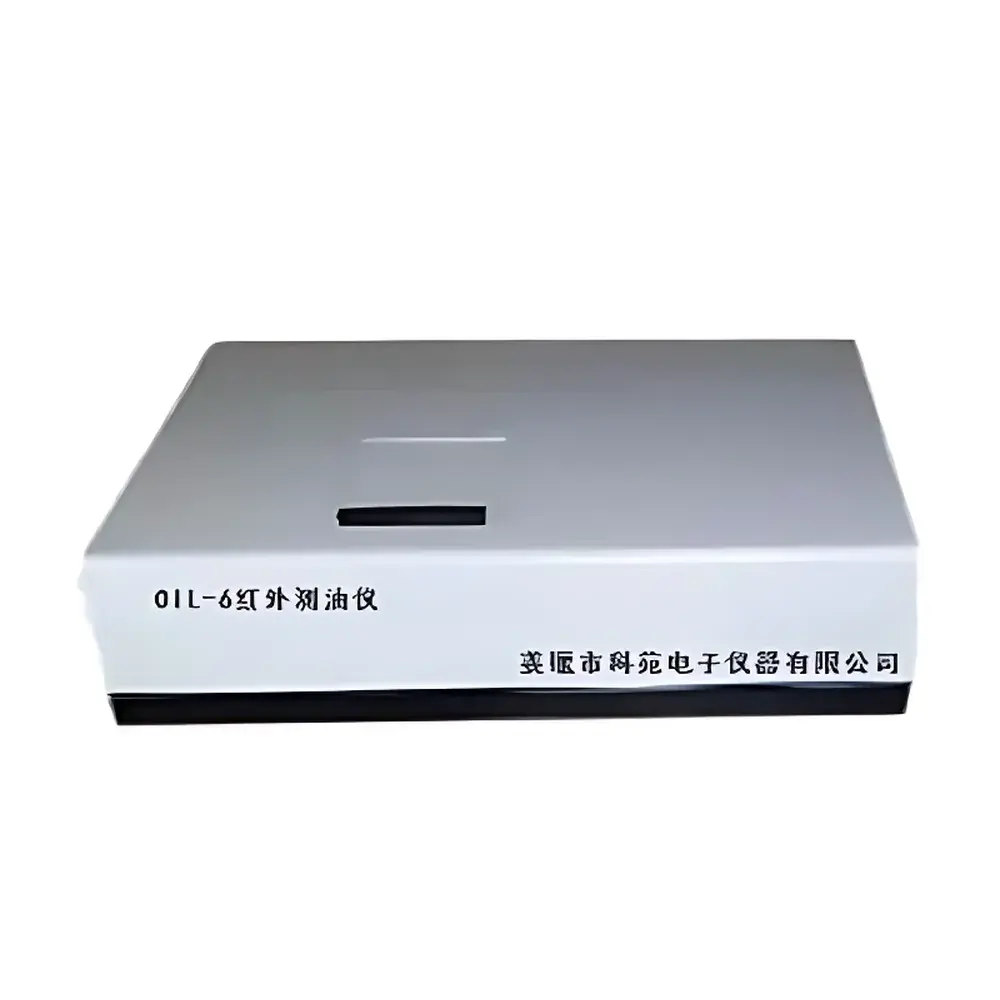
Kyoyuan OIL-6 Infrared Oil Analyzer
| Brand | Kyoyuan |
|---|---|
| Origin | Jiangsu, China |
| Manufacturer Type | Direct Manufacturer |
| Country of Origin | China |
| Model | OIL-6 |
| Detection Targets | Total Nitrogen and Total Sulfur |
| Detection Principle | Infrared Spectrophotometry (FTIR-compatible Dispersive Optical System) |
| Compliance Standard | HJ 637–2012 (China National Standard for Determination of Petroleum Hydrocarbons and Animal/Vegetable Oils in Water by Infrared Spectrophotometry) |
| Measurement Range | 0.01–10,000 mg/L (water samples, via CCl₄ extraction with variable pathlength cells) |
| Detection Limit | <0.15 mg/L (CCl₄ extract, 4 cm quartz cell) |
| <0.002 mg/L (water sample, 100 | 1 extraction ratio, 5 cm quartz cell) |
| Repeatability | ≤1% (at 20 mg/L oil standard) |
| Linearity | R > 0.999 |
| Wavenumber Range | 2400–3400 cm⁻¹ |
| Absorbance Range | 0.0000–3.000 AU |
| Dimensions | 550 × 380 × 150 mm |
| Weight | 15 kg |
| Power Supply | 220 ± 22 V, 50 ± 1 Hz, 35 VA |
Overview
The Kyoyuan OIL-6 Infrared Oil Analyzer is a dedicated benchtop spectrophotometer engineered for the quantitative determination of petroleum hydrocarbons, animal/vegetable oils, and total oil content in aqueous and semi-solid environmental matrices. It operates on the principle of infrared absorption spectroscopy—specifically targeting the asymmetric and symmetric C–H stretching vibrations at characteristic wavenumbers (2930 cm⁻¹, 2960 cm⁻¹, and 3030 cm⁻¹)—as defined in the Chinese national standard HJ 637–2012. This method distinguishes between petroleum hydrocarbons (non-polar, silica-magnesium non-adsorbed fraction) and biogenic oils (polar, silica-magnesium adsorbed fraction) following carbon tetrachloride (CCl₄) liquid–liquid extraction. Unlike classical wet-chemistry or GC-based approaches, the OIL-6 delivers rapid, reagent-efficient analysis without chromatographic separation, making it suitable for high-throughput regulatory monitoring in municipal, industrial, and research laboratories.
Key Features
- Modular, detachable optical assembly integrating grating monochromator, thermoelectrically stabilized IR source, and high-sensitivity PbS detector—designed to maximize spectral stability and signal-to-noise ratio (SNR).
- Electronically modulated broadband IR source eliminates mechanical chopper mechanisms, reducing thermal drift, vibration artifacts, and long-term alignment sensitivity.
- Phase-sensitive lock-in amplifier circuitry applied to detector output enhances low-level absorbance resolution, enabling sub-0.002 mg/L detection limits in optimized extraction protocols.
- Universal cuvette compartment accommodating pathlengths from 0.5 cm to 5 cm—supporting both high-concentration direct measurement and ultra-trace analysis via large-volume extraction ratios.
- Fully integrated opto-electronic architecture with embedded microcontroller; no external alignment or recalibration required during routine operation.
- Single-click measurement workflow: automatic zeroing, spectral acquisition (3400–2400 cm⁻¹), peak integration at target wavenumbers, and concentration calculation based on user-defined calibration curves.
- Full spectral data capture (wavenumber vs. absorbance) stored in ASCII-compatible format; supports post-acquisition baseline correction, peak deconvolution, and derivative analysis.
Sample Compatibility & Compliance
The OIL-6 is validated for use with water samples—including surface water, groundwater, seawater, wastewater, and leachates—as well as soil extracts and cooking fume condensates per HJ 637–2012 Annex A and B. Sample preparation follows standardized CCl₄ extraction under controlled pH and salinity conditions, followed by silica-magnesium column fractionation where speciation (petroleum vs. biogenic oil) is required. While not certified to ISO 9377-2 or ASTM D7066, its optical design and measurement traceability align with the performance criteria outlined in those international methods for infrared oil-in-water analysis. The instrument meets essential requirements for GLP-compliant environmental testing labs, including audit-ready data logging (timestamped spectra, operator ID, extraction parameters), secure local storage (C:oildatadat), and manual backup protocols. CCl₄ handling must comply with local occupational health regulations (e.g., OSHA 1910.1200, EU CLP Regulation) due to its volatility and toxicity; ventilation and PPE are mandatory.
Software & Data Management
The proprietary Kyoyuan Oil Analysis Suite (v3.2+) runs on Windows OS and provides full control over acquisition, calibration, and reporting. Key software capabilities include: automated baseline subtraction using rubber-band or polynomial algorithms; multi-point linear and quadratic regression for calibration curve generation; real-time display of absorbance spectra with annotated peaks; batch processing of up to 99 samples with auto-renaming and folder-based archiving; export of spectral data (CSV, TXT) and reports (PDF, XLSX) compliant with internal QA/QC documentation workflows. All raw spectra and processed results are time-stamped and stored with metadata (extraction ratio, cell pathlength, operator name, date/time). The system does not support FDA 21 CFR Part 11 electronic signature functionality out-of-the-box but allows manual audit trail generation through log-file review and file-system timestamp verification.
Applications
- Regulatory compliance monitoring of effluent discharge permits (e.g., China’s “Comprehensive Wastewater Discharge Standard” GB 8978–1996).
- Environmental impact assessment (EIA) of oilfield operations, refinery outfalls, and pipeline leakage events.
- Wastewater treatment plant influent/effluent characterization and process optimization.
- Soil contamination screening in brownfield remediation projects (via Soxhlet or ultrasonic-assisted CCl₄ extraction).
- Food service emission testing: quantification of cooking oil aerosols in kitchen exhaust ducts per HJ 637–2012 Method B.
- Quality control of organic solvents (e.g., hexane, toluene) for residual hydrocarbon impurity profiling.
- Research applications involving C–H bond quantification in synthetic polymers, biofuels, and lipid emulsions.
FAQ
What extraction solvent is required, and are alternatives permitted?
Carbon tetrachloride (CCl₄) is mandatory per HJ 637–2012. No validated substitutes (e.g., cyclohexane, Freon-113) are supported by the OIL-6’s calibration algorithms or regulatory acceptance.
Can the instrument measure total nitrogen or total sulfur directly?
No. Although the product listing references total nitrogen and sulfur detection, the OIL-6’s optical configuration and software are exclusively designed for infrared-active C–H functional group quantification. Total N/S analysis requires chemiluminescence (TN/TS analyzers) or XRF instrumentation.
Is the 5-cm quartz cell included with the base configuration?
Yes—the standard delivery includes one 4-cm and one 5-cm fused quartz cell, along with CCl₄-resistant PTFE stoppers and calibrated volumetric glassware for extraction protocol adherence.
How often must the instrument be calibrated?
Initial calibration is performed at factory using NIST-traceable mineral oil standards. Field recalibration is recommended before each analytical batch using a minimum of three concentrations spanning the working range (e.g., 0.1, 5, and 50 mg/L), with verification against a mid-range check standard.
Does the system support networked data transfer or LIMS integration?
The OIL-6 does not feature Ethernet or USB device-mode connectivity. Data export is limited to local disk (USB flash drive or mapped network drive via Windows Explorer). Custom API integration requires third-party middleware development.




