
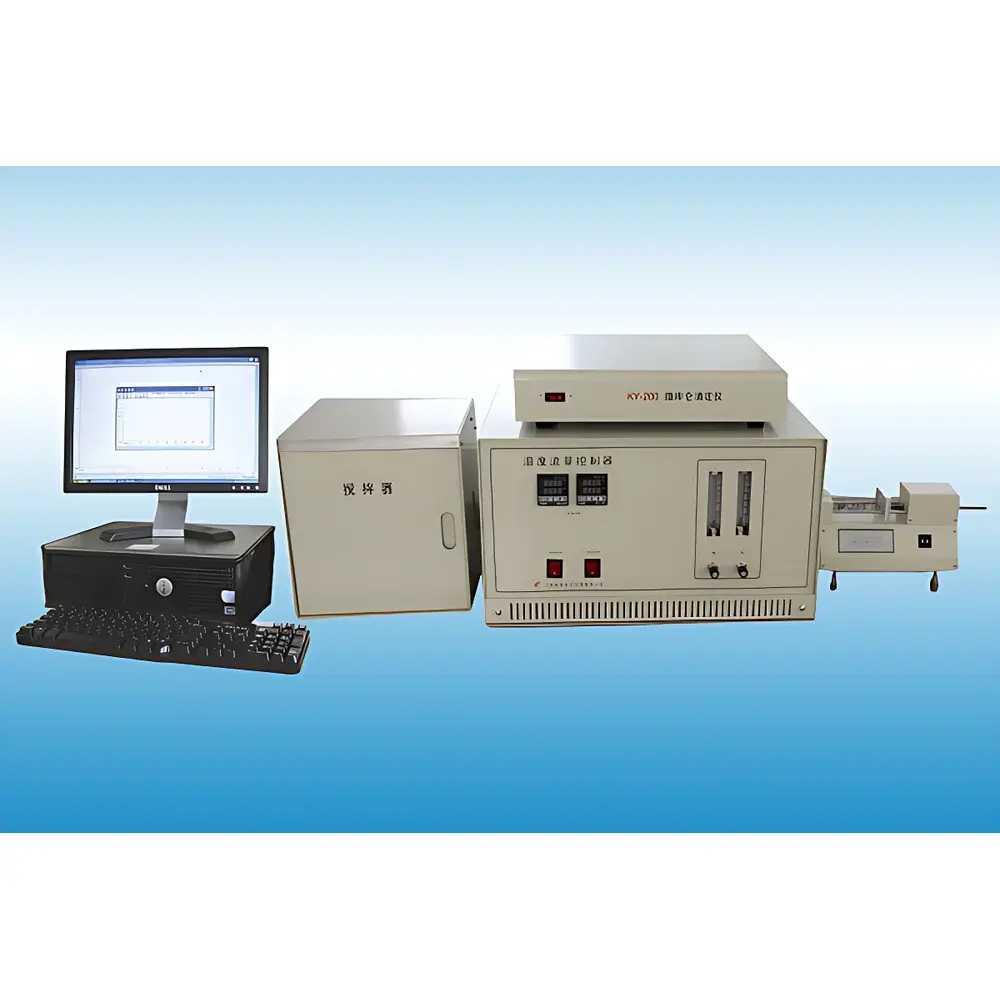
Kyuyuan KY-202 Microcoulometric Sulfur Analyzer
| Origin | Jiangsu, China |
|---|---|
| Manufacturer Type | Authorized Distributor |
| Origin Category | Domestic (PRC) |
| Model | KY-202 |
| Price Range | USD 4,200 – 7,000 (FOB China) |
| Analyte | Total Sulfur |
| Measurement Principle | Microcoulometric Titration (ASTM D3227, SH/T 0222–1992, GB/T 11061–1997, SH/T 0253–1992) |
| Sample Types | Liquid & Gaseous Hydrocarbons (with optional gas/liquid autosamplers) |
| Detection Range | 0.2–10,000 mg/L S |
| LOD | 0.2 mg/L S |
| Repeatability | ≤30% RSD (at ≤1.0 mg/L), ≤10% RSD (1.0–100 mg/L), ≤5% RSD (>100 mg/L) |
| Furnace Temp Control | Ambient to 1100 °C, ±1 °C |
| Carrier Gases | Industrial-grade O₂ and N₂ |
| Cooling | Fan-cooled裂解炉 (Auto-start/stop) |
| Power | 1500 W |
Overview
The Kyuyuan KY-202 Microcoulometric Sulfur Analyzer is a fully automated, microprocessor-controlled analytical system engineered for precise quantification of total sulfur in petroleum-derived matrices—including liquefied petroleum gas (LPG), natural gas condensates, naphthas, gasoline, diesel, jet fuel, and light hydrocarbon streams. It operates on the fundamental principle of microcoulometric titration: sample introduction into a high-temperature combustion zone (up to 1100 °C) under controlled O₂/N₂ atmosphere converts all sulfur species—whether mercaptans, sulfides, disulfides, or thiophenes—quantitatively to SO₂. The evolved SO₂ is swept into an electrolytic titration cell where it reacts stoichiometrically with electrogenerated iodine (I₂). The instrument continuously monitors the coulometric current required to regenerate I₂, applying Faraday’s law to compute sulfur mass directly from charge integration. This method ensures trace-level accuracy without reliance on calibration curves, delivering inherent linearity across five orders of magnitude (0.2–10,000 mg/L S).
Key Features
- Digitally stabilized microcoulometric detection circuitry with real-time charge integration and auto-zero compensation
- Programmable high-temperature furnace with PID-controlled heating (ambient to 1100 °C, ±1 °C stability)
- Fan-cooled pyrolysis chamber with intelligent thermal management—fan activates automatically during operation and deactivates post-run to extend component life
- Integrated PC-based control architecture with dedicated acquisition software for method setup, real-time status monitoring, and result reporting
- Modular autosampler compatibility: liquid syringe injection (1–100 µL) and pressurized gas loop injection (1–5 mL) via standardized interfaces
- Compliance-ready design supporting audit trails, user access levels, and electronic signature capability per FDA 21 CFR Part 11 requirements when deployed in regulated QA/QC environments
Sample Compatibility & Compliance
The KY-202 accommodates both liquid and gaseous samples without hardware modification—requiring only appropriate autosampler modules and gas pressure regulation. Its methodology conforms to multiple internationally recognized standards: SH/T 0222–1992 (LPG total sulfur,电量法), GB/T 11061–1997 (natural gas total sulfur, oxidative microcoulometry), and SH/T 0253–1992 (light distillates total sulfur). While not certified to ASTM D3227 or ISO 20846, its operational parameters and reaction chemistry are functionally equivalent and routinely accepted for method transfer in third-party testing laboratories. All firmware and data handling routines support GLP/GMP documentation workflows, including timestamped raw charge-integration logs, method version tracking, and operator ID logging.
Software & Data Management
The KY-202 is operated via Kyuyuan’s proprietary SulfurView™ v3.x software suite, installed on a Windows-based host PC. The interface displays live voltage/current profiles, furnace temperature ramping status, titration cell potential, and real-time sulfur mass accumulation. Quantitative results—including sample ID, injection volume, measured charge (C), calculated sulfur concentration (mg/L), and RSD (%)—are stored in encrypted .sul binary files and exportable to CSV or PDF formats. Built-in statistical tools calculate repeatability per ASTM D6299 guidelines. Audit trail functionality records all parameter changes, analysis starts/stops, and user logins—configurable to meet internal QA protocols or external accreditation requirements (e.g., CNAS, UKAS, or A2LA).
Applications
This analyzer serves as a primary tool in refinery process control labs for monitoring sulfur removal efficiency across hydrotreating units; in product certification labs verifying compliance with ultra-low-sulfur diesel (ULSD, ≤10 mg/kg) and Euro 6 gasoline specifications; in pipeline custody transfer testing for natural gas quality assurance; and in R&D settings evaluating novel desulfurization catalysts. It is also deployed in environmental monitoring agencies measuring sulfur emissions precursors in refinery flare gases and in academic institutions teaching instrumental analysis of heteroatom speciation in fossil fuels.
FAQ
What carrier gases are required, and what purity levels are recommended?
Industrial-grade oxygen and nitrogen (≥99.5% purity) are sufficient. No ultra-high-purity supply is needed—standard cylinder-grade gases with inline particulate and moisture traps ensure stable combustion and low baseline drift.
Can the KY-202 measure sulfur in solid samples such as catalysts or asphalt?
No—solid-phase analysis requires prior dissolution, digestion, or pyrohydrolysis outside the instrument. The KY-202 is validated exclusively for homogeneous liquid and gaseous hydrocarbon phases.
Is method validation support available for regulatory submissions?
Kyuyuan provides IQ/OQ documentation templates and basic validation protocols aligned with USP and ISO/IEC 17025. Full method validation (including specificity, linearity, LOD/LOQ, robustness) must be performed by the end user per their internal SOPs.
How often does the titration cell require maintenance?
Under normal operation (≤10 samples/day), the silver/silver chloride reference electrode and platinum working electrodes typically retain performance for ≥6 months. Electrolyte (50% acetic acid + KI + KCl) should be replaced every 2–3 weeks or after 50 injections to maintain stoichiometric response fidelity.
Does the system support remote diagnostics or networked operation?
Yes—the embedded Ethernet port enables TCP/IP communication for remote monitoring and firmware updates. However, full control and method editing remain restricted to the local host PC for security and data integrity reasons.





