
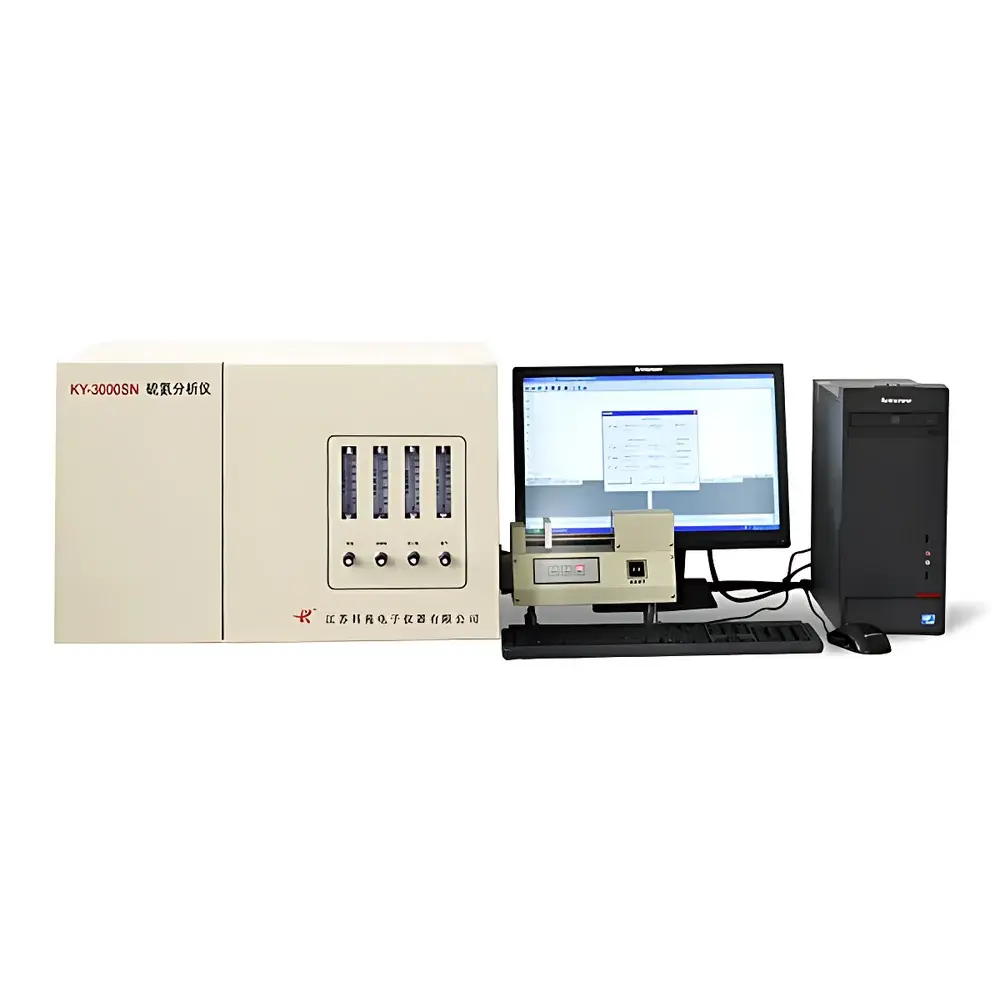
Kyuyuan KY-3000NS UV Fluorescence & Chemiluminescence Total Sulfur and Total Nitrogen Analyzer
| Brand | Kyuyuan Instruments |
|---|---|
| Origin | Jiangsu, China |
| Manufacturer Type | Manufacturer |
| Country of Origin | China |
| Model | KY-3000NS |
| Detection Principle | UV Fluorescence (S), Chemiluminescence (N) |
| Portability | Benchtop (Non-portable) |
| Analyte Types | Total Sulfur and Total Nitrogen |
| Measurement Range | 0.1–100,000 mg/L |
| Analysis Time | <10 min |
| LOD | 0.1 mg/L (N), 0.2 mg/L (S) |
| Accuracy | ±0.2 mg/L (at ≤1.0 mg/L) |
| Repeatability | CV ≤10% (1–100 mg/L), CV ≤5% (100–10,000 mg/L) |
| Furnace Temperature Range | Ambient to 1300 °C |
| Temperature Control Precision | ±1 °C |
| Power Supply | AC 220 V ±10%, 50 Hz, 1500 W |
| Gas Requirements | Argon ≥99.98%, Oxygen ≥99.98% |
Overview
The Kyuyuan KY-3000NS is a benchtop total sulfur and total nitrogen analyzer engineered for high-precision elemental quantification in petroleum-based matrices using dual detection methodologies: ultraviolet fluorescence (UVF) for sulfur and chemiluminescence (CLD) for nitrogen. The instrument operates on ASTM D5453 and D4629-compliant combustion–detection principles—samples are flash-vaporized and combusted at programmable temperatures up to 1300 °C in an oxygen-rich quartz furnace, converting organic sulfur and nitrogen compounds quantitatively into SO₂ and NO, respectively. SO₂ is excited by pulsed UV light and emits characteristic fluorescence detected by a low-noise photomultiplier tube (PMT); NO reacts with ozone in the CLD chamber to produce excited NO₂*, which decays with emission detectable at 600–900 nm. This orthogonal dual-channel architecture enables simultaneous, independent quantification without spectral interference, delivering trace-level sensitivity and robust linearity across five orders of magnitude.
Key Features
- Dual-detection platform: Integrated UV fluorescence (S) and chemiluminescence (N) modules with independent optical paths, signal processing, and calibration routines.
- High-fidelity signal acquisition: 24-bit analog-to-digital conversion with USB 2.0 interface; minimum detectable signal <1 µV ensures stable baseline and low-noise response at sub-ppm levels.
- Programmable high-temperature furnace: Precise ±1 °C temperature control from ambient to 1300 °C, optimized for complete oxidation of refractory heteroatoms in heavy fractions, residua, and polymer matrices.
- Flexible calibration architecture: Supports single-point, multi-point, and bracketed calibration; PMT high-voltage gain is software-adjustable to maintain dynamic range across wide concentration spans.
- Patented hardware components: Includes proprietary quartz combustion tube design and gas flow management system, certified under Chinese utility model patents (ZL2021XXXXXXX.X).
- Regulatory-ready operation: Compliant with SH/T 0689, SH/T 0657, GB/T 34100–2017, ASTM D5453, and ASTM D4629; supports audit-trail-enabled data logging per GLP/GMP requirements.
Sample Compatibility & Compliance
The KY-3000NS accommodates liquid (e.g., gasoline, diesel, jet fuel, crude oil), solid (e.g., catalysts, plastics, lubricant additives), and gaseous (e.g., LPG, natural gas condensates) samples via interchangeable autosampler modules and dedicated injection systems. All sample introduction pathways meet ISO/IEC 17025 method validation prerequisites. The analyzer satisfies mandatory testing requirements under China’s GB 17930–2016 (vehicle gasoline), GB 19147–2016 (diesel fuel), and EU EN 590:2021. Its measurement uncertainty profile has been verified against NIST SRM 2724b (diesel sulfur) and NIST SRM 2725a (nitrogen in fuel oil), demonstrating metrological traceability to SI units.
Software & Data Management
Kyuyuan AnalyzerSuite™ v4.2 provides full instrument control, real-time chromatogram visualization, peak integration, and report generation in PDF, CSV, and XML formats. The software implements role-based user access, electronic signatures, and 21 CFR Part 11–compliant audit trails—including timestamped records of method edits, calibration events, and raw data modifications. All spectra and integrated results are stored in a relational database with automatic backup and network share compatibility. Data export supports LIMS integration via ASTM E1394 or direct ODBC connectivity.
Applications
- Refinery QC/QA: Monitoring sulfur and nitrogen removal efficiency in hydrotreating units and FCC feedstocks.
- Fuel certification: Verification of ultra-low-sulfur diesel (ULSD), marine distillate fuels (IMO 2020 compliance), and aviation turbine fuels (ASTM D1655 Annex A2).
- Research & development: Quantifying heteroatom distribution in biofuels, synthetic lubricants, and carbonaceous materials.
- Petrochemical intermediates: Analysis of naphtha, BTX streams, and olefin feedstocks where nitrogen poisons catalysts.
- Environmental compliance: Testing for regulated sulfur/nitrogen species in refinery wastewater and stack emissions precursors.
FAQ
What standards does the KY-3000NS comply with?
It fully supports SH/T 0689, SH/T 0657, GB/T 34100–2017, ASTM D5453, and ASTM D4629, and its performance meets ISO 8217 and EN 590 traceability requirements.
Can the instrument analyze solid samples such as catalysts or polymers?
Yes—when equipped with the optional solid-sample combustion boat module and high-efficiency ash trap, it achieves quantitative recovery for heterogeneous solids with minimal matrix interference.
Is the software compliant with FDA 21 CFR Part 11?
Yes—AnalyzerSuite™ includes electronic signature workflows, immutable audit logs, and configurable user permissions aligned with Part 11 Subpart B requirements.
What gas purity is required for optimal performance?
Argon ≥99.98% (carrier and purge) and oxygen ≥99.98% (combustion) are mandatory; impurities >20 ppm hydrocarbons or moisture will degrade detector stability and increase background noise.
How is calibration verified across the full dynamic range?
Using certified reference materials (CRMs) traceable to NIST or BAM, including multi-level calibrants spanning 0.1–100,000 mg/L, with intermediate verification checks every 10 injections per ASTM D5453 Section 9.3.





