
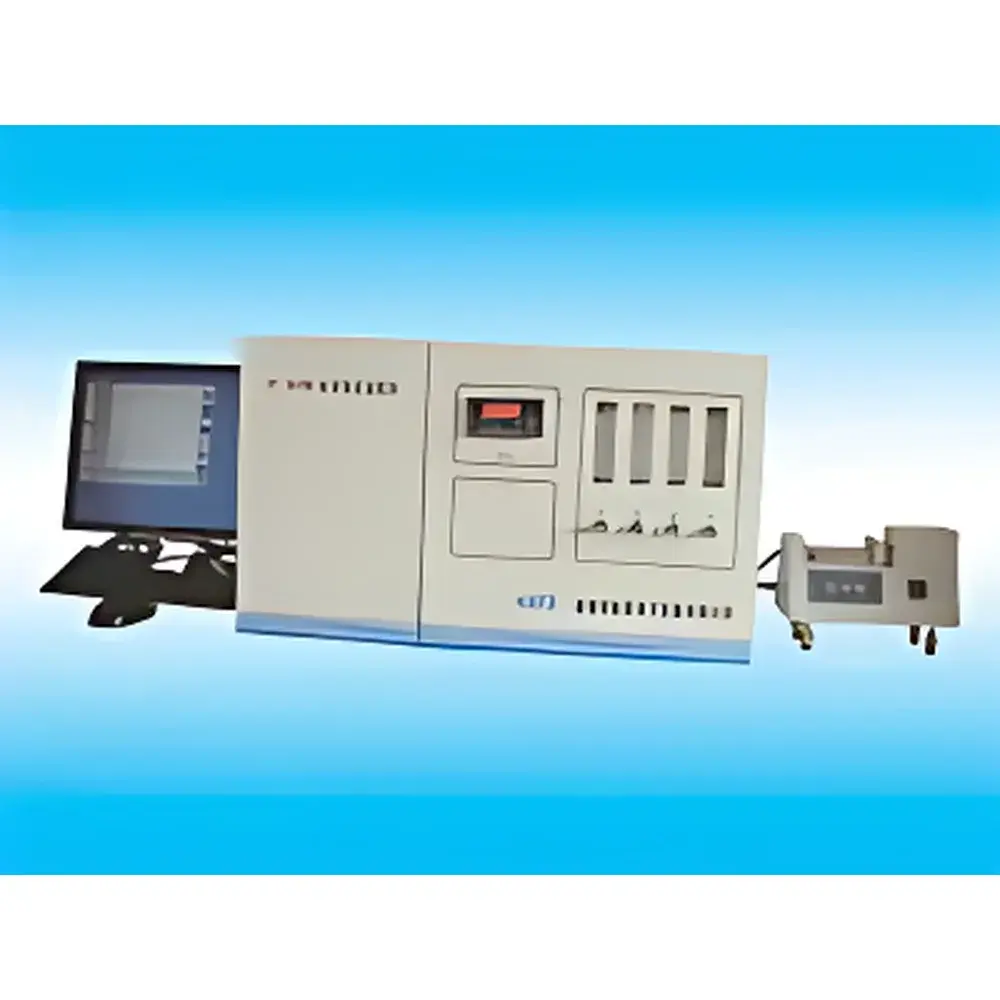
Kyoyuan KY-3000N Chemiluminescence Total Nitrogen Analyzer
| Brand | Kyoyuan |
|---|---|
| Model | KY-3000N |
| Instrument Type | Chemiluminescence Nitrogen Determinator |
| Measurement Principle | Oxidative Combustion + Chemiluminescence Detection (N) |
| Detection Range | 0.1 mg/L to 100% w/w (N) |
| Detection Limit | 0.1 mg/L (N) |
| Repeatability | ≤ ±0.1 mg/L (for X < 1.0 mg/L) |
| Sample Types | Liquid (≤20 mL), Solid (with optional solid sampler), Gas (with optional gas sampler) |
| Combustion Temperature Range | Ambient to 1100 °C |
| Temperature Control Accuracy | ±3 °C |
| Carrier & Oxidant Gases | High-purity O₂ (≥99.98%) and Ar (≥99.98%) |
| Power Consumption | 2000 W |
| Dimensions (L×W×H) | 680 mm × 480 mm × 400 mm |
| Compliance Standards | SH/T 0657, ASTM D4629 |
| Data Acquisition | 24-bit USB interface, minimum detectable signal < 1 µV |
| PMT Voltage | Adjustable |
| Calibration Options | Single-point or multi-point calibration |
| Software Features | GLP-compliant data logging, audit trail, export to CSV/PDF, password-protected user levels |
Overview
The Kyoyuan KY-3000N Chemiluminescence Total Nitrogen Analyzer is a high-precision elemental analyzer engineered for quantitative determination of total nitrogen in liquid, solid, and gaseous hydrocarbon samples—including crude oil, refined fuels, distillates, petrochemical feedstocks, polymers, and liquefied petroleum gases. It operates on the principle of high-temperature oxidative combustion followed by chemiluminescent detection of nitrogen monoxide (NO) generated from nitrogen-containing compounds. Upon complete oxidation in a quartz combustion tube at up to 1100 °C under controlled oxygen/argon atmosphere, nitrogen is converted quantitatively to NO. The NO reacts with ozone (O₃) in a reaction chamber, emitting photons in the near-UV region (200–300 nm). A photomultiplier tube (PMT) detects this emission intensity, which is linearly proportional to nitrogen concentration across five orders of magnitude (0.1 mg/L to 100% w/w). This method ensures stoichiometric response independent of molecular structure—critical for accurate analysis of complex matrices such as heavy fuel oils or nitrogen-heterocyclic compounds.
Key Features
- Robust high-temperature furnace system with programmable ramping and ±3 °C thermal stability across 25–1100 °C, enabling complete pyrolysis of refractory nitrogen species (e.g., porphyrins, carbazoles).
- Optimized quartz combustion and reduction zones with dual-stage oxygen/argon flow control to minimize NO₂ formation and maximize NO yield.
- 24-bit USB-based digital data acquisition system with sub-microvolt signal resolution (<1 µV minimum detectable signal), ensuring high dynamic range and low baseline noise.
- Adjustable high-voltage PMT power supply supporting wide linear response without saturation—even at trace-level (0.1 mg/L) and high-concentration (≥5000 ppm) measurements.
- Modular sample introduction architecture: standard liquid autosampler (≤20 mL injection volume), plus optional certified solid sampler (powder/pellet) and pressurized gas loop injector for LPG/CNG analysis.
- Comprehensive internal diagnostics including real-time gas pressure monitoring, combustion temperature validation, ozone generator status, and PMT gain drift compensation.
Sample Compatibility & Compliance
The KY-3000N accommodates diverse sample forms per ASTM D4629 and SH/T 0657 protocols. Liquid samples (e.g., gasoline, diesel, jet fuel) are introduced via syringe or autosampler; solids (catalysts, coal extracts, polymer pellets) require optional ceramic crucibles and ash-free combustion aids; gaseous samples (natural gas, refinery off-gas) use calibrated loop injection with back-pressure regulation. All configurations maintain full traceability under GLP and GMP frameworks. The instrument supports 21 CFR Part 11–compliant electronic records through role-based user authentication, immutable audit trails, and time-stamped raw data archiving. Calibration verification standards (e.g., pyridine, quinoline, acetonitrile) are traceable to NIST SRMs, and system suitability tests include recovery checks per ISO 17025 requirements.
Software & Data Management
KY-3000N Control Suite is a Windows-based application offering intuitive workflow navigation, real-time chromatogram visualization, and automated peak integration using adaptive baseline algorithms. It enforces data integrity through mandatory electronic signatures for method changes, calibration updates, and report generation. All analytical sequences—including blank subtraction, multi-point calibration curves (R² ≥ 0.9998), and QC sample scheduling—are configurable and exportable in CSV, PDF, or XML formats compatible with LIMS integration. Audit logs record operator ID, timestamp, parameter modifications, and instrument events—retained for ≥36 months. Optional modules support IQ/OQ/PQ documentation templates aligned with FDA and EU Annex 11 validation guidelines.
Applications
- Refinery QC labs: Monitoring nitrogen content in naphtha, kerosene, and vacuum gas oil to prevent catalyst poisoning in hydrotreating units.
- Fuel certification: Verifying compliance with ASTM D6448 (jet fuel), EN 14214 (biodiesel), and ISO 8217 (marine fuels) nitrogen limits.
- Petrochemical R&D: Quantifying nitrogen impurities in ethylene cracker feedstocks and aromatic solvents affecting polymerization kinetics.
- Environmental testing: Measuring organic nitrogen in wastewater effluents and soil extracts following EPA Method 351.2 adaptations.
- Materials science: Assessing nitrogen doping levels in carbon nanotubes, graphene derivatives, and battery cathode precursors.
FAQ
What combustion gases are required, and what purity specifications must they meet?
High-purity oxygen (≥99.98%) and argon (≥99.98%) are mandatory. Oxygen serves as the oxidant; argon acts as carrier and purge gas. Impurities (e.g., moisture, hydrocarbons, NOₓ) must be below 1 ppm to avoid background interference and PMT contamination.
Can the KY-3000N analyze solid samples without sample digestion?
Yes—using the optional solid sampler module, which employs flash combustion in sealed quartz boats with controlled oxygen burst. No acid digestion or solvent extraction is needed, preserving nitrogen speciation integrity.
How does the system handle matrix-induced quenching in high-sulfur or high-metal samples?
The dual-zone combustion design separates sulfur oxide removal (via NaOH scrubber) from nitrogen detection. Additionally, the software applies matrix-matched calibration and optional internal standard correction (e.g., ¹⁵N-labeled surrogates) to compensate for signal suppression.
Is remote operation and data review supported?
Yes—via secure HTTPS-enabled web interface (optional license). Authorized users can monitor run status, download reports, and trigger diagnostic routines from any networked workstation while maintaining full 21 CFR Part 11 audit compliance.
What maintenance intervals are recommended for routine operation?
Quartz combustion tubes should be inspected every 200 injections and replaced after 1000 cycles; ozone generator cells require annual replacement; PMT gain recalibration is advised quarterly or after major ambient temperature shifts.






