
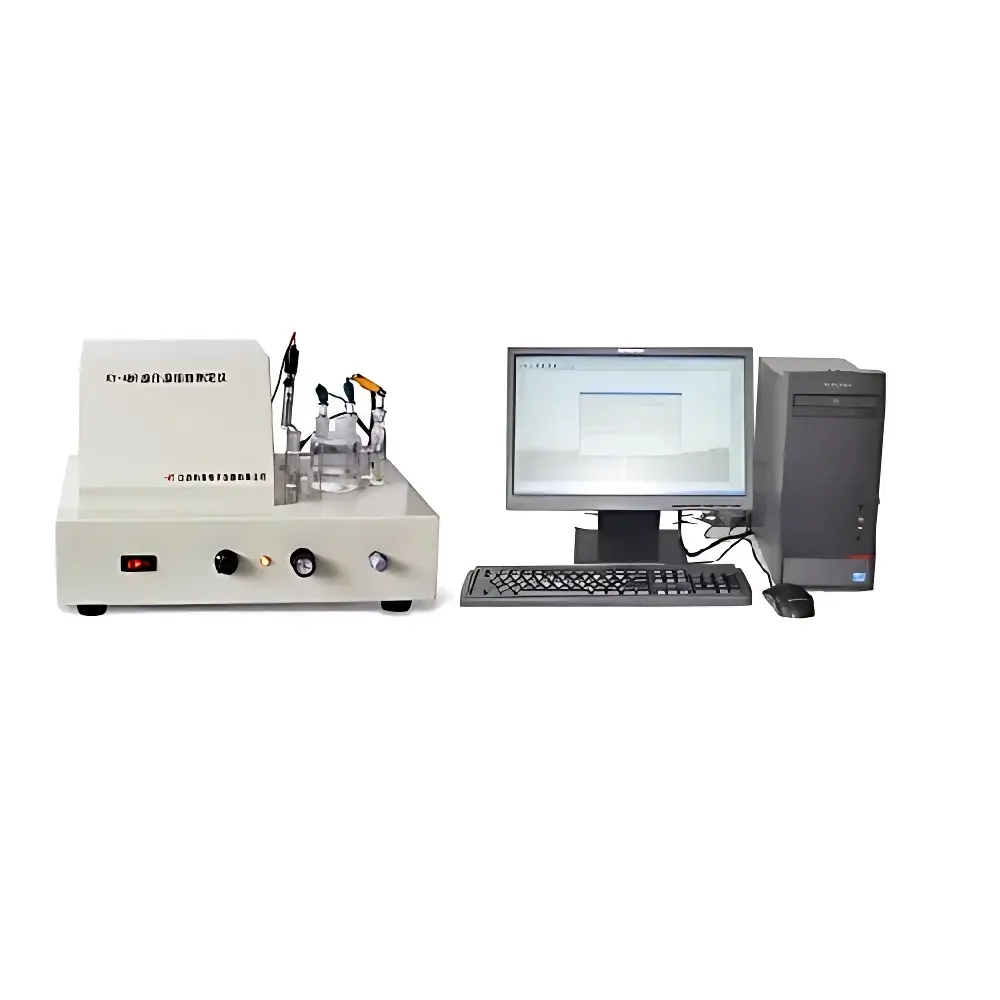
Kyoyuan KY-4BR Microcoulometric Bromine Number and Bromine Index Analyzer
| Brand | Kyoyuan |
|---|---|
| Origin | Jiangsu, China |
| Manufacturer Type | Direct Manufacturer |
| Instrument Type | Universal Potentiometric Titrator |
| Application Scope | Dedicated for Hydrocarbon Analysis |
| Bromine Number Range | 0–300 g Br/100 g oil |
| Bromine Index Range | 1–1000 mg Br/100 g oil |
| Potential Measurement Accuracy | 0.1 mV ± 0.03% |
| Potential Resolution | 0.1 mV |
| Titration Volume Precision | 0.001 mL |
| Bromine Mass Resolution | 0.01 mg Br |
| Detection Limit | 0.1 mg Br |
| Accuracy | ±5% (bromine index ≥ 1 mg Br/100 g oil) |
| Bias Voltage Range | 0–500 mV |
| Cell Volume | 150 mL |
| Stirring Method | Magnetic Stirring |
| Power Supply | 220 V, 50 Hz |
| Power Consumption | 20 W |
| Weight | ~1.6 kg |
Overview
The Kyoyuan KY-4BR Microcoulometric Bromine Number and Bromine Index Analyzer is a dedicated electrochemical measurement system engineered for precise quantification of unsaturation in petroleum-based hydrocarbons via controlled microcoulometric titration. It operates on the principle of controlled-potential coulometry: bromine is generated *in situ* by electrolysis of bromide ions in a sealed titration cell; the generated bromine reacts stoichiometrically with carbon–carbon double bonds in the sample. The endpoint is detected potentiometrically using dual platinum indicator electrodes, and the total charge consumed (Q, in coulombs) is integrated in real time. Bromine number (g Br/100 g sample) and bromine index (mg Br/100 g sample) are calculated directly from Faraday’s law, eliminating volumetric calibration and minimizing reagent dependency. Designed for compliance with SH/T 0630–1996, SH/T 1551–2018, GB/T 11136–1989(2004), SH/T 1767–2008(2015), GB/T 1815–1997, and ASTM D1492, the KY-4BR delivers trace-level sensitivity and high reproducibility in routine QC laboratories handling gasoline, kerosene, diesel, lubricating oils, and light/heavy aromatic streams.
Key Features
- Microcoulometric detection with potentiometric endpoint determination using dual Pt electrodes — ensures stable signal response and high endpoint resolution.
- Non-toxic, benzene-free electrolyte formulation — eliminates health hazards associated with traditional halogenated solvents while maintaining analytical robustness.
- Proprietary fritted-glass coulometric cell (replacing conventional ion-exchange membranes) — prevents membrane degradation, leakage, or drift-induced errors over extended operation.
- Automatic current control during electrolysis — dynamically adjusts generator current to match sample reactivity, improving charge integration accuracy and reducing over-titration risk.
- High-resolution potential measurement (0.1 mV ± 0.03%) and bromine mass resolution (0.01 mg Br) — enables reliable quantification down to 0.1 mg Br/100 g oil.
- Minimal sample consumption: ≤10 µL for bromine number; ≤50 µL for bromine index — critical for high-value or limited-availability samples.
- Full PC-based control via RS-232 serial interface — supports automated method execution, real-time curve plotting, data logging, and report generation.
Sample Compatibility & Compliance
The KY-4BR is validated for liquid hydrocarbon matrices including aliphatic and aromatic fractions, refinery intermediates, and finished fuels. It accommodates samples with low volatility and moderate polarity without pre-treatment. All operational parameters align with internationally recognized standards for coulometric bromination analysis. The instrument architecture supports audit-ready data integrity: raw potential traces, charge integration windows, endpoint timestamps, and user-defined method parameters are stored with timestamped metadata. Data export formats (CSV, TXT) facilitate integration into LIMS environments compliant with GLP and GMP requirements. While not certified to FDA 21 CFR Part 11 out-of-the-box, its deterministic measurement logic, electronic signature-capable software interface, and immutable data logs provide a foundation for laboratory-specific Part 11 validation.
Software & Data Management
The bundled Windows-compatible application provides intuitive method setup, real-time electrochemical curve visualization (E vs. t), automatic endpoint recognition based on first-derivative thresholding, and post-run calculation of bromine number/index with uncertainty propagation. All measurements include full traceability: operator ID, sample ID, injection volume, cell temperature (monitored via embedded sensor), bias voltage setting, and integrated coulombs. Data files are stored in structured directories with ISO 8601 timestamps. Batch reporting supports customizable templates for QA/QC documentation, including statistical summaries (mean, RSD%, recovery %) across replicate analyses. Export functions support direct import into Excel, ChemStation, or enterprise LIMS platforms.
Applications
- Quality control of cracked naphthas and reformate streams for olefin content verification prior to hydrotreating.
- Monitoring bromine index stability in ethylbenzene, xylene isomers, and cumene feedstocks to assess oxidation or polymerization onset.
- Regulatory compliance testing per ASTM D1492 for aromatic purity in petrochemical grade specifications.
- Research-scale screening of catalyst performance in selective hydrogenation processes via unsaturation tracking.
- Refinery lab verification of product specification conformance against SH/T 0630 limits for jet fuel and diesel blending components.
FAQ
What detection principle does the KY-4BR employ?
It uses controlled-potential microcoulometric titration with potentiometric endpoint detection via dual platinum electrodes.
Is the instrument compatible with non-hydrocarbon solvents such as chlorinated or oxygenated organics?
No — it is specifically calibrated and validated for hydrocarbon matrices per SH/T and ASTM standards; solvent interference may compromise coulometric efficiency and endpoint stability.
Does the system support multi-point calibration or standard addition protocols?
Yes — the software allows manual or automated standard addition sequences and stores calibration curves with correlation coefficients and residual error analysis.
How is data integrity maintained during power interruption?
The embedded controller retains real-time coulomb integration in non-volatile memory; upon recovery, the software resumes calculation from the last valid timestamp without data loss.
Can the titration cell be cleaned and reused indefinitely?
Yes — the fritted-glass cell is chemically resistant to common electrolytes and can be regenerated via ultrasonic cleaning and thermal conditioning; typical service life exceeds 500 analyses under proper maintenance.




