
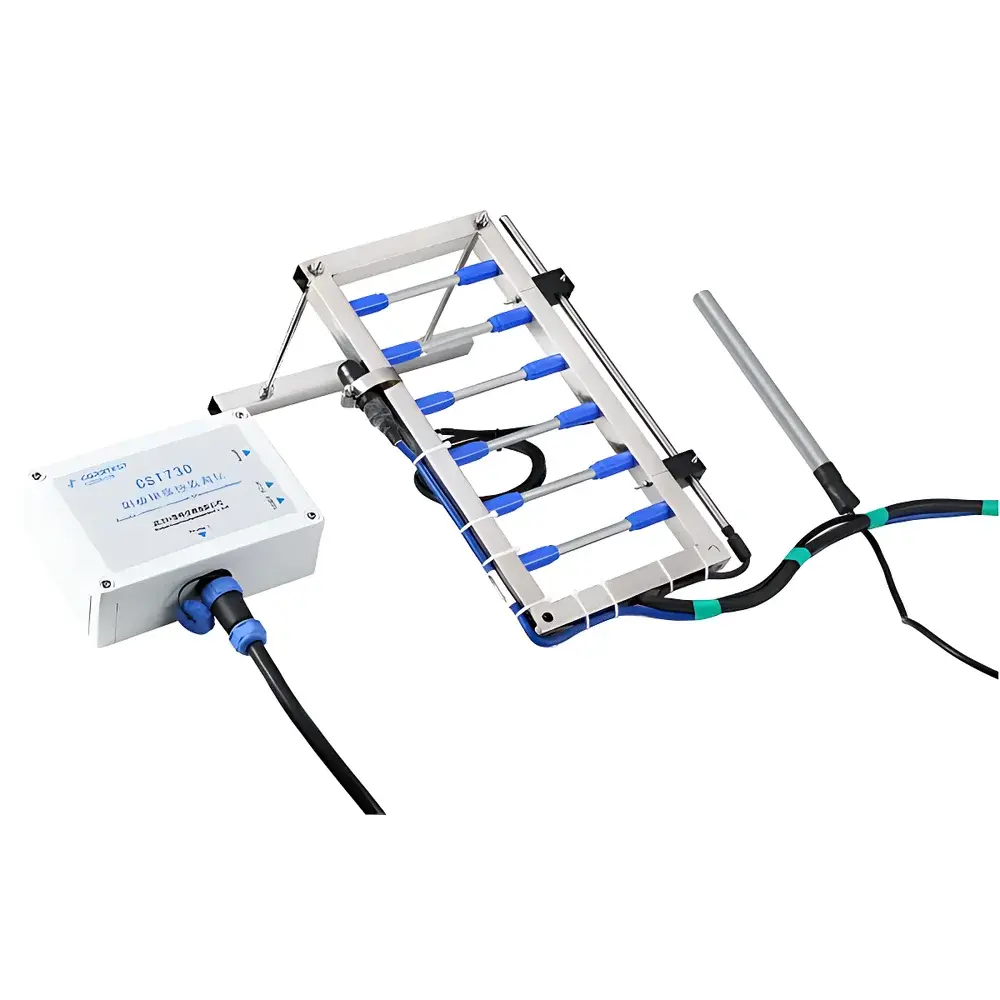
CorrTest CST730 Anodic Gradient Corrosion Monitoring System
| Brand | CorrTest |
|---|---|
| Origin | Hubei, China |
| Model | CST730 |
| Measurement Channels | 6-potential / 6-current / 6-impedance |
| Input Impedance | 1×10⁸ Ω |
| Potential Range | −2.0 V to +2.0 V |
| Potential Accuracy | ±0.5% of full scale |
| Potential Resolution | 0.1 mV |
| Current Range | −10 mA to +10 mA (5 auto-ranging scales: 2 µA, 20 µA, 200 µA, 2 mA, 20 mA) |
| Current Accuracy | ±0.5% FS (>20 µA), ±1% FS (≤20 µA) |
| Current Resolution | 0.01 µA |
| Impedance Range | 100 Ω to 10 MΩ |
| Impedance Accuracy | ±0.5% FS (<1 MΩ), ±2% FS (≥1 MΩ) |
| Impedance Resolution | 0.1 Ω |
| Temperature Range | −30 °C to +85 °C (±1 °C) |
| Logging Interval | 1–255 hours |
| Data Storage | 2 MB (~10,000 records) |
| Communication | RS485, Modbus RTU protocol |
| Power Supply | DC 12 V |
| Dimensions | 180 mm × 130 mm × 60 mm |
| Weight | 2.0 kg |
| Operating Temperature | −30 °C to +60 °C |
| Operating Humidity | ≤95% RH (non-condensing) |
| Enclosure Material | Weather-resistant engineering plastic |
| Ingress Protection | IP67 |
Overview
The CorrTest CST730 Anodic Gradient Corrosion Monitoring System is an engineered field-deployable electrochemical instrument designed for long-term, in-situ assessment of reinforcement corrosion initiation and propagation in concrete structures. It operates on the principle of multi-depth anodic gradient sensing—leveraging spatially resolved electrochemical measurements across a vertically aligned array of embedded carbon steel or stainless steel anodes. By continuously acquiring open-circuit potential (OCP), galvanic current between the anode ladder and a dedicated cathode, and inter-anode AC impedance spectra (EIS), the system enables quantitative tracking of the corrosion front migration—driven by CO₂ ingress (carbonation), chloride ion penetration, and moisture transport. This spatial-temporal profiling supports mechanistic modeling of depassivation kinetics, allowing estimation of time-to-corrosion onset at varying cover depths—a critical input for service life prediction under ISO 16204, ASTM C876, and EN 1504-9 frameworks.
Key Features
- Simultaneous 6-channel acquisition of corrosion potential, galvanic current, and inter-electrode impedance—enabling synchronized depth-resolved electrochemical mapping.
- High-input-impedance (1×10⁸ Ω) potential measurement circuitry ensures minimal loading error on high-resistivity concrete matrices.
- Auto-ranging current measurement with five selectable full-scale ranges (2 µA to 20 mA) and sub-microamp resolution (0.01 µA) for detecting early-stage macrocell activity.
- Integrated temperature and relative humidity sensing (via external probe compatibility) for environmental normalization of electrochemical data per ASTM C1549 and RILEM TC 116-PCD guidelines.
- IP67-rated enclosure with UV-stabilized engineering plastic housing—certified for permanent outdoor installation in bridge decks, marine splash zones, and precast elements.
- Modbus RTU over RS485 interface supports integration into SCADA systems and centralized structural health monitoring (SHM) platforms compliant with IEC 61850-90-5.
Sample Compatibility & Compliance
The CST730 is optimized for use with the CP-73 anodic ladder probe—comprising six equally spaced carbon steel anodes (Φ6 mm, ASTM A615 Grade 60) mounted on a corrosion-resistant stainless-steel frame. Each anode is individually insulated and shielded against alkali attack and chloride-induced pitting via proprietary ceramic-polymer hybrid coating. A dedicated reference electrode (Ag/AgCl/saturated KCl or Cu/CuSO₄) is optionally deployed alongside the ladder for stable OCP referencing. The system conforms to key international standards governing reinforced concrete corrosion monitoring: ASTM C876 (potential mapping), ASTM G102 (electrochemical corrosion rate calculation), ISO 12627 (embedded sensor performance), and EN 1504-9 (diagnostics and monitoring of concrete structures). All firmware and data logging routines support audit-ready timestamping and metadata tagging required for GLP-compliant infrastructure asset management.
Software & Data Management
Supplied CorrView™ software provides calibrated data visualization, automated corrosion front depth calculation, and export-ready reporting in CSV, PDF, and XML formats. The software implements Nernstian correction algorithms for temperature-compensated potential analysis and employs Cole-Cole plot fitting to extract concrete resistivity from EIS data—directly supporting ISO 12627 Annex B resistivity classification (high/medium/low corrosion risk). Raw datasets include full Modbus register dumps with embedded calibration coefficients, enabling third-party integration with MATLAB, Python (via PyModbus), or cloud-based digital twin platforms. All data files retain traceable device ID, probe configuration metadata, and operator-defined location tags—meeting FDA 21 CFR Part 11 requirements for electronic records when deployed in regulated infrastructure projects.
Applications
- Long-term carbonation front tracking in cementitious overlays and repair mortars.
- Chloride diffusion coefficient validation in laboratory-exposed specimens and field-retrofitted bridge girders.
- Quantification of corrosion inhibition efficiency in migrating corrosion inhibitors (MCIs) and electrochemical chloride extraction (ECE) treatments.
- Calibration and verification of numerical models predicting reinforcement depassivation (e.g., DuraCrete, Life-365).
- Performance benchmarking of high-performance concretes (HPC), ultra-high-performance concretes (UHPC), and geopolymer binders under accelerated aging protocols.
FAQ
Can the CST730 operate autonomously for extended periods without manual intervention?
Yes—the instrument supports unattended operation for up to 10,000 measurement cycles with programmable intervals from 1 hour to 255 hours. Internal non-volatile memory retains all data during power loss, and DC12V supply compatibility enables integration with solar-charged battery systems for remote deployments.
Is the CP-73 probe compatible with existing embedded sensor networks?
The CP-73 uses standardized 4-conductor shielded cables terminated in IP68 M12 connectors. Its electrical interface complies with EN 1504-9 Annex C mechanical and signal specifications, allowing retrofitting into legacy monitoring systems using Modbus gateway adapters.
How does the system handle data normalization across variable environmental conditions?
CorrView™ applies real-time temperature compensation to both potential and impedance values using built-in polynomial coefficients derived from ASTM C1549 calibration curves. Humidity data (from optional external probes) is logged separately for post-hoc statistical correlation with corrosion parameter drift.
Does the CST730 support regulatory compliance for infrastructure asset reporting?
Yes—data export includes ISO 8601 timestamps, device serial numbers, probe calibration dates, and user-defined project IDs. Audit logs record all configuration changes, satisfying ISO/IEC 17025 and EN 1504-9 documentation requirements for certified inspection agencies.
What maintenance is required for long-term field deployment?
No routine calibration is needed within 12 months of factory certification. The IP67 enclosure requires only periodic visual inspection of cable glands and connector seals. Reference electrodes should be verified annually per ASTM C876 Section 7.3 procedures.
Related Products





