
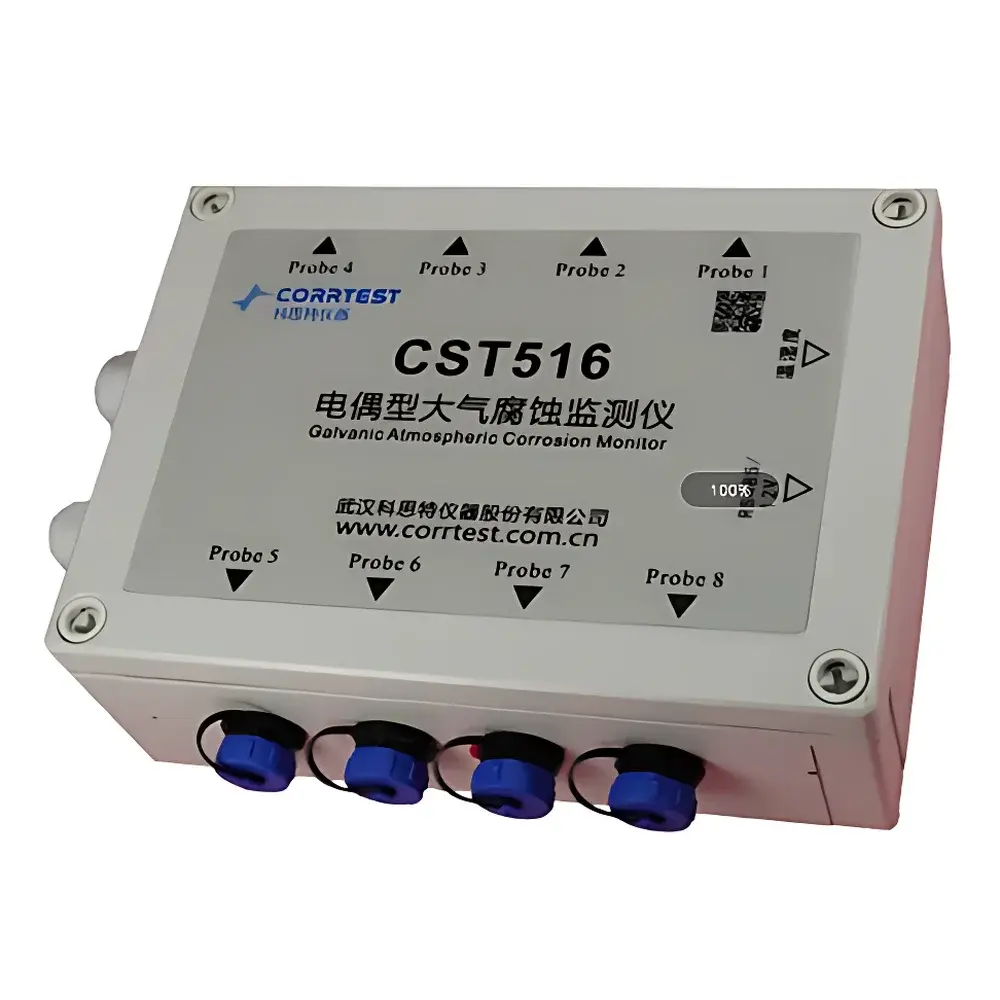
CorrTest CST516 Galvanic Corrosion Monitor
| Brand | CorrTest |
|---|---|
| Origin | Hubei, China |
| Model | CST516 |
| Channels | 8 |
| Galvanic Current Range | ±0.01 nA to ±10 mA |
| Current Resolution | 10 pA (at 10 nA range) |
| Potential Range | −1.20 V to +1.20 V |
| Potential Accuracy | ±1 mV |
| Temperature Range | −30 °C to +60 °C (±1 °C) |
| Relative Humidity Range | 0–100% RH (±3% RH) |
| Barometric Pressure Range | 500–1200 hPa (±0.5 hPa) |
| Sampling Interval | 1–99 s |
| Data Storage | 2 MB (≈20,000 records) |
| Communication | RS485, Modbus RTU |
| Power Supply | DC 12 V |
| Dimensions | 180 × 130 × 60 mm |
| Weight | 600 g |
| Enclosure Rating | IP65 |
| Electrode Configurations | Cu–Fe, Zn–Fe, Al–Fe symmetric comb-type electrodes (0.5 mm pitch) |
| Onboard Filtering | 2nd-order low-pass analog filter |
| Microcontroller | STM32-based embedded system |
| Input Architecture | 8-channel ultra-high-impedance voltage followers + 8-channel precision zero-resistance ammeters |
Overview
The CorrTest CST516 Galvanic Corrosion Monitor is an engineered field-deployable instrument designed for quantitative, long-term assessment of atmospheric corrosion activity under thin electrolyte films—such as dew, condensate, or hygroscopic salt layers—on metallic surfaces. It operates on the galvanic couple principle: when dissimilar metals (e.g., Cu–Fe, Zn–Fe, or Al–Fe) are electrically connected and exposed to a common corrosive electrolyte film, a measurable galvanic current flows between them. This current correlates directly with localized electrochemical driving force and serves as a real-time proxy for corrosion aggressiveness. Unlike conventional weight-loss coupons or electrochemical noise sensors, the CST516 delivers continuous, multi-channel galvanic current and open-circuit potential (OCP) data at sub-nanoampere resolution—enabling detection of early-stage moisture-induced activation and differentiation of corrosion severity across heterogeneous material pairings. Its architecture supports unattended operation in harsh outdoor or semi-controlled indoor environments, including industrial infrastructure, energy transmission assets, cultural heritage sites, and cleanroom facilities.
Key Features
- Eight independent galvanic measurement channels with simultaneous dual-parameter acquisition (potential + current) per channel
- Auto-ranging current measurement spanning eight decades (±1 nA to ±10 mA), with 10 pA resolution at the 10 nA range
- Ultra-high-input-impedance voltage followers (>1014 Ω) ensuring minimal loading error during OCP monitoring
- Onboard 2nd-order analog low-pass filtering to suppress high-frequency electromagnetic interference common in industrial settings
- Integrated temperature, relative humidity, and barometric pressure sensing with traceable accuracy specifications
- Real-time clock (RTC) with drift <1 minute/month, enabling time-synchronized corrosion event logging
- RS485 physical layer compliant with EIA-485 standard; supports Modbus RTU protocol for seamless integration into SCADA, DCS, or PLC systems
- IP65-rated polycarbonate enclosure rated for continuous outdoor deployment under rain, dust, and thermal cycling
Sample Compatibility & Compliance
The CST516 is compatible with standardized comb-type ACM (Atmospheric Corrosion Monitor) probes featuring symmetric electrode geometries and 0.5 mm inter-electrode spacing—optimized for reproducible thin-film electrolyte contact. Pre-configured probe sets include Cu–Fe, Zn–Fe, and Al–Fe couples; custom electrode materials may be integrated subject to galvanic series compatibility and surface area matching. The instrument’s measurement methodology aligns with ASTM G102 (Standard Practice for Calculation of Corrosion Rates), ASTM G71 (Guide for Conducting and Evaluating Galvanic Corrosion Tests), and ISO 9223 (Corrosion of metals and alloys — Corrosivity of atmospheres). Data integrity meets GLP/GMP-aligned requirements through timestamped storage, non-volatile memory retention, and deterministic sampling intervals. While not FDA-certified, its Modbus interface and audit-ready data structure support validation pathways under 21 CFR Part 11 when deployed in regulated manufacturing or facility monitoring contexts.
Software & Data Management
The included CS Kit corrosion management software provides full lifecycle data handling: configuration of sampling schedules, real-time visualization of galvanic current transients and OCP drift, trend analysis using moving-average and derivative-based corrosion onset detection, and automated generation of corrosion rate estimates via Faraday-based conversion. All datasets export to CSV and Excel-compatible XLSX formats, preserving metadata (channel ID, timestamp, environmental conditions). The database engine supports relational querying by location, probe type, or temporal window, facilitating comparative analysis across asset classes (e.g., wind turbine towers vs. refinery piping supports). Software logs include operator actions, firmware version, and calibration history—enabling traceability during internal audits or third-party verification.
Applications
- Long-term corrosion surveillance of steel infrastructure in coastal or industrial atmospheres (e.g., bridge girders, offshore wind tower bases)
- Condition-based monitoring of grounding grids and transmission tower hardware in utility networks
- Environmental qualification of protective coatings and inhibitor efficacy in petrochemical processing units
- Microclimate corrosion mapping inside controlled environments: museum display cases, pharmaceutical cleanrooms, and data center server rooms
- Validation of HVAC dehumidification performance against corrosion risk thresholds in archival storage facilities
- Field calibration reference for predictive atmospheric corrosion models (e.g., ISO CORRAG, IEC 60068-2-30)
FAQ
Can the CST516 operate without external power for extended periods?
No—it requires a stable DC 12 V supply. For remote deployments, it is commonly paired with solar-charged battery systems or PoE-powered RS485 media converters.
Is probe calibration required before installation?
No routine calibration is needed; however, baseline measurements should be recorded under dry, inert conditions prior to field exposure to establish reference OCP and leakage current levels.
Does the instrument support wireless telemetry out-of-the-box?
Not natively—but RS485 output is fully compatible with commercial wireless serial servers (e.g., Digi XBee, Laird Sentrius) supporting LTE-M, NB-IoT, or LoRaWAN protocols.
How is corrosion rate calculated from galvanic current data?
Using Faraday’s law and predefined electrode surface area and metal valence assumptions; CS Kit applies ASTM G102 equations and allows user-defined equivalents for non-standard alloys.
What maintenance is recommended for long-term reliability?
Annual visual inspection of probe electrode surfaces for passivation or contamination; cleaning with isopropyl alcohol if necessary; verification of seal integrity on the instrument housing and cable glands.
Related Products





