
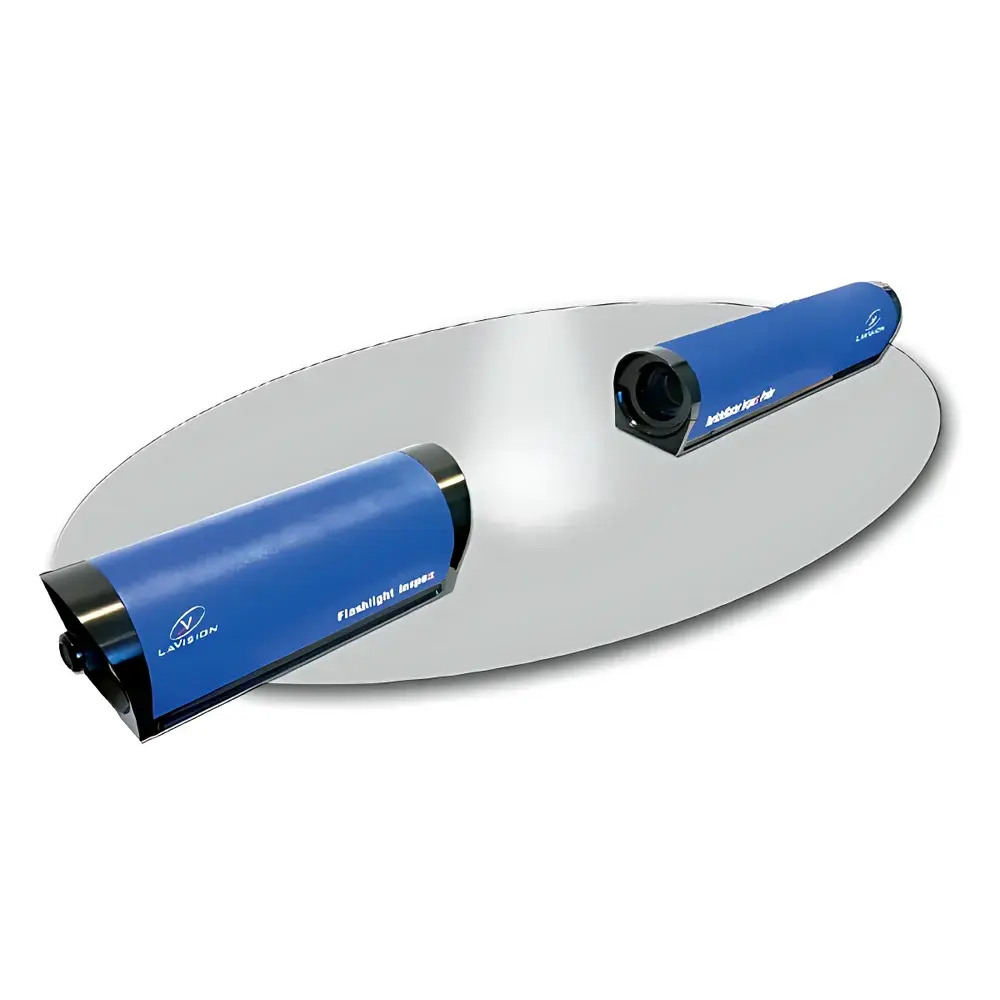
ParticleMaster inspex Online Droplet & Particle Analyzer
| Brand | LaVision GmbH |
|---|---|
| Origin | Germany |
| Model | ParticleMaster inspex |
| Dispersion Method | Dry & Wet |
| Measurement Range | >5 µm |
| Repeatability | <1% |
| Measurement Time | 30–60 s |
| Compliance | IP54 |
| Light Source | LED (Eye-Safe) |
| Calibration | Factory-Preconfigured Particle Size & Depth-of-Field Calibration |
| Installation | Fixed-Mount Integrated Probe with Coaxial Illumination |
Overview
The ParticleMaster inspex is a high-speed, inline digital imaging analyzer engineered for real-time characterization of droplets and coarse particles in industrial process streams. Unlike laser diffraction or dynamic light scattering systems, the inspex employs dual-frame high-resolution digital microscopy combined with deterministic image segmentation algorithms to extract per-particle metrics—including equivalent circular diameter, aspect ratio, convexity, orientation angle, perimeter, and projected area. Its measurement principle relies on time-resolved shadowgraphy: two consecutive frames captured at a precisely controlled inter-frame interval enable pixel-level tracking and velocity vector computation for each resolvable object (>5 µm). This approach delivers not only static size distribution statistics (D10, D32, Dv10, Dv50, Dv90) but also dynamic flow parameters such as mass-based volumetric flux and spatial concentration gradients. Designed for continuous operation in harsh environments, the system operates without optical alignment requirements post-installation—factory calibration covers both particle sizing accuracy and depth-of-field mapping across the full working distance range.
Key Features
- True inline capability: Integrated probe head with coaxial LED illumination and telecentric optics enables direct mounting into pipelines, spray chambers, or exhaust ducts—no sample extraction or dilution required.
- Eye-safe illumination: High-intensity, narrow-spectrum LED source eliminates regulatory constraints associated with Class 3B/4 lasers; compliant with IEC 62471 for photobiological safety.
- Dual-frame velocimetry: Synchronized image acquisition at up to 1 kHz frame rate supports quantitative analysis of particle trajectory, acceleration, and collision dynamics.
- Robust mechanical design: IP54-rated housing ensures protection against dust ingress and water splashing—suitable for chemical processing, food drying, pharmaceutical fluidized beds, and combustion exhaust monitoring.
- No field recalibration needed: Factory-performed traceable calibration includes certified reference particles and depth-of-field verification; documented per ISO/IEC 17025 procedures.
- Real-time statistical engine: Onboard FPGA-accelerated processing computes distributions, histograms, scatter plots, and cumulative volume fractions within ≤60 seconds per measurement cycle.
Sample Compatibility & Compliance
The ParticleMaster inspex accommodates opaque, translucent, and semi-transparent particulates—ideal for emulsions, atomized sprays, granular effluents, and agglomerated powders. It does not require refractive index input or dispersion media optimization, making it inherently compatible with non-aqueous solvents, viscous oils, and reactive gases. The system meets functional safety requirements for Zone 2/22 environments when installed with appropriate conduit seals. Data integrity aligns with ALCOA+ principles: all raw images, metadata, and processed results are timestamped, digitally signed, and stored with immutable audit trails. While not intrinsically rated for explosive atmospheres, optional ATEX-compliant enclosure variants are available upon request. Regulatory documentation supports compliance with FDA 21 CFR Part 11 (electronic records/signatures), EU GMP Annex 11, and ISO 13322-2 for static image analysis.
Software & Data Management
LaVision’s DaVis ParticleMaster software provides a validated platform for configuration, visualization, and export. The interface supports multi-user role-based access control (RBAC), configurable alarm thresholds (e.g., Dv50 drift >2%), and automated report generation in PDF or CSV format. All measurement sessions are archived with embedded calibration certificates and environmental logs (temperature, pressure, ambient humidity). Raw TIFF sequences and processed HDF5 datasets can be exported for third-party statistical modeling (e.g., Python/Pandas, MATLAB). Software validation packages—including IQ/OQ documentation, test scripts, and UAT protocols—are provided to support regulated laboratory deployment under GLP or GMP frameworks.
Applications
- Chemical process optimization: Monitoring droplet size evolution in reactor quench lines or solvent recovery scrubbers.
- Pharmaceutical spray drying: Quantifying particle morphology and velocity profiles in dryer exhaust to correlate with residual moisture and API crystallinity.
- Fuel injection diagnostics: Characterizing ligament breakup and secondary atomization in diesel and biofuel injectors under transient conditions.
- Food & beverage quality control: Inline verification of starch granule dispersion in dairy emulsions or cocoa powder hydration kinetics.
- Environmental emission monitoring: Real-time quantification of fly ash particle size distribution in flue gas desulfurization bypass streams.
FAQ
Is the ParticleMaster inspex suitable for sub-5 µm particles?
No—the system’s optical resolution and minimum detectable feature size are optimized for particles ≥5 µm. For finer dispersions, LaVision recommends the SprayMaster or BOS system based on background-oriented schlieren or Mie scattering principles.
Can the probe be retrofitted into existing stainless-steel piping?
Yes—standard configurations include ANSI/ISO flange mounts (DN25–DN100) with cooling jackets and purge gas ports for high-temperature or fouling-prone applications.
Does the system support remote diagnostics and firmware updates?
Yes—via secure TLS-encrypted Ethernet connection; remote support requires customer-configured firewall exceptions and authenticated SSH access.
How is measurement uncertainty quantified and reported?
Uncertainty budgets follow EURACHEM/CITAC Guide CG4, incorporating contributions from pixel resolution, depth-of-field blurring, segmentation algorithm sensitivity, and reference standard traceability to PTB-certified microspheres.



