
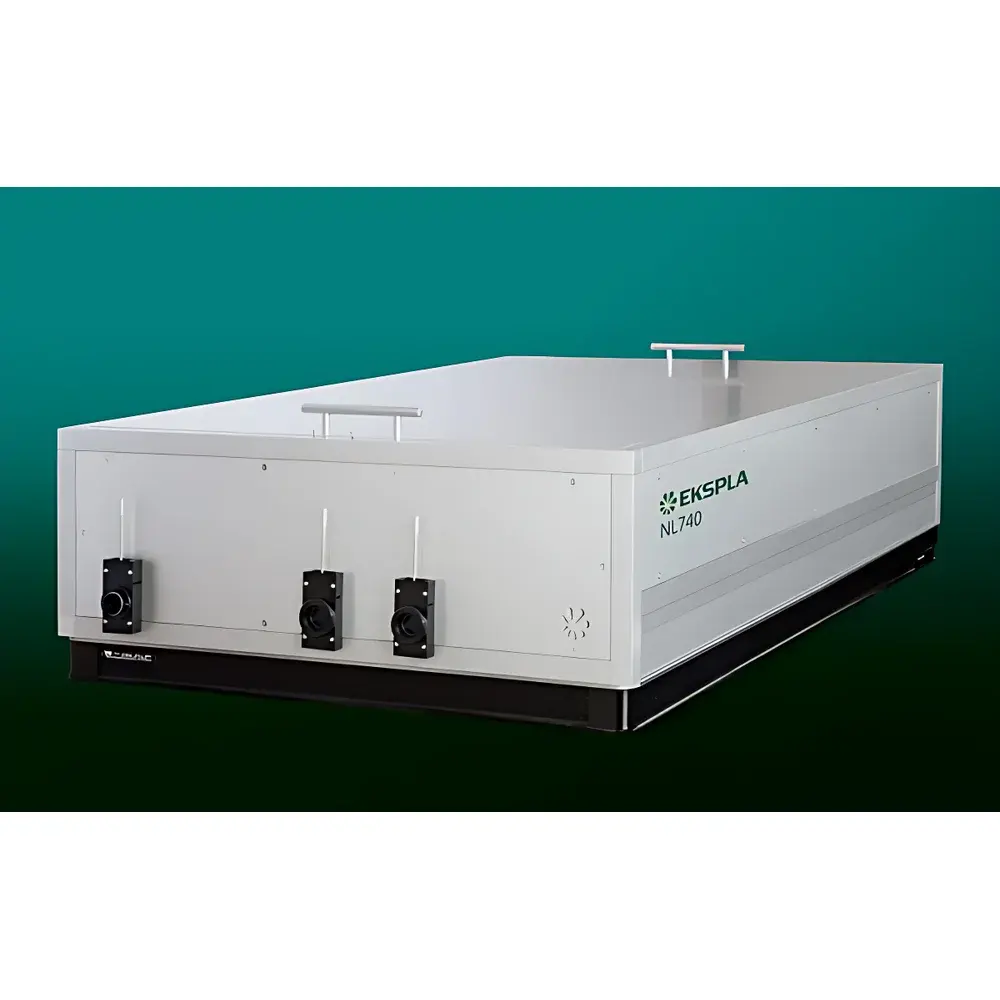
Ekspla NL740 Ultra-Stable Nanosecond Laser System
| Brand | Ekspla |
|---|---|
| Origin | Lithuania |
| Manufacturer Type | Original Equipment Manufacturer (OEM) |
| Product Category | Imported High-Power Solid-State Nanosecond Laser |
| Model | NL740 |
| Pulse Energy | Up to 100 mJ per pulse |
| Repetition Rate | 100 Hz |
| Pulse Width | 2–10 ns (adjustable) |
| Wavelength Options | 1064 nm, 532 nm, 355 nm |
| Output Configuration | Fiber-coupled front-end amplified via diode-pumped regenerative amplifier |
| Core Technology | Q-switched Nd:YAG solid-state laser with active stabilization architecture |
Overview
The Ekspla NL740 is a high-performance, ultra-stable nanosecond laser system engineered for demanding scientific and industrial applications requiring exceptional temporal and spatial beam stability. Built upon a master oscillator–power amplifier (MOPA) architecture, the NL740 integrates a low-noise, actively stabilized Q-switched Nd:YAG oscillator with a diode-pumped regenerative amplifier stage, enabling precise control over pulse energy, duration, and timing jitter. Its core design prioritizes long-term amplitude stability (<±0.5% RMS over 8 hours), pointing stability (<5 µrad RMS), and pulse-to-pulse timing jitter (<200 ps RMS), making it suitable for interferometric metrology, pump-probe experiments, and synchronization-critical laser systems. The system delivers up to 100 mJ pulse energy at 1064 nm with a repetition rate of 100 Hz and configurable pulse widths from 2 to 10 ns—optimized for efficient harmonic generation and nonlinear optical pumping.
Key Features
- Ultra-low amplitude and pointing instability—engineered for sub-microradian beam pointing reproducibility and <±0.5% pulse energy fluctuation over extended operation.
- Integrated fiber-coupled front-end output—enables seamless integration into complex optical setups while maintaining modal purity and minimizing alignment drift.
- Harmonic generation compatibility—standard wavelength outputs include fundamental 1064 nm, second-harmonic 532 nm, and third-harmonic 355 nm, all generated with high conversion efficiency and spectral purity.
- Active thermal and mechanical stabilization—precision-machined monolithic baseplate, low-CTE optics mounts, and closed-loop temperature control ensure robust performance across ambient fluctuations.
- Industrial-grade control interface—RS-232, USB, and Ethernet connectivity support remote triggering, parameter programming, and real-time diagnostics compliant with SCPI command set.
- CE-marked and RoHS-compliant construction—designed for laboratory and cleanroom environments under ISO 14644-1 Class 5 conditions.
Sample Compatibility & Compliance
The NL740 is compatible with a broad range of optical components and experimental configurations, including Ti:sapphire oscillator seeding, multi-stage power amplifiers, and vacuum-compatible plasma chambers. Its pulse parameters meet requirements for ASTM F2971 (laser-induced shock wave characterization) and ISO 11554 (laser beam parameter measurements). For regulated environments, the system supports audit-ready operation logs and can be configured with optional hardware interlocks and emergency stop circuits aligned with IEC 60825-1:2014 Class 4 laser safety standards. When deployed in GLP/GMP-aligned facilities, its firmware supports timestamped event logging and user-access-level authentication—facilitating traceability in FDA 21 CFR Part 11–governed workflows.
Software & Data Management
Ekspla’s proprietary LaserStudio software provides comprehensive control, monitoring, and data export capabilities. Users can configure pulse parameters, monitor real-time energy histograms, track thermal sensor readings, and log operational events with microsecond timestamp resolution. Export formats include CSV, HDF5, and MATLAB-compatible binaries—enabling direct integration with Python-based analysis pipelines (e.g., SciPy, NumPy) and LabVIEW-based DAQ systems. Optional API libraries (C/C++, .NET, Python) allow full programmatic access to laser status, fault reporting, and calibration history—critical for automated metrology platforms and synchronized multi-laser experiments.
Applications
- Metrology: Used in absolute distance interferometry, time-of-flight measurements, and cavity ring-down spectroscopy where pulse timing fidelity and energy stability directly impact measurement uncertainty.
- Ti:sapphire pumping: Provides high-energy, low-jitter 532 nm pulses for broadband oscillator seeding and chirped-pulse amplification (CPA) systems.
- Laser peening: Delivers controlled shockwave generation on metallic surfaces for residual stress modification and fatigue life extension—validated per SAE AMS 2430 and ASTM E3053 protocols.
- Plasma and shock physics: Serves as driver source for Z-pinch initiation, laser-induced breakdown spectroscopy (LIBS), and equation-of-state studies in high-energy-density physics experiments.
- Nonlinear frequency conversion: Optimized for efficient optical parametric amplification (OPA), difference-frequency generation (DFG), and terahertz generation via optical rectification in DAST or GaSe crystals.
FAQ
What is the typical pulse-to-pulse energy stability specification for the NL740 at 100 mJ output?
Energy stability is specified as ≤±0.5% RMS over 8 hours under constant ambient conditions, measured with a calibrated pyroelectric sensor and digital integrator.
Can the NL740 be synchronized to an external clock signal?
Yes—the system accepts TTL/CMOS external trigger inputs with programmable delay (0–10 s, 100 ps resolution) and supports phase-locking to external RF references via optional PLL module.
Is harmonic generation included as standard equipment?
The NL740 is supplied with integrated 2nd- and 3rd-harmonic modules; optional 4th-harmonic (266 nm) and 5th-harmonic (213 nm) generators are available as field-upgrade kits.
What cooling method does the NL740 require?
It employs closed-loop water cooling with integrated chiller interface (standard 18–22°C inlet, ≤0.5 bar pressure drop); air-cooled variants are not offered due to thermal load constraints.
Does the system comply with FDA laser product regulations for U.S. import?
Yes—the NL740 carries FDA accession number and complies with 21 CFR 1040.10/1040.11 requirements; full compliance documentation is provided with each shipment.



