
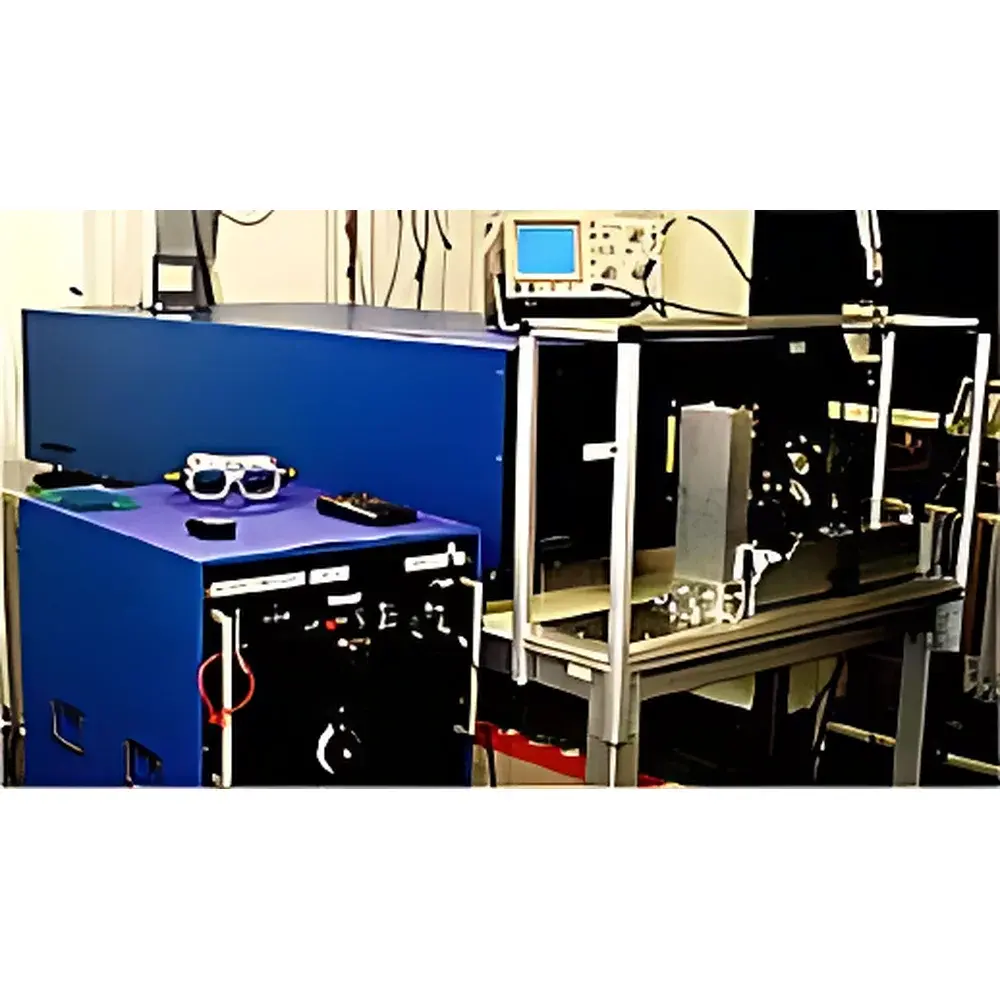
LLG50 UV Femtosecond Laser Amplifier by Laser-Laboratorium Göttingen e.V.
| Brand | Laser-Laboratorium Göttingen e.V. |
|---|---|
| Origin | Germany |
| Model | LLG50 |
| Wavelength | 248 nm |
| Pulse Energy | 50 mJ (for seed pulse energy > 50 µJ at 248 nm) |
| Timing Jitter | ±2 ns (relative to trigger) |
| Beam Size | 36 × 36 mm² |
| Beam Quality | M² ≤ 2 (input M² = 1) |
| Amplification Geometry | Dual- or triple-pass configuration |
Overview
The LLG50 UV Femtosecond Laser Amplifier is a high-energy, narrow-bandwidth, 248 nm excimer-based amplifier system engineered for the amplification of ultrashort seed pulses generated by frequency-doubled Ti:sapphire or optical parametric chirped-pulse amplification (OPCPA) sources. Unlike broadband solid-state amplifiers, the LLG50 leverages KrF excimer gain medium dynamics to deliver high-peak-power UV pulses with exceptional temporal contrast and spatial coherence. Its core function is to boost low-energy (<100 µJ), sub-100-fs seed pulses—typically derived from a 496 nm or 248 nm oscillator chain—into millijoule-level output while preserving pulse duration fidelity and minimizing amplified spontaneous emission (ASE). The system operates on a master oscillator–power amplifier (MOPA) architecture, where precise synchronization between the seed laser and excimer discharge timing is maintained via a dedicated low-jitter electronic control unit. This ensures stable long-term operation under laboratory-grade environmental conditions and supports pump-probe experiments requiring sub-nanosecond relative timing stability.
Key Features
- High-gain KrF excimer amplifier optimized for 248 nm operation with >10⁴ small-signal gain
- Dual- or triple-pass beam geometry configurable via motorized mirror stages to maximize extraction efficiency based on input seed energy
- Integrated synchronization module delivering ±2 ns timing jitter relative to external TTL trigger, compliant with standard delay generator interfaces (e.g., Stanford DG535)
- Beam delivery path designed for diffraction-limited propagation: input M² = 1 yields output M² ≤ 2 across full aperture (36 × 36 mm²)
- Robust mechanical architecture featuring kinematic mounts, vacuum-tight stainless-steel chamber, and active thermal stabilization of the excimer gas mixture
- Comprehensive interlock system meeting IEC 60825-1:2014 Class 4 laser safety requirements, including shutter control, door interlocks, and emission indicators
Sample Compatibility & Compliance
The LLG50 is compatible with seed sources delivering ≥50 µJ pulses at 248 nm with durations between 50 fs and 500 fs. It supports both single-shot and repetition-rate operation up to 10 Hz (limited by gas refresh cycle and thermal management). The system conforms to EU Machinery Directive 2006/42/EC and Electromagnetic Compatibility Directive 2014/30/EU. All optical enclosures are certified per EN 60825-1 for Class 4 laser product safety. For regulated environments—including ISO 17025-accredited laboratories and GLP-compliant facilities—the amplifier’s timing electronics support audit-trail-capable logging when interfaced with external data acquisition systems. While not inherently FDA 21 CFR Part 11 compliant, its digital control interface allows integration into validated workflows via third-party SCADA or LabVIEW-based supervision layers.
Software & Data Management
The LLG50 does not include embedded GUI software but provides a standardized RS-232 and Ethernet (TCP/IP) interface for remote control of discharge voltage, repetition rate, delay settings, and diagnostic monitoring (e.g., gas pressure, HV status, trigger alignment feedback). A comprehensive command-line protocol enables scripting in Python, MATLAB, or LabVIEW. All operational parameters are timestamped and exportable in CSV format for traceability. Optional OEM firmware extensions support synchronized triggering with streak cameras, time-of-flight mass spectrometers, or ultrafast electron diffraction (UED) systems. Firmware updates are delivered via signed binary packages verified against SHA-256 checksums to ensure integrity in secure lab networks.
Applications
- Ultrafast photoelectron spectroscopy (PES) and time-resolved ARPES using 248 nm probe pulses
- Pump–probe studies of carrier dynamics in wide-bandgap semiconductors (e.g., GaN, SiC, diamond)
- UV-pumped transient absorption spectroscopy of biological chromophores and photocatalytic complexes
- Generation of coherent EUV via high-harmonic generation (HHG) in noble gases, where 248 nm driving pulses improve phase-matching bandwidth
- Laser-induced breakdown spectroscopy (LIBS) with enhanced ablation efficiency and reduced thermal loading on conductive samples
- Calibration of single-photon detectors and streak camera response functions in the deep-UV spectral region
FAQ
What is the minimum required seed pulse energy for efficient amplification?
A seed pulse energy ≥50 µJ at 248 nm is recommended to achieve optimal gain saturation and output stability. Lower energies may result in reduced extraction efficiency and increased ASE background.
Can the LLG50 be operated at repetition rates above 10 Hz?
No—continuous operation above 10 Hz is not supported due to thermal load limitations in the KrF gas mixture and electrode cooling constraints. Burst-mode operation (e.g., 5 pulses @ 100 Hz) requires prior consultation with Laser-Laboratorium Göttingen for gas-handling modifications.
Is vacuum UV (VUV) output possible with this amplifier?
No—the LLG50 is strictly a 248 nm amplifier. VUV generation (e.g., 126 nm) would require additional nonlinear conversion stages (e.g., Ar gas-filled hollow-core fiber harmonic generation), which are outside the scope of this system.
Does the system include beam diagnostics such as autocorrelation or FROG?
No—pulse duration characterization tools are not integrated. Users must employ external devices (e.g., second-harmonic-generation autocorrelator or GRENOUILLE) calibrated for 248 nm operation.
What gas mixture is used, and how often must it be replenished?
The amplifier uses a proprietary Kr/F₂/Ne mixture. Typical gas lifetime is 10⁶ shots at 10 Hz; replacement intervals depend on operating pressure history and are monitored via integrated piezoresistive gauges and discharge impedance tracking.



