
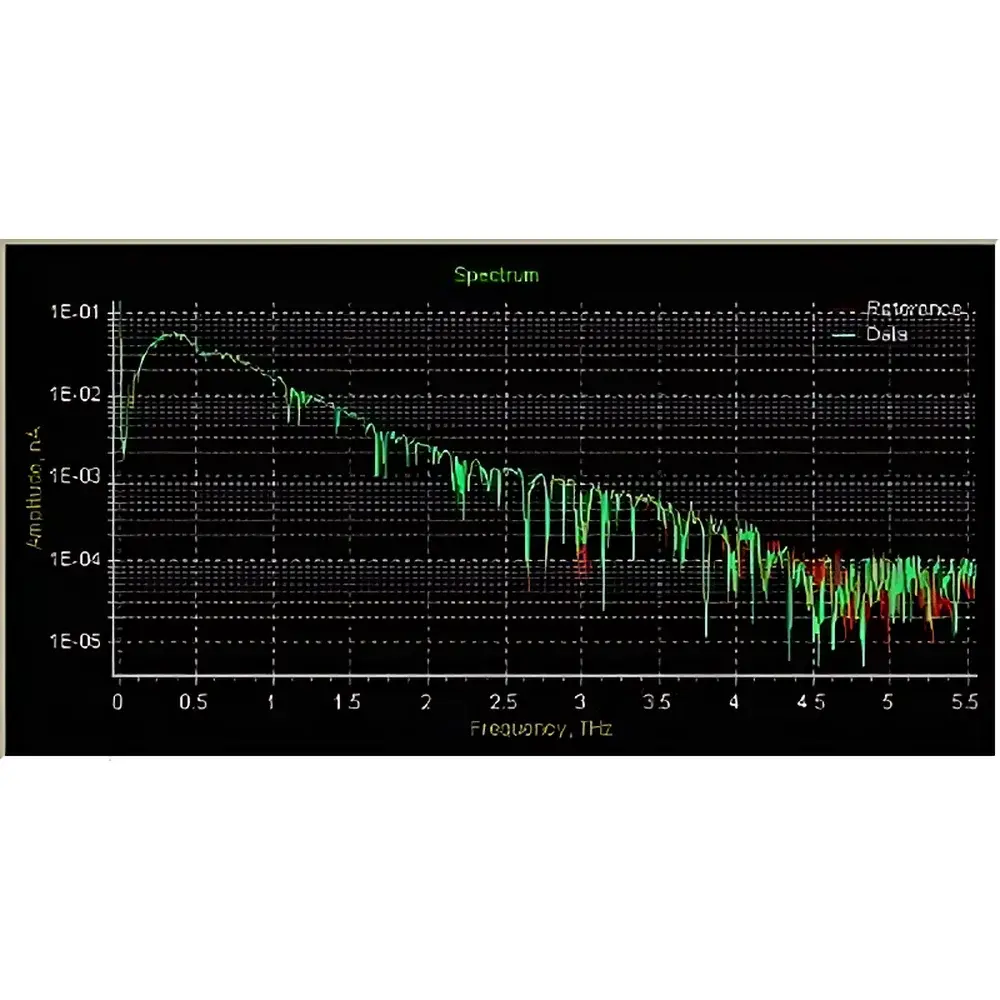
Ekspla Fast Scan THz-TDS System
| Brand | Ekspla |
|---|---|
| Model | Fast Scan |
| Spectral Range | 0.2–3.5 THz (6–116 cm⁻¹) |
| Spectral Resolution (Fast Mode) | 10 GHz |
| Spectral Resolution (Fast/Slow Hybrid Mode) | 5 GHz |
| Acquisition Rate | 10 spectra/s |
| SNR | >10⁶:1 @ 0.4 THz |
| Origin | Lithuania |
| Import Status | Imported Instrument |
| Distributor Type | Authorized General Distributor |
| Category | Terahertz Time-Domain Spectroscopy (THz-TDS) System |
Overview
The Ekspla Fast Scan THz-TDS System is a high-performance, turnkey terahertz time-domain spectroscopy platform engineered for rapid, high-fidelity spectral acquisition and spatially resolved imaging in research and industrial R&D environments. Based on photoconductive antenna or electro-optic sampling detection (configuration-dependent), the system employs ultrafast femtosecond laser excitation (typically 800 nm, <100 fs pulse width) to generate and coherently detect broadband THz pulses via optical rectification and field-induced birefringence. Its core architecture integrates a motorized delay line with sub-5 fs timing resolution and a synchronized, programmable XYZ sample translation stage—all governed by a single embedded motion controller. This unified control eliminates inter-device synchronization latency and enables deterministic temporal alignment critical for phase-sensitive measurements. Designed for laboratory-based material characterization, the system delivers broadband spectral coverage from 0.2 to 3.5 THz (6–116 cm⁻¹), bridging the gap between microwave and mid-infrared domains where many molecular rotational, vibrational lattice, and low-energy electronic transitions reside.
Key Features
- Broadband spectral coverage: 0.2–3.5 THz (6–116 cm⁻¹), supporting identification of intermolecular vibrations, crystalline phonon modes, and carrier dynamics in semiconductors.
- Two operational scanning modes: Fast mode (10 spectra per second) optimized for dynamic process monitoring; Fast/Slow hybrid mode achieving 5 GHz spectral resolution—suitable for high-precision gas-phase spectroscopy and narrow-line solid-state analysis.
- Signal-to-noise ratio exceeding 10⁶:1 at 0.4 THz (measured over 1000 averages, 1 Hz bandwidth), enabling trace-level detection of weak absorption features in pharmaceuticals and polymers.
- Unified controller architecture: Single-board motion and data acquisition coordination for delay stage and motorized sample stage ensures sub-micron positional repeatability and picosecond-level timing fidelity across large-area raster scans.
- Modular optical layout: Compatible with optional cryogenic sample chambers, vacuum enclosures, and polarization-resolved detection modules for advanced anisotropy studies.
- Compliance-ready design: Firmware supports timestamped metadata logging, user-accessible calibration traceability, and audit-ready configuration snapshots—facilitating alignment with GLP and internal QA documentation requirements.
Sample Compatibility & Compliance
The system accommodates transmission and reflection geometries for solid, liquid, and powder samples—including tablets, thin films, packaged polymers, and aqueous solutions (with appropriate path-length control). Non-contact measurement avoids sample preparation artifacts common in FTIR or Raman. All optical components meet ISO 10110 surface quality standards; mechanical stages conform to ISO 9283 repeatability specifications. While not certified for clinical diagnostics, the instrument’s measurement stability and data integrity support method validation under ASTM E2977 (Standard Guide for Terahertz Spectroscopy) and preliminary alignment with ICH Q5C (stability testing of biopharmaceuticals) for secondary structural analysis.
Software & Data Management
Control and analysis are performed via Ekspla’s proprietary TeraScan software (Windows 10/11, 64-bit), featuring real-time FFT processing, baseline correction algorithms (asymmetric least squares), and multi-parameter fitting of complex dielectric functions (n, κ). Raw time-domain waveforms and Fourier-transformed spectra are stored in HDF5 format with embedded experimental metadata (laser power, humidity, stage coordinates, detector bias). The software supports export to CSV, MATLAB (.mat), and JCAMP-DX for third-party chemometric tools (e.g., PCA, PLS regression). Audit trail functionality records operator logins, parameter changes, and data export events—meeting foundational expectations for FDA 21 CFR Part 11 compliance when deployed with institutional IT security policies.
Applications
- Pharmaceutical solid-state analysis: Polymorph differentiation, hydrate/anhydrate quantification, and coating thickness mapping in controlled-release tablets.
- Security screening: Identification of concealed explosives and narcotics through spectral fingerprint matching in transmission geometry.
- Non-destructive evaluation: Delamination detection in composite laminates, void analysis in thermal barrier coatings, and moisture ingress assessment in insulating foams.
- 2D/3D terahertz imaging: Sub-mm spatial resolution tomography of semiconductor wafers and cultural heritage artifacts (e.g., layered paint structures beneath varnish).
- Fundamental physics: Carrier lifetime extraction in 2D materials (graphene, TMDCs), superconducting gap measurements, and ultrafast spin dynamics probing.
FAQ
What laser source is integrated into the Fast Scan THz-TDS system?
The system is configured with a diode-pumped, mode-locked Ti:sapphire or Yb-fiber femtosecond oscillator (80 MHz repetition rate, <100 fs pulse duration), optimized for stable THz generation via ZnTe or GaP emitters.
Can the system operate under vacuum or inert atmosphere?
Yes—the optical beam path and sample chamber are modular; vacuum-compatible versions (≤10⁻³ mbar) and nitrogen-purged enclosures are available as factory options.
Is spectral calibration traceable to NIST standards?
While THz frequency calibration relies on laser interferometry and known molecular absorption lines (e.g., water vapor at 0.557 THz), full NIST-traceable calibration services are offered separately through Ekspla’s metrology division.
Does the software support automated pass/fail criteria for QC workflows?
TeraScan includes customizable threshold-based reporting modules; integration with LIMS via OPC UA or REST API requires site-specific configuration and validation.
What maintenance intervals are recommended for long-term stability?
Annual alignment verification and detector responsivity recalibration are advised; optical components require cleaning only if contamination is observed—no routine consumables are specified.





