
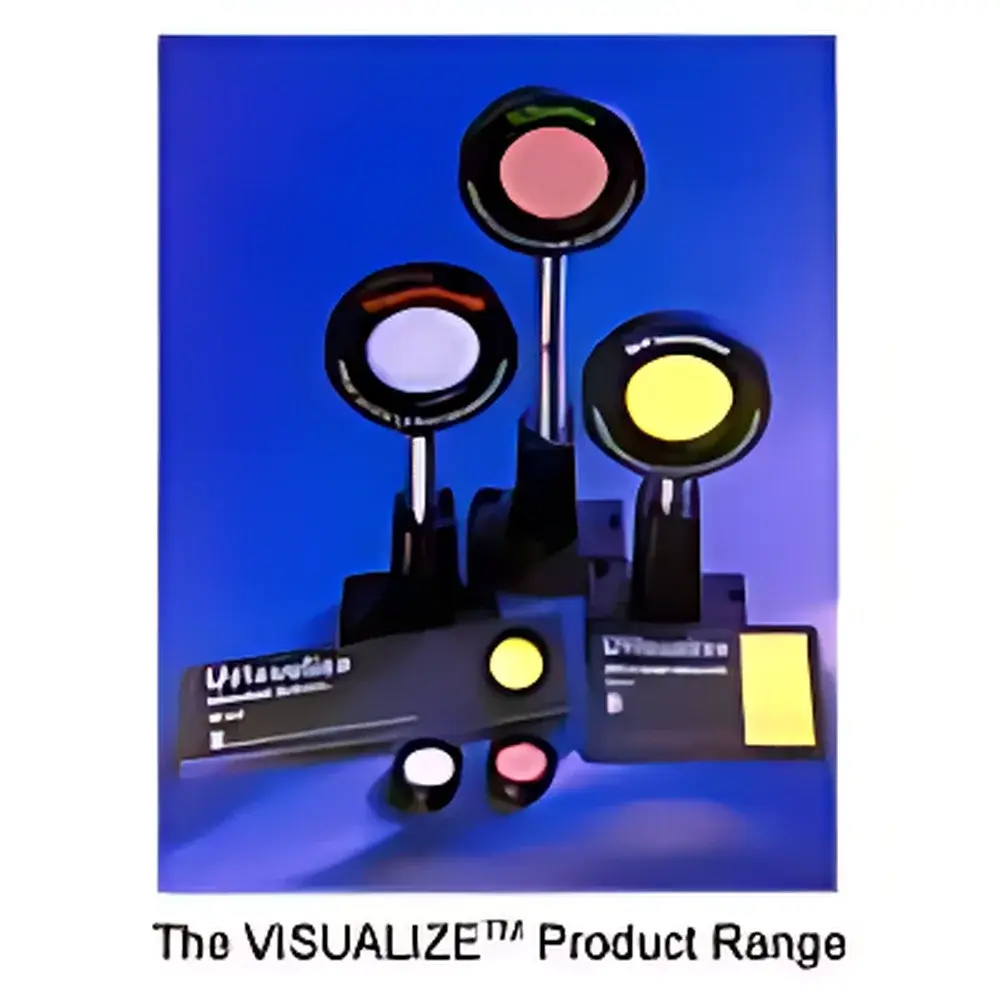
Laser Infrared Detection Card
| Origin | UK |
|---|---|
| Manufacturer Type | Distributor |
| Import Status | Imported |
| Model | IR |
| Price | USD 170 |
Overview
The Laser Infrared Detection Card (Model IR) is a passive, non-powered optical diagnostic tool engineered for real-time visualization and qualitative assessment of near-infrared (NIR) and short-wave infrared (SWIR) laser emissions in the 700–1550 nm spectral range. Unlike active detectors requiring power or signal processing, this card operates on phosphor-based upconversion: incident infrared photons excite rare-earth-doped luminescent materials, emitting visible light (typically green or orange) proportional to local irradiance intensity. It is widely deployed in laser alignment, safety verification, beam profiling validation, and educational demonstrations where immediate visual feedback is critical—particularly for Class 3B and Class 4 NIR lasers used in fiber optics, telecommunications, spectroscopy, and biomedical instrumentation.
Key Features
- Compact card format (standard credit-card dimensions: 85.6 × 53.98 mm) with rigid polymer substrate and scratch-resistant coating for field durability
- High-sensitivity phosphor layer optimized for 808 nm, 980 nm, 1064 nm, and 1550 nm laser lines—detecting irradiance as low as 10 µW/cm² under ambient-dark conditions
- No external power supply, batteries, or calibration required—enabling immediate deployment in cleanrooms, optical tables, or confined enclosures
- Thermal stability rated from −10 °C to +50 °C; non-hygroscopic formulation prevents fogging or degradation in controlled laboratory environments
- Reversible response: fluorescence ceases within <100 ms after beam interruption, supporting dynamic alignment tasks
- CE-marked and RoHS-compliant construction; compatible with ISO 11551 (laser beam profiling standards) for auxiliary visual verification
Sample Compatibility & Compliance
The IR Detection Card is compatible with continuous-wave (CW) and pulsed infrared sources operating within its responsive wavelength window. It does not interfere with beam path integrity and introduces no optical absorption or scattering artifacts—making it suitable for use upstream or downstream of sensitive components such as interferometers, photodetectors, or fiber couplers. While not a quantitative radiometric instrument, it supports compliance workflows per IEC 60825-1:2014 (Safety of Laser Products) by enabling rapid identification of unintended beam leakage, misalignment, or housing breaches. Its passive design ensures zero electromagnetic interference (EMI), satisfying EMC requirements for integration into GLP- and GMP-regulated optical test benches.
Software & Data Management
As a purely analog, visual diagnostic aid, the IR Detection Card does not interface with software or generate digital data streams. However, it is routinely integrated into documented alignment procedures governed by FDA 21 CFR Part 11–compliant quality management systems: operators record date/time-stamped photographs of card illumination during laser setup, archived alongside equipment logbooks and SOPs (e.g., SOP-OP-LAS-023). These visual records serve as auditable evidence of beam path verification during equipment qualification (IQ/OQ) and routine maintenance. For traceable documentation, users may pair the card with calibrated CCD cameras or smartphone-based imaging rigs using NIST-traceable grayscale references.
Applications
- Laser diode and fiber-coupled module alignment in R&D and production environments
- Verification of shutter functionality and interlock integrity in Class 4 laser enclosures
- Educational illustration of infrared invisibility and photon upconversion physics
- Field troubleshooting of free-space optical links (e.g., FSO transceivers operating at 1550 nm)
- Qualitative assessment of beam divergence, hot spots, and mode structure prior to quantitative measurement with scanning slit profilers or camera-based systems
- Supporting ISO/IEC 17025-accredited calibration labs in pre-check protocols for infrared power meters and thermal sensors
FAQ
Is this card calibrated or NIST-traceable?
No—it provides qualitative, comparative visualization only. For quantitative irradiance measurement, use a calibrated thermopile or photodiode sensor.
Can it detect mid-infrared (MIR) or far-infrared (FIR) wavelengths?
No. The phosphor formulation is optimized for 700–1550 nm. It exhibits negligible response beyond 1600 nm.
Does repeated exposure degrade sensitivity?
Under normal use (≤1 W/cm² peak irradiance), phosphor fatigue is minimal over 10,000+ exposure cycles. Avoid prolonged direct exposure to >5 W/cm² CW sources.
Is the card reusable?
Yes—provided it is stored in a dry, dark environment and protected from mechanical abrasion or solvent contact.
What is the typical lead time for international shipment?
Standard delivery to EU, US, and APAC destinations is 3 business days from order confirmation, consistent with express courier services compliant with IATA Dangerous Goods Regulations (for non-battery, non-radioactive devices).





