
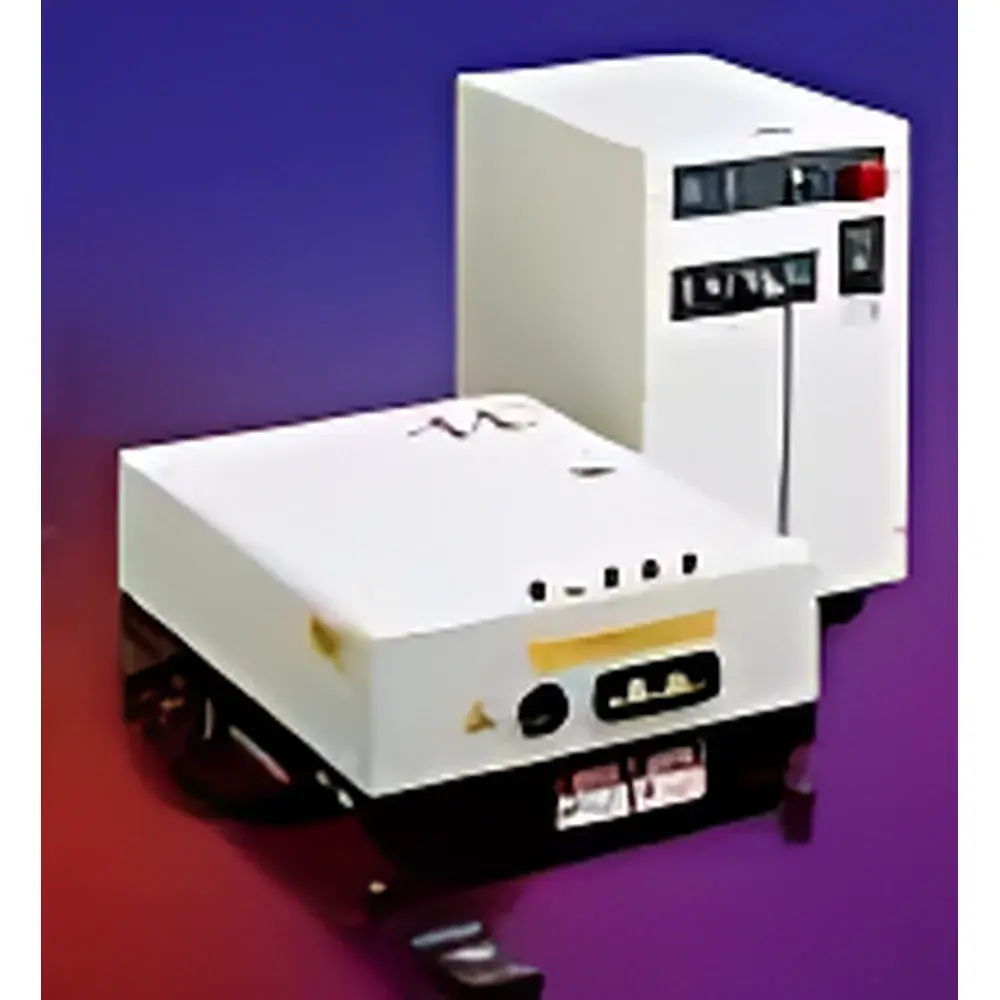
Ekspla NT352 Diode-Pumped Nanosecond Tunable Optical Parametric Oscillator Laser System
| Brand | Ekspla |
|---|---|
| Origin | Lithuania |
| Manufacturer Type | Original Equipment Manufacturer (OEM) |
| Product Type | Solid-State Tunable Laser System |
| Model | NT352 |
| Wavelength Tuning Range | 700–1000 nm & 1140–2100 nm (expandable to 330–550 nm) |
| Spectral Linewidth | <30 cm⁻¹ |
| Repetition Rate | 10 Hz |
| Pulse Energy @ 800 nm | >100 mJ |
| Beam Radius | ~10 mm |
| Output Options | 532 nm (pump), 1064 nm, 355 nm |
| Control Interface | RS232 with LabVIEW-compatible drivers |
Overview
The Ekspla NT352 is a diode-pumped, nanosecond-pulsed, tunable optical parametric oscillator (OPO) laser system engineered for high-stability spectroscopic and nonlinear optical applications. Based on a master oscillator–power amplifier (MOPA) architecture, it employs a Q-switched Nd:YAG solid-state laser as the fundamental pump source, delivering precise temporal control and excellent pulse-to-pulse energy stability. The system integrates an intracavity OPO stage enabling continuous wavelength tuning across two primary spectral bands—700–1000 nm (signal) and 1140–2100 nm (idler)—with optional harmonic generation modules extending coverage into the UV (355 nm) and visible (532 nm) regions. Its <30 cm⁻¹ linewidth supports high-resolution absorption and fluorescence excitation experiments, while the 10 Hz repetition rate ensures compatibility with gated detection schemes and time-resolved measurements. Designed and manufactured in Vilnius, Lithuania, the NT352 complies with IEC 60825-1:2014 safety standards for Class 4 lasers and meets CE marking requirements for electromagnetic compatibility (EN 61326-1) and low-voltage directive (2014/35/EU).
Key Features
- Diode-pumped Nd:YAG oscillator-amplifier architecture for superior thermal management and long-term pointing stability
- Integrated OPO cavity with motorized grating and crystal angle adjustment for automated wavelength scanning
- On-board photodiode-based energy monitor for real-time OPO pump energy feedback (532 nm channel)
- RS232 serial interface with ASCII command protocol and native LabVIEW VI library for seamless integration into automated test benches
- Optional harmonic generation modules: SHG (532 nm), THG (355 nm), and IR output at 1064 nm via bypass path
- Beam delivery optimized for Gaussian spatial profile with ~10 mm beam radius (1/e² intensity) and M² < 1.3
- Passive air-cooling design eliminating need for external chillers or water circulation systems
Sample Compatibility & Compliance
The NT352 is compatible with standard optical tables, kinematic mounts, and vacuum-compatible beamlines. Its output beam meets ISO 11146-1:2005 beam propagation specifications and is suitable for coupling into single-mode fibers (with appropriate focusing optics), optical parametric amplifiers (OPAs), and ultrafast pump-probe setups. The system conforms to GLP-compliant operation protocols when used with traceable calibration standards. While not FDA-cleared for medical use, its emission characteristics align with ASTM E2912–21 guidelines for laser-based analytical instrumentation. Full audit trails—including timestamped wavelength settings, pulse energy logs, and interlock status—are recordable via external DAQ systems using the RS232 interface.
Software & Data Management
Ekspla provides a Windows-based control application (NT352 Manager v3.x) supporting manual wavelength selection, preset scanning sequences, and energy normalization routines. All commands are fully scriptable via RS232, enabling integration with Python, MATLAB, or custom C++ acquisition frameworks. The system supports IEEE 488.2-style syntax (e.g., “WAV?”, “ENE?”, “WAV 850.0”) and includes error logging with event codes per IEC 62443-3-3 Annex A. Raw energy and timing data can be exported in CSV format; no proprietary binary formats are used. For regulated environments, the software architecture permits configuration of user access levels and electronic signatures in accordance with 21 CFR Part 11 requirements when deployed with validated third-party LIMS platforms.
Applications
- Time-resolved fluorescence spectroscopy of organic semiconductors and quantum dots
- Photoacoustic imaging excitation in biological tissue phantoms (NIR-II window: 1000–1350 nm)
- Gas-phase absorption spectroscopy targeting rovibrational transitions of CH₄, CO₂, and NO
- Pump-probe studies of carrier dynamics in perovskite thin films
- Standoff detection of explosives residues via resonance-enhanced multiphoton ionization (REMPI)
- Calibration source for FTIR spectrometers and hyperspectral imagers
FAQ
Is the NT352 compatible with ultra-high vacuum (UHV) beamline integration?
Yes—the laser head and OPO module are constructed from stainless steel and aluminum alloys with bake-out rated seals; optional UHV-compatible feedthroughs for RS232 and trigger signals are available upon request.
Can the 330–550 nm extension be retrofitted to an existing NT352 unit?
Yes—this requires installation of a BBO-based sum-frequency generation (SFG) stage and associated dichroic mirrors; Ekspla offers factory retrofit services with full recalibration and performance validation.
Does the system include built-in wavelength calibration?
Yes—a calibrated reference etalon and internal HeNe laser provide automatic wavelength verification before each scan sequence; NIST-traceable calibration certificates are supplied with each unit.
What maintenance intervals are recommended for optimal OPO crystal lifetime?
Under normal operating conditions (≤10⁶ shots), periodic inspection of crystal alignment and coating integrity is advised every 12 months; no routine consumables replacement is required within the first 5 years of operation.





