
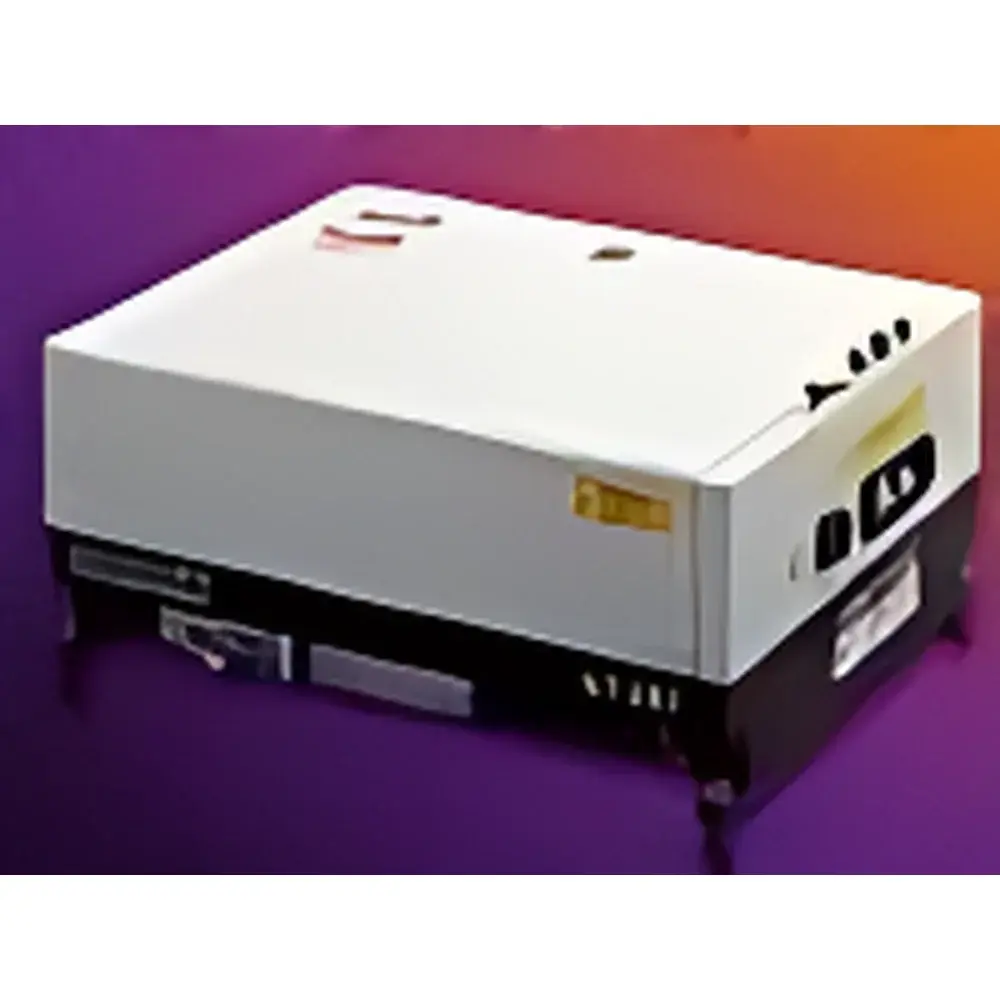
Ekspla NT253 Series Diode-Pumped Nanosecond Tunable Laser System
| Brand | Ekspla |
|---|---|
| Origin | Lithuania |
| Manufacturer Type | Original Equipment Manufacturer (OEM) |
| Product Category | Imported |
| Model | NT253 |
| Core Technology | Solid-State OPO-Based Tunable Laser Source |
| Tuning Range | 670–1000 nm & 1140–2300 nm (expandable to 335–5000 nm) |
| Spectral Linewidth | <4 cm⁻¹ |
| Pulse Repetition Rate | 1 kHz (NT253-1K), 500 Hz (NT253-500) |
| Average Output Power | >100 mW (NT253-1K), >150 mW (NT253-500) |
| Beam Radius | ~1 mm |
| Control Interface | RS232, LabVIEW™ Drivers |
| Integrated Pump Source | 532 nm DPSS Laser |
| Optional Harmonic Outputs | 1064 nm, 532 nm, and Sum-Frequency Generation (SFG) at 300–335 nm |
Overview
The Ekspla NT253 Series is a high-stability, diode-pumped nanosecond tunable laser system engineered for precision spectroscopic applications requiring broad spectral coverage and reliable pulse-to-pulse energy consistency. At its core, the NT253 integrates a frequency-doubled Nd:YAG solid-state pump laser (532 nm) with a synchronously pumped optical parametric oscillator (OPO), enabling continuous wavelength tuning across two primary bands—670–1000 nm (signal) and 1140–2300 nm (idler)—with optional harmonic and sum-frequency extensions spanning from 335 nm to 5000 nm. Its nanosecond pulse duration (typically <8 ns FWHM), narrow spectral linewidth (<4 cm⁻¹), and low temporal jitter support time-resolved techniques including transient absorption, laser-induced fluorescence (LIF), and coherent anti-Stokes Raman scattering (CARS). Designed and manufactured in Vilnius, Lithuania, the NT253 complies with IEC 60825-1:2014 safety standards for Class 4 lasers and features a robust, air-cooled architecture suitable for integration into OEM instrumentation platforms or laboratory-grade spectroscopy setups.
Key Features
- Integrated 532 nm diode-pumped solid-state (DPSS) pump laser with internal energy monitoring and real-time feedback stabilization
- Optically synchronized OPO cavity with motorized grating and crystal angle adjustment for automated, software-controlled wavelength scanning
- Two standard repetition rate variants: NT253-1K (1 kHz) optimized for high-throughput measurements; NT253-500 (500 Hz) configured for higher pulse energy per shot
- Expandable output architecture supporting fundamental (1064 nm), second-harmonic (532 nm), and sum-frequency generation (SFG) outputs down to 300–335 nm via external nonlinear crystals
- RS232 serial interface and native LabVIEW™ drivers enable seamless integration with custom data acquisition systems and automated experiment workflows
- Front-panel controls and remote operation capability via TTL/USB-triggered start-stop, shutter control, and wavelength preset recall
Sample Compatibility & Compliance
The NT253 is compatible with a wide range of optically transparent and scattering samples, including gases, liquids, thin-film semiconductors, and biological tissues. Its tunability enables resonance matching with electronic transitions in organic dyes, quantum dots, transition metal oxides, and rare-earth-doped materials. The system meets CE marking requirements under the EU Machinery Directive 2006/42/EC and Electromagnetic Compatibility Directive 2014/30/EU. For regulated environments—including GLP-compliant analytical laboratories and ISO/IEC 17025-accredited testing facilities—the NT253 supports audit-ready operation through configurable logging of laser parameters (wavelength, energy, repetition rate) with timestamped metadata export. While not FDA-cleared as a medical device, its performance characteristics align with ASTM E2912–22 guidelines for tunable laser source calibration in photometric reference applications.
Software & Data Management
Ekspla provides the proprietary “LaserLab” control suite, a Windows-based application offering graphical wavelength scanning, multi-channel energy logging, and scriptable macro execution. All communication protocols are documented in the SDK, permitting third-party integration with Python (PySerial), MATLAB®, or National Instruments TestStand™. Energy readings from the built-in pyroelectric probe are recorded at full repetition rate with 0.5% linearity and traceable NIST-calibrated uncertainty. Data exports adhere to HDF5 and CSV formats, ensuring compatibility with spectral analysis toolchains such as Igor Pro, OriginLab, and Python’s SciPy ecosystem. Audit trail functionality records user actions, parameter changes, and firmware updates—supporting compliance with 21 CFR Part 11 when deployed on validated Windows OS configurations.
Applications
- Time-resolved photoluminescence spectroscopy of perovskite solar cell absorbers and 2D transition metal dichalcogenides
- Vibrational fingerprinting of pharmaceutical polymorphs using tunable mid-IR idler output (1140–2300 nm)
- Remote gas sensing via differential absorption lidar (DIAL) at selected ro-vibrational lines of CH₄, CO₂, and NH₃
- Nonlinear optical characterization including Z-scan measurements and two-photon absorption cross-section determination
- Calibration source for monochromator wavelength accuracy verification across UV–NIR spectral ranges
- Seed source for optical parametric chirped-pulse amplification (OPCPA) systems requiring stable, narrow-linewidth nanosecond pulses
FAQ
Is the NT253 compatible with ultra-high vacuum (UHV) chamber feedthroughs?
Yes—standard beam delivery includes Ø12.7 mm kinematic mounts and optional fiber-coupled output modules rated for UHV use (10⁻⁹ mbar) with CF-35 flange interfaces.
Can the OPO cavity be manually tuned without software?
Manual coarse tuning is supported via front-panel encoder knobs; however, fine spectral positioning and repeatability require closed-loop control via LaserLab or external host software.
What maintenance intervals are recommended for long-term stability?
No routine optical alignment is required. Annual verification of OPO crystal temperature calibration and energy meter zero-point drift is advised per ISO 17025 traceability protocols.
Does the system include factory calibration documentation?
Each unit ships with a Certificate of Conformance, wavelength accuracy report (±0.5 nm across tuning range), and energy calibration certificate traceable to PTB (Physikalisch-Technische Bundesanstalt).



